A Metaphor for the Electron

The electron blindly runs either within or without the body; but it runs
within the body in accordance with its character within the body; that
is to say, in accordance with the general plan of the body, and this plan
includes the mental state
.”

Alfred North Whitehead, Science and the Modern World

I have always found the above quote fascinating. It comes from one of Whitehead’s many fine books. Whitehead’s work in process philosophy has had a tremendous influence in the setting of process theology and open & relational theology. In fact, there is considerable overlap in these three areas of philosophy and theology.

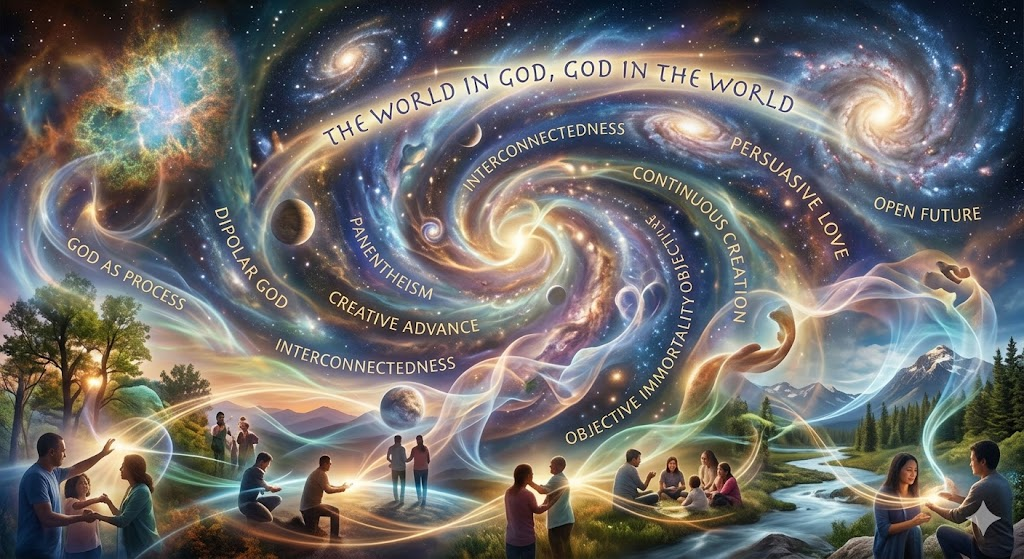
I made this image using Google Gemini.

In this post, I am going to think about the term “panexperientialism” which is contained in these three ideas. Panexperientialism means that all experience. The electron experiences charge, mass, and spin. Humans experience the objective and subjective at every moment. Galaxies experience gravity and rotation.

Consider this aspect. Every large structure also experiences the effects of its smaller components as well…sort of like nesting dolls. For example, a human experiences the effects of all his / her cells (including the non-human microbiome cells). The cells experience the effects of all of the organelles inside it. The organelles experience the effects of their molecular structure. Molecules experience the effects of their atomic structure.

Nesting dolls

One can then consider that the experience also goes the other way…atom to molecule to organelle to cell to human. Each smaller system is experiencing the effect of the larger system that they are contained in.

And the effect could grow even larger as well…human to society to nature to planet to solar system to galaxy as well as in the reverse.

Slide from my IRAS talk (https://www.youtube.com/watch?v=B8Id8-zQCVA)

I want to just consider a thought experiment which is not the least bit scientifically provable. This “experiment” is more of a theological idea in the setting of panexperientialism.

I want to consider the idea of entanglement for which I am not an expert.

The basic ideas of entanglement are as follows: If a system is maximally possibly known (no statistical mathematics involved) and if the system has two particles, such as electron A and electron B, then the two quantum systems of electron A and electron B will combine to form a single quantum state. Electron A no longer has an independent quantum state. It is now “entangled” with electron B.

Thus, although electron A is in a quantum state and has statistical uncertainty, the interaction between electron A and electron B is known. Whatever is measured of electron A will lead to knowledge about electron B since the two quantum states are now a single quantum state.

Here is the weird thing. This entanglement between electron A and electron B is independent of distance. Electron A and electron B could be on other ends of the Milky Way galaxy and still be perfectly entangled. A great explanation is here.

Image from New Scientist Magazine

Okay, on to my theological thought experiment.

Let’s say that Electron A and electron B are entangled. Then let’s say that electron A is in the limbic system (the emotion center) of my brain while I am experiencing something emotional. Then, let’s then say that electron B is hanging out near Proxima Centauri. Since these two electrons are entangled, do they have a panexperiential quality of my experience? I like this idea.

On the other hand: From my understanding, this idea makes little sense scientifically. Entangled particles seem to be disrupted when they interact with any aspect of the environment. Also, there is some difficulty in understanding how entangled particles could carry information (I assume due to the effects of environmental interaction).

However, theologically, if every entity experiences, then how can one NOT say that the subjective experience of the electron in my brain is not affecting the experience of an entangled electron somewhere else right away?

Notice that I am not using the word, “panpsychism”. Panpsychism suggests some consciousness at every level of reality, even at the particle level. I am suggesting panexperientialism, not panpsychism.

Experience is not necessarily consciousness. If I throw a rock in the air, the rock experiences my throwing, the rock’s velocity, the effect of gravity, etc. It is not conscious of my throwing. I realize that some may find my statement different from what Jesus expressed in Luke 19: 39-40, but those verses really have a different connotation.

Experience…perhaps if particles, molecules, and humans have the possibility of entanglement, then perhaps they experience each other. This experience cannot be proven scientifically, but it can be considered theologically.

God in the setting of panentheism (“all in God”), then would experience all of reality in real time. God would experience our joy and our sadness. God would experience our birth, our life, and our death. God would experience us from our singular bodies to our consciousness to our electrons.

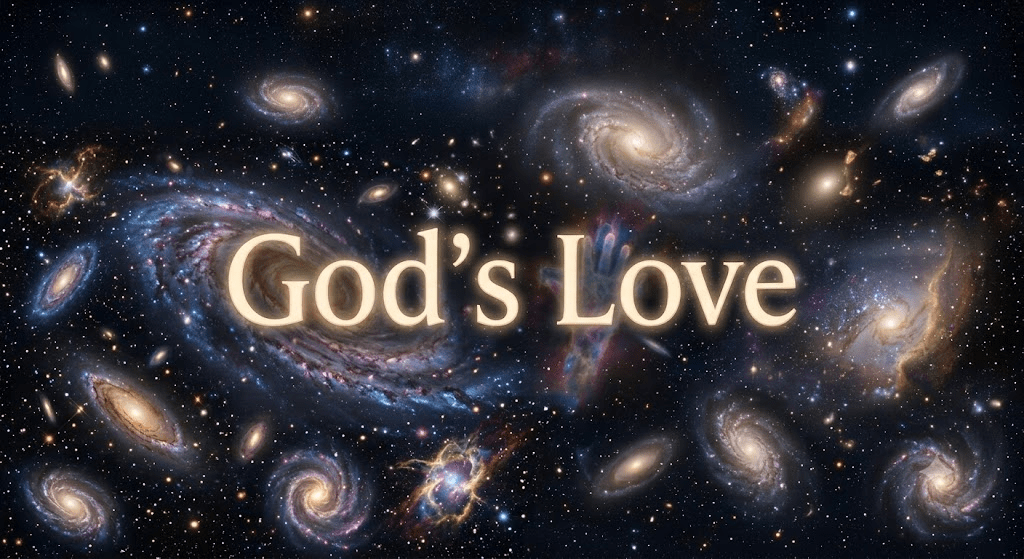
I find such an idea comforting as God is not some distant entity. God is there with us in real time. And if God is love (which I believe), then God is loving us through our experiences. Even at the level of our electrons.

Image generated by Gemini Advanced

The Axial Age Perhaps Never Existed

I have been reading about the Axial Age which is defined as an approximately 200 year period (500 – 300 BCE) in which the main religious traditions of Eurasian society began. Of note, some people extend the Axial Age a bit farther out on either end of the time spectrum. The term, “Axial Age” was coined by Karl Jaspers (1883-1969). Jaspers was a philosopher who started off as a psychiatrist. He came up with this term although many others had considered similar ideas previously.

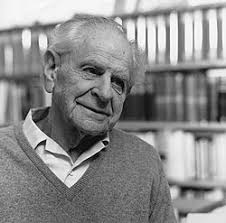
Karl Jaspers

Like any axis providing a turn of the wheel, the idea of the Axial Age is that human thought changed or pivoted around a certain period.

Specific thought leaders during this time period include Socrates, Pythagoras, Buddha, Mahavira, Confucius, Lao Tse, and the various Hebrew prophets. In some ways, this list makes sense when one considers that philosophical and theological paradigms that arose from these individuals.

It is unclear why this time period had the association of the Axial Age. Some have attributed it to a change in Homo sapiens cognitive ability. Some have attributed it to the formation of urban structures allowing population density and the exchange of ideas. Some have attributed it to a change from short-term material needs to long-term spiritual desires. Perhaps the rise of early city states with the association of agriculture for food and city walls to protect populations provided people time to think, to cognitively change, to philosophize.

It is a fascinating idea.

However, there are issues here:

  1. Certain cultures are left out of the Axial Age such as ancient Egypt. I have a hard time considering that the beaming systems, column formations, and art / political art painted on their structures were not an influential component of architecture going forward in time. I feel the same way about cave art. One can’t help to see such ancient art heralding the future of the great painters of history.

The Egyptian Pyramids

Chauvet Cave, southern France

2. The Axial Age may not be such a compressed time period. Two hundred years (or so) seems long, but in the setting of the first H. sapiens bone fragments going back 300,000 years, 200 years is quite small. This would be 0.07% of the time of the known existence of our species. Newer research suggests that there, in fact, may be no Axial Age as “axial” shifts may have been occurring as early as 3000 B.C.E. in areas such as Cambodia or Japan. Thus, the development of proto-modern human culture may have occurred over millennia, not centuries. As always, more research is needed here.

3. I have a hard time explaining why Jesus (as the founder of Christianity) or Muhammad (as the founder of Islam) would not be considered in the context of the definition of the Axial Age above. Jesus lived approximately 300 years after the Axial Age; Muhammad lived 900 years after the Axial Age. Although one can point to the influences of important Axial figures and cultures on the teachings of Jesus and of Muhammad, it also be remembered that all past cultures influence present cultures, religious or not…Axial or not. I would argue that the rise of both Christianity and Islam have caused profound changes in the world, far more than many of the figures listed as belonging to the Axial Age.

4. Finally, I am going to make an argument from process philosophy as to why the Axial Age idea may be problematic. If one looks at the Axial Age as a directional evidence occurring in history, one might fall into Georg Wilhelm Friedrich Hegel’s camp in stating that “teleology is a structure of reciprocal interaction.” In other words, history is directional. It has a purpose. I don’t know if history is directional.

Hegel

I recall my father who was a military historian telling me that war provided evidence that there was no direction in the human experience.. There was to be no final war (outside of a potential nuclear holocaust). Wars would just continue. Kingdoms and countries would rise and fall. I find truth in that.

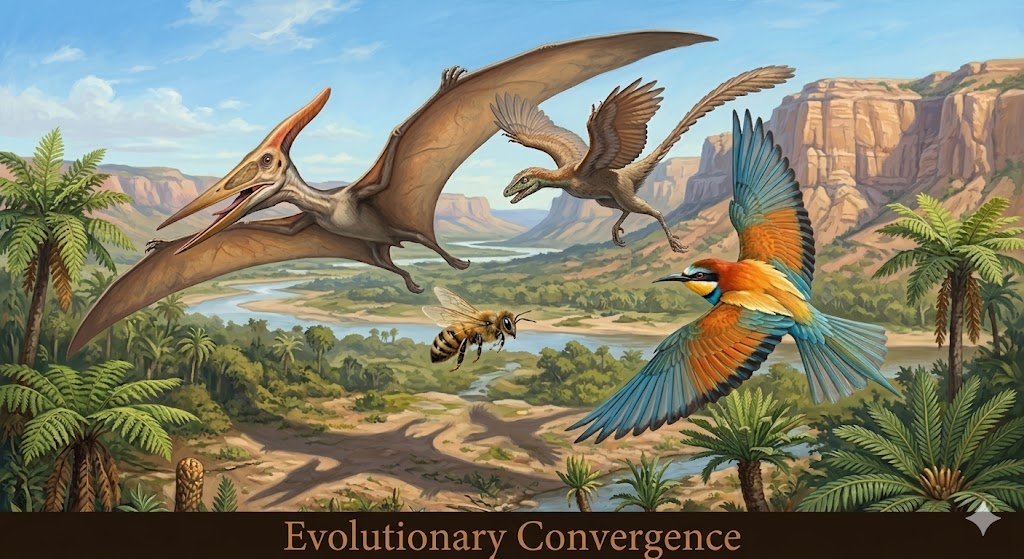
5. However and in contrast, I like the ideas as expressed by Alfred North Whitehead in his famous book, Process and Reality. In the book, he states, “Neither God, nor the World, reaches static completion. Both are in the grip of the ultimate metaphysical ground, the creative advance into novelty. Either of them, God and the World, is the instrument of novelty for the other.” In other words, things change as time moves on. Things in history may repeat themselves somewhat (as in convergent evolution), but change is in the air. Change is all we have as our ground. The only “purpose” in world history may be change itself without direction.

Now as someone who is a proponent of process theology / open & relational theology, I think it makes sense that God is the “still small voice” to give nature the opportunity to have directionality for the good or for the creative. All of nature (including our species) has free choice here. Original sin or not, we generally seem to demur to the Divine Lure. Thus, the Axial Age doesn’t seem to make sense to me.

6. One final thought…it appears that the world is quickly becoming less religious. How would this not be a new Axial Age in line with Jaspers’s definition? Is this directional? Is this just novelty in time? Is this simply change itself? More philophical and theological work is needed here.

Image generate by Gemini Advanced

Pantheism or Panentheism?

This weekend, I was a panelist for a session of ORTLINE 2026. ORTLINE stands for “Online Open & Relational Theology Conference.” This international online theology conference occurs annually over three days and is used to discuss very intriguing books on theology — Christianity as well as world religions. It is a great conference, and I recommend signing up for it even if you are not a theologian or pastor.

I was asked to review (as part of a panel discussion) , Science and the Sacred:  Beyond the Gods in Our Image” by C.S. Pearce and Philip Clayton. It’s a great book. I’m not sure if should paste my whole review as a panelist as I want to respect the organizers of the conference.

This book is really a great read for lay persons trying to understand how both theists and atheists can look at the world and find common agreement among scientific topics that extend into protecting our species and our planet. The authors go over specific issues including the Big Bang, biological evolution, human consciousness, human sexuality, and many other topics. Clayton is a theist; Pearce (now unfortunately, deceased) is an atheist. Both are well-known individuals in regard to their academics and their writings. They both are pro-science. I found myself absolutely loving this book.

The authors discuss the pros and cons of the theological idea of panentheism. Panentheism basically means “All in God.” This term makes sense to me. All of nature. All of the universe. All of reality. All are in God.

My diagram of panentheism

This term is different from pantheism (no “-en”). I would interpret this term as “nature is God” or “the universe is God.” Famous people who have leaned into pantheism would include Baruch Spinoza and Albert Einstein.

My diagram of pantheism

When I gave my presentation today about the book discussed above, I provided the following critique:

“One small criticism of the book…  I am very much in agreement with the idea of panentheism – I believe very much that all of nature is contained in God.  However, due to the closeness in pronunciation to ‘pantheism’, I think the authors need to consider how this book differentiates panentheism from pantheism.  Complexity over time, the possibility of the universe learning, various religious claims searching for a divine entity…How is this not the universe itself learning and perhaps even luring (for creativity)?”

I guess my concern is relatively minor, but I wonder if we can provoke the issue the following way: Can the possibility of panentheism answered theologically or metaphysically have a “yes/no” response to potentially being true? Or does it have a spectrum answer or spectrum response?

For example, consider the Trinity. I am a Trinitarian. In the Christian world, the Holy Trinity is a pretty big deal. I am not a “Quartinarian.” I think I just made this word up. I don’t believe in the sameness of God, Jesus, the Holy Spirit and whatever “X” factor would make sense as a Quartinarian. It is a yes/no response when considering a Trinitarian concept of God. You either accept it or not.

From the Stanford Encyclopedia of Philosophy

Consider the Wesleyan Quadrilateral. I don’t worship in the Wesleyan Christian tradition although I respect it greatly. I don’t think a “Wesleyan Pentagon” would make sense in that tradition. The importance of scripture, reason, tradition, experience with the addition of whatever “X” factor to the Wesleyan tradition would not seem logical in that tradition. It is a yes/no response to considering the Wesleyan Quadrilateral. You either accept it or not.

I am not Muslim, but one of my closest friends is of that faith. The Five Pillars of Islam is an inherent part of that world religion. The importance of a declaration of faith, obligatory prayer, compulsory giving, fasting during Ramadan, and a Pilgrimage to Mecca with the addition of a whatever “X” factor to make the Six Pillars of Islam would not make sense in this religion. It is a yes/no response in accepting the Five Pillars of Islam. You either accept it or not.

By the way, the examples above are theological arguments. I’m not interested if you answer “yes” or “no.”

Yes/No: Here is the argument that I am working on from a very preliminary perspective when it comes to panentheism. The similarities of the universe responding to us either through the universe itself (pantheism) or through the universe in God (panentheism) seems almost a “spectrum” response. There seems to be more than one possibility. There seems to be the potential for combinations of possibilities.

Consider:

1) Maybe there is just the universe with no God (atheism, materialism). 2) Maybe the universe and God are the same (pantheism). 3) Maybe the universe is running on its own with God having set the initial conditions (deism). 4) Maybe the universe controls nature no matter how much God lures for creativity (extreme open theism, some interpretations of process theology). 5) Maybe God lures all of nature for creativity since the universe is in God (some interpretations of process theology, open & relational theology, panentheism). 6) Maybe there is a universe and God with God controlling everything (theistic determinism). There seems to be a spectrum here with the potential for overlap.

The spectrum of light (from Arizona State University)

As an example, when I look at how the universe works from my simple perspective of doing some small degree of clinical research in the field of medicine, I obviously look at results of my work from a scientific perspective. If I expand my results to a metaphysical perspective (not a scientific perspective), I can see my results fitting all 6 options above. There is overlap.

So, I definitely am a panentheist. I embrace panentheism wholeheartedly. I am fine if a person tells me that my metaphysical belief system is wrong. However, I can’t envision that same person give me a valid binary “no” because they would have all of the other options that I listed above available (and there likely are more options).

Maybe, I should experiment with “theism-en-pan”…Theismenpan…sounds really complicated. My AI (Google Gemini) tells me that the better Latin wording is “Deus in omne” or “God in All.” God is in all 6 options above and even in options that I cannot comprehend. As someone who has done work in process theology / open & relational theology, I imagine this God-In-All lures all creation for the good, for the novel, for the creative even in ways beyond our universe and unto God’s self.

Image from NPR

The Prick Against the Lure

I have been reflecting on the recent racist social media posting by our U.S. President. The state of my country (the United States) currently has left me in a current state of despair. We seem to have one political party that is leaning on the worst of human behavior to get its way. We have the other political party that seems lost in its ability to confront the worst of human behavior which suggests to me that the opposition party either doesn’t understand or doesn’t care. At the same time, we have seen U.S. Justice Department files released that show the abhorrent behavior of captains of industry, famous academics, and various other leaders.

The various degrading “-phobias” and “-isms” by many (not all) in my country becomes even more depressing when one considers the state of religion in the United States. It seems that there is a movement afoot in many Christian denominations that American power should be mixed with Christian faith as well as with violence. Such a combination seems ridiculous as Jesus was not a power seeker. He searched out the weakest in society when one reads through the Gospels.

Jesus healing the blind man (Mark 8)

In the realm of open & relational theology (ORT) which is within the tree of process theology, God has two main characteristics. 1) The future is open. In other words, God does not force an entity (including humans) to do things. 2) God is “relational.” God relates to everyone and everything…from quark to quail to quasar as I like to say. This relationality is based on love in which love is defined as creativity or novelty over time. God is relational. God knows us, and God lures for us to be creative. Being awful to others is not creative or novel and is simply destructive. It is every entity’s choice…every human’s choice to go along with the lure in the setting of love or to ignore the lure / to be the prick against the lure.

I did some hunting around and found an interesting article written by Michel Foucault titled “About the Concept of the ‘Dangerous Individual’ in 19th Century Legal Psychiatry.” It was published in 1978 based on a lecture in Toronto at York University. It can be hard to find this lecture, but I did find a link here.

Michel Foucault (1926-1984), image from Wikipedia

The article is not long — just 18 pages. Like much of Foucault’s writing, there is immense detail written in rather long paragraphs. I had to concentrate to get through it.

Say what you want about Foucault, but I think he Continental philosophy often seems to make sense. In this specific article, he discusses “homicidal mania” in the setting of psychiatry, criminal law, and civil law. I would like to parallel his thoughts about homicidal mania with perhaps the Diagnostic and Statistical Manual of Mental Disorders (the DSM) definition of antisocial personality disorder. This disorder has the following criteria:

  • Nonconformity: Repeatedly performing acts that are grounds for arrest, failing to conform to social norms and laws.
  • Deceitfulness: Lying, using aliases, or conning others for personal profit or pleasure.
  • Impulsivity: Acting without forethought or failing to plan ahead.
  • Aggressiveness/Irritability: Frequent physical fights, assaults, or hostility.
  • Reckless Disregard: Disregarding the safety of oneself or others.
  • Irresponsibility: Consistent failure to maintain work, education, or financial obligations.
  • Lack of Remorse: Indifference to or rationalizing the harm, mistreatment, or theft of others. 

As someone who works in the medical field, I appreciate the work put into the DSM used by psychiatrists and psychologists. Mental health therapy is very hard work, but perhaps it is getting easier with better understandings of genetics, neuronal activity, and brain pharmacology.

However, when I look at the criteria for antisocial behavior, it seems (theologically) that such behavior goes against being creative or being benevolent or being loving. The behavior is choosing to go against God’s lure for the good.

Foucault then states in the article that “…insanity [I will use antisocial personality disorder] can produce not just behavioral disorders, but absolute crime, the crime which transgresses all the laws of nature and of society…” I think Foucault is on to something here although I know he wasn’t thinking in a religious sense.

Are the laws of nature inherently creative? I would think so when I look at the current state of the universe. The universe seems uniform from the point of view of galaxy distribution, but every galaxy is a bit different as is every star, every planet, and every potential for life or non-life throughout our universe.

Galaxy distribution, from the University of Chicago

Are the laws of society inherently creative? I would think a creative society would produce a creative populace. I would think a destructive society (for example, the Khmer Rouge) would decrease the creativity of its population.

Time contains events. Past events uniformly affect future events in the setting of time’s arrow. These past events for each individual human action contain innumerable factors. Such factors include star stuff contained in our bodies, our genetics, past genetic mutations occurring in us and in past generations, and the epigenetics of geography, pollution, wealth inequality, society, and culture. Thus, when Foucault states “He [the criminal] is responsible since by his very existence he is a creator of risk, even if he is not at fault, since he has not of his own free will chosen evil rather than good..”, he is considering the setting of people who perform unspeakably evil acts.

I am a believer in free will only in the setting that we have limitations to such free will. I have some degree free will in how I raise my children, but I have some degree of limitation based on how I was raised as a child myself. The past influences my decisions to some degree. I have free will in my work life, but I have some degree of limitation based on my ability to be reflective, to have some degree of memory, and to be placed in an environment of required work hours and management decisions. I have free will in what I do every day, but I am limited by my life span and the risk of disease, injury, and eventual death.

Foucault points to this idea in the setting of a person doing bad things. Genetics likely can increase the benefit or risk of making certain decisions. The environment one has grown up in and is currently exposed to can increase the benefit or risk of making certain decisions. Again, there is some degree of free will present, but life’s circumstances from genetics to one’s personal exposures throughout life can affect the degree of free will from minuscule to massive amounts at every moment in time.

We cannot forget, however, that God’s lure is present in this very moment just as God’s lure was present in all of the past events of the individual. The parents of an abused child could have chosen to not abuse. The thief could have chosen to not steal from their neighbor. The current U.S. President could choose not to say or to do awful things that have been so hurtful to so many people.

Finally, Christian nationalism (seeming to be increasing in our country currently) appears to be a big prick against a relational God in the setting of ORT. Christian nationalists could choose to put their love of God in front of their loving the country.

It seems simple. God loves all people just as God loves all entities The United States is just matter (land, rivers, buildings) and non-corporeal pseudo-objects (borders and laws). God was creative in nature when land and rivers were made. These are objects of God’s love. God’s love also is present when we go along with God’s lure to love others through just, humane laws.

All objects in our society can demonstrate God’s love if they lead to human thriving as well as to thriving of all of nature in a rejoicing never-ending hymn of thanks for a God who wants to work with us to love and to co-create.

Image from Gemini Advanced

Theology Journal Club

Northwind Theological Seminary had its journal club last week, and on line attendees to this event are those who are studying or have graduated from the Open & Relational Theology program at Northwind. Our journal club tends to discuss scientific issues in the setting of theology. This combination makes sense when one considers that any observation, including scientific observations, can have associated metaphysical implications whether one is a theist or atheist.

Our two articles were:

How ‘green’ can religions be? Tensions about religious environmentalism” written by Jens Koehrsen, Julia Blanc, and Fabian Huber (2022) and published in Zeitschrift für Religion, Gesellschaft und Politik. The English translation is open access.

The Imago Dei: A Bridge to Faith-Infused Reconciliation Ecology” written by Abigail Tamkin and David Wituszynski (2025) and published in Perspectives on Science and Christian Faith. The article is open access.

The former article is more of a sociological study; the latter article is theological in nature.

I would like to highlight some of the interesting topics from the 2 articles that we discussed.

From the Koehrsen, et al. article:

The authors state that “…tensions are an inherent part of religious environmentalism.” This statement is very true. In my opinion, religions that lean toward the apocalyptic side of thinking about the world, seem to be against environmentalism. A good review article about this issue is here. If one thinks Jesus is coming back very soon, one risks thinking that they do not need to worry about the current state of the environment. If one belongs to a religious group that is anti-science and anti-education, then the purpose of environmentalism is lost. If one puts one’s nation ahead of one’s faith (for example, Christian nationalism which is not Christian), then one puts a priority of one’s nation over others, thus risking environmental degradation.

The authors point out that “indigenous religions and new spiritualities” tend to have a stronger belief in environmentalism. They tend to have a closer relationship with nature and likely consider nature as divine. I think this is quite true in the vast number of circumstances. I would point out that Evan Connell’s book (Son of the Morning Star: Custer and the Little Bighorn) points out some possible exceptions to this idea. In the end, humans are humans, and individual humans can cause environmental waste regardless of culture. The readers of this blog can read that specific book to consider his opinion.

Photo from the Alaska Wildlife Alliance

Genesis 1: 28 is read completely wrong by many Christians. The verse states, “God blessed them and said to them, “Be fruitful and increase in number; fill the earth and subdue it. Rule over the fish in the sea and the birds in the sky and over every living creature that moves on the ground.” Subdue it. I think there are some interpretation issues here made by Christians that our Jewish brothers and sisters find lacking in us. Even if “subdue” was part of the original translation, this verse in Hebrew was written thousands of years before modern technology, modern pollution, modern warfare, and the modern risk of global warming. What if “subdue” initially meant “to farm” and further meant “to farm while protecting the land”? By protecting the land, H. sapiens can be the equivalent of a good king, not a tyrant. Good references for such ideas are here and here.

The authors point out that even when the head of religions want their adherents to be better stewards of the environment, the followers under the religious leaders typically ignore such messages. I think this idea is quite true, and I don’t know how to fix the issue. As a physician in an academic medical center, we often do quality improvement studies to improve patient outcomes by changing small things in patient flow or patient care structure. Often the changes occur in small group settings (such as one clinic) first before being implemented throughout the hospital system. Medicine is not religion, but one wonders if a quality improvement-adjacent system could be used in the religious setting in promoting environmentalism.

From the Tamkin and Wituszynski article:

The authors state that Christians should reconcile ourselves to the environment using the FIRE mnemonic. FIRE would be “Faith-Infused Reconciliation Ecology.” I do not always like mnemonics as I think they tend to lose their importance over time in the setting of repetitive use. However, if FIRE helps one to remember that humans need to restore their relationship with non-humans / the environment / nature, then I am all for it.

I took this picture from Alta where I skied today.

The 5 steps mentioned by the authors to reconcile humans with the environment include:

“Recognizing the wrong that was done
(Awareness).

Lamenting personal complicity
(Repentance).

Minimizing further harm and working to fix
the wrong that was done (Restoration).

Accepting forgiveness extended by the
agent that was wronged (Acceptance).

Moving forward in a new relationship
marked by mutual flourishing (Renewal).”

Honestly, I love these 5 steps. I think they are easy to remember personally and in the church setting. I think the steps can be followed in other religious traditions as well as the 5 steps could be considered ideal for interfaith dialogue.

The authors state that we should treat the environment just as Jesus treats us in the setting of the munus triplex. In the Christian setting, we consider Jesus the ultimate 1) king, 2) priest, and 3) prophet (a triplex). What does this mean in the setting of how we should treat the environment? As “king”, we should be the good king of the environment who is a steward, not a tyrant. As “priest”, we should provide loving care for the flock which should be expanded to our planet and to all of nature. As “prophet”, we should speak truth about nature and about how we should protect it. I like this idea.

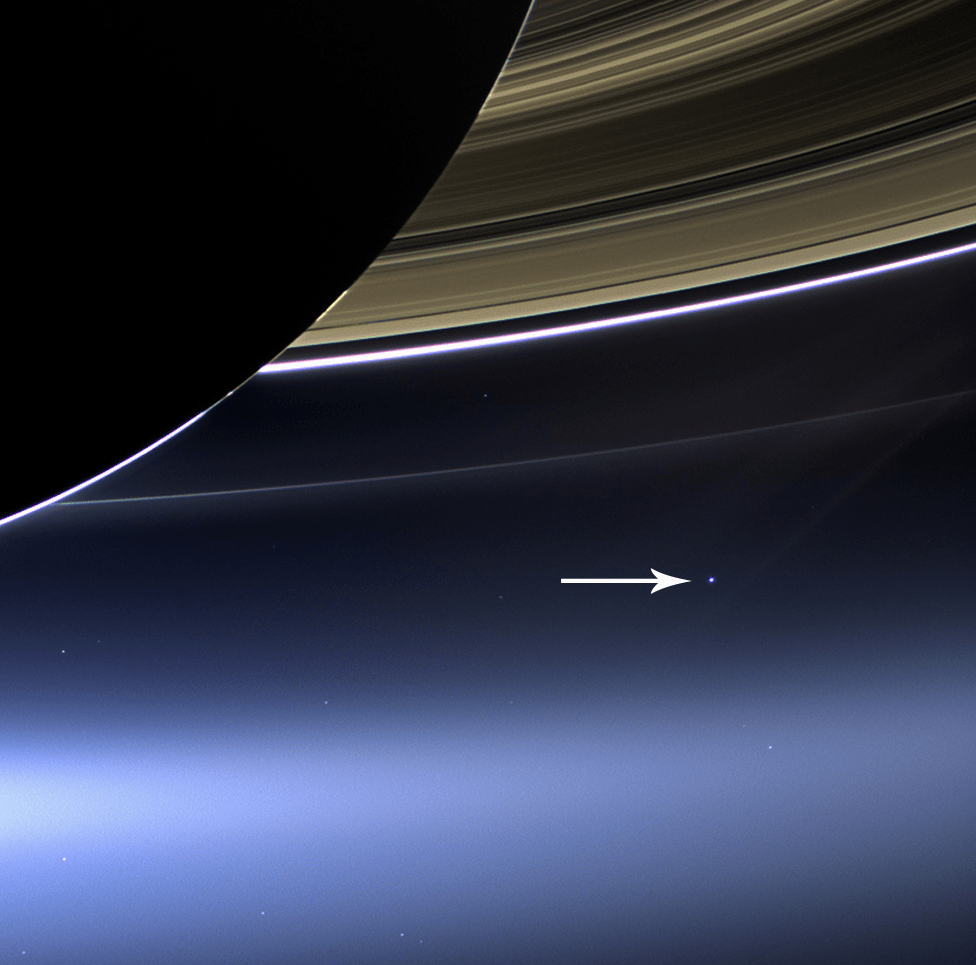
Earth (image from NASA)

My one issue as an American is that I have a difficulty with the “king” concept as our country has never had a king (even though we have had United States presidents who have wanted to be or tried to be kings). I have a hard time relating to the word. Perhaps, our species should be “regents” and not “kings.” As regents we are assisting God who is the ultimate divine authority. This ultimate divine authority is simply love. We are not God, but as creatures who should love nature and all that it entails, we are there to protect, love, and speak truth to the importance of protecting our wonderful little planet.

Prehension and Kuhn

I have been reading Juan V. Mayoral’s excellent new biography of Thomas Kuhn titled Thomas Kuhn: From Physics to Philosophy of Science. I imagine I will be using this book as a reference for future posts. I highly recommend it.

Thomas Kuhn (1922-1996) was one of the more important philosophers of science in the 20th century. Besides his concept of the “paradigm shift“, he came up with many other concepts about science that are still influential today. Here is short biography from the on-line Stanford Encyclopedia of Philosophy.

Kuhn’s The Structure of Scientific Revolutions. It is a good read. The idea of the “paradigm shift” is an important aspect of this book.

Kuhn came from a family of pacifists. Yet, he joined the military in World War II, and in fact, he was a member of the Radio Research Lab which was a secret military facility.

Raised a pacifist; joined the military. This change was fairly upsetting to Kuhn. He wrote an essay titled “The War and My Crisis.” It is a hard essay to find because he wrote it very early in his life before he became famous. Some publications have discussed this essay in detail.

Mayoral (and others) have suggested that his subjective turn from pacifism to joining the U.S. military may have been a nidus, of sorts, for his eventual publication of The Structure of Scientific Revolutions in which the whole idea of the paradigm shift became fully mature. In short, he recognized the capacity for change.

Kuhn changed. We all change. I would argue that all entities change. Change involves the concept of “prehension”, especially in the fields of process philosophy and process theology.

Prehension is when an entity is presented the panoply of possibilities before an event occurs. This panoply is based on all past events…from the very small to the very large. The entity “chooses” a reaction to these past events. This choice comes together concretely (called a “concrescence” and is the act “of becoming”). The choice becomes a unique “actual occasion” in real time which then passes on to become a fixed occurrence from the past while also being a possible influence in future prehensions. The process of past events influencing actual occasions with actual occasions becoming past events is an eternal process that is accomplished in real time.

I made this image in Google Gemini Advanced. I hope it makes sense.

Let’s look at Kuhn’s example from his personal life. He had many, many past events that changed his mind about participating in World War II.

Think about every event that you have been involved in. Some are significant; some are mostly insignificant. Now think about the sheer mass of past events leading to how you chose to be in a specific moment. You can consider your past relationships with family, friends, and strangers as you decide to act at a current moment in time. However, what about your genetic history, your ancestors’ prior genetic mutations, your serotonin levels, your altitude, your longitude on Earth, the effect of gravity on your actions, and on and on and on?

In fact, there is the potential for an infinite number of events in the past to affect how you ultimately make a decision (at least from a metaphysical perspective). If the universe is infinitely large, then perhaps a quantum wave effect thousands of light years away (thus, a very ancient event) would have some incredibly small effect on how you might make a decision. Conversely, having an important conversation with a significant other one hour before you might make a decision would be exponentially more important.

Thus, we change, and this change is influenced yet not necessarily determined by all that has happened to us in the past. A helpful reference is here. In a way, this idea matches the “Ship of Theseus Paradox.” If Theseus’s ship is around long enough, eventually all parts of the ship will need to be replaced. In the end, is it the same ship? In the end and as time passes, are we the same person that we have always been?

A few years ago, I was asked to give a lecture at a memorial lecture series for one of my mentors in the field of medicine. In retrospect, I probably did the wrong thing and talked about the microbiome and the philosophy of causation / change. I say “the wrong thing” as I think the conference organizers really wanted a lecture on hard science, not philosophy. My mentor’s daughter liked my talk which is really all that mattered in the end.

As part of my lecture, I discussed the difference between “endurantism” and “perdurantism.” Perdurantists believe that ordinary things like animals, boats, and planets only have temporal parts (things persist by “perduring”). Endurantists believe that ordinary things do not have temporal parts; instead, things are wholly present whenever they exist (things persist by “enduring”). 

Perdurantism (from https://medium.com/@lukeschrager/persistence-of-concrete-particulars-through-time-endurantism-vs-perdurantism-3442e044b376)

Endurantism (from https://link.springer.com/article/10.1007/s11098-024-02194-8)

In my opinion, the human body is very much an example of perdurantism, and thus, the human body is an example of prehension –> concrescence –> actual occasion –> repeat.

Image from: Sinicrope FA. Increasing Incidence of Early-Onset Colorectal Cancer. N Engl J Med. 2022 Apr 21;386(16):1547-1558.

In my lecture, I discussed the myriad of events that cause a human to change over time. These events are a complex web of past history that affect our physical health, mental health, and our decisions through time.

So, atoms change. People change. Galaxies change. Even our universe is changing. All of this change is based on past events in which there is a spectrum of decisions or reactions to such past events.

My blog posts are typically theological in nature. Where does God fit in here? Many of you who read my blog (or who know me personally) are aware that I believe in the concept of Naturalismppp. This term means that God fits neatly into the natural world via the 3 concepts of 1) prehension, 2) panentheism (the universe is in God), and 3) panexperientialism (all entities experience — even God).

Thus, if we all have a current state at each moment in time and if our current change or decision status is based on prior events, then we can state that nature exists in change itself. Reality, in many ways, is change itself.

Consider: If change if paramount for the physical world (prehension) and if this change is in God (panentheism) and if God experiences all of the experiences of nature (panexperientialism), then God at a minimum experiences change. God is present in the change.

We individually change. Nature changes. God changes. All change is based on the influence of past events. If God is love (which I very much believe), then God’s change over time is to desire creativity and to want love throughout God’s creation. This is a universal love luring for the best outcome for all entities. However, this love does not force change. It is simply a desire for the most loving outcome. God tries to relate to me. Thus, I can try to be loving aim for the best outcomes in events close to me and even events far away from me. I can try to be a loving husband and father. I can spend time learning the medical literature better for when I take care of patients. I can try to send money or other resources to strangers in need both locally and far away. I can pray for my enemies.

Thomas Kuhn has helped the world in many ways by exploring the world of science. His life experiences are a good reminder of how we each decide to live our lives through time. We have influences, and we have a choice in how we utilize these influences.

Image made by Gemini Advanced

Is Sin Equal to Removing the Evolutionary Potential of Others?

First of all, biological evolution is a real thing. The effect of organisms changing through time can be seen in the fossil record as well as in the science of genetics. Inherent mutation rates at the DNA level exist. Human diseases and human adaptations occur in the setting of genetic change. Epigenetics is real. Biological evolution is real simply because change itself is real. Time encompasses change.

Irenaeus (125 – 202 CE) was an interesting church father. I think he differed in some ways from how Augustine (354-430 CE) conceived of sin. For example, in Irenaeus’s The Demonstration of the Apostolic Preaching, he states the following:

“And Adam and Eve—for that is the name of the woman— were naked, and were not ashamed; for there was in them an innocent and childlike mind, and it was not possible for them to conceive and understand anything of that which by wickedness through lusts and shameful desires is born in the soul. For they were at that time entire, preserving their own nature; since they had the breath of life which was breathed on their creation: and, while this breath remains in its place and power, it has no comprehension and understanding of things that are base. And therefore they were not ashamed, kissing and embracing each other in purity after the manner of children.”

Irenaeus

The paragraph is certainly interesting to consider theologically. Animals eat animals (and plants). Plants compete for niche space. Bacteria compete for resources. One might point to such ideas as “natural evil” which certainly could be a true. However, the actions of the majority of living organisms on our planet occur due to nutrient needs, daily survival, and reproductive potential. They do not eliminate each other out of thoughts of cruelty. I say “the majority” because there appears to be the one exception of Homo sapiens.

Our species has a long history of injuring the other, destroying the environment of the other, and killing the other. This “other” consists of life on our planet, including the life of others of our own species.

Biological evolution causes new species to appear, and it causes older species to go extinct. This is change in the setting of time. It is a natural occurrence which can be tragic for the species that dies but beneficial for the species that survive. In a way, the process is no different than stars exploding at the end of their lifetimes, galaxies losing star-making ability, or our universe eventually (as far as we can tell) using up all useful energy. This is change, and the death associated with this change is not due to malicious intent.

In other words, these are natural occurrences.

The Cassiopeia A Supernova from Scientific American

Humans, unfortunately, have the unique ability to make such changes even drastic, especially in the setting of biological change / evolution. By consciously ending the life of an individual or species, we also are making a conscious decision to end the evolutionary potential of that individual or species. We are consciously deciding to limit change and the potential of biological creativity.

If we kill a fellow human out of anger, we prevent that person’s ability to affect future generations either through genetics (reproduction) or societally (their emotional or material consequences on others). If nations create war on other nations, we affect entire populations in their ability to make new generations of people as well as destroying or modifying the general emotions, finances, food supplies, and leadership options of all nations involved.

If we destroy a species or group of species of other animals or plants, we are preventing their ability to continue on as a species.

Perhaps extinguishing a species or group of animals is beneficial at times. I am not sure. I very much despise mosquitoes as they bite and can carry diseases such as malaria. However, these insects can be beneficial.

Almost completely extinguishing a species can be harmful. An example is the American bison (Bison bison) extermination in the 19th century. Besides almost completely destroying a species simply to rid the United States of a food source for native communities (thus causing human starvation and an inability to reproduce), the destruction of the bison affected some Native American cultures permanently.

American Bison

Humans make these conscious decisions. We are not ants just trying to find resources to keep their colony alive. We are not trees sending out pollen to hopefully fertilize or be fertilized. We are not lions looking for limited resources on the Serengeti with feelings of satiety after eating a gazelle and not needing more.

Humans typically make conscious decisions to hurt of kill the “other.” As we hurt or kill, we are limiting the evolutionary potential of an individual or a species. If an individual is killed in the setting of murder or drunk driving, they have lost any potential ability to pass on their genetics, have lost subsequent ability of their genetics to undergo potential beneficial mutations, and have lost their genetic life be passed on to other generations. Their genes are gone as is their individual’s influence on their family, culture, and society. If we kill a whole group of humans (as in war), this effect is horribly magnified. We prevent the potential for that group to undergo potential passage of genetics to future generations and thus prevent their evolutionary potential. The same idea goes with other individuals, groups, and species throughout our planet.

Image from Nelson University

I would propose that a definition of “sin” would be our wanting to remove the evolutionary capacity or potential of others in a pointless manner.

Humans can consciously make a real decision to remove the evolutionary potential of other creatures. Humans can consciously make a real decision to remove the evolutionary potential of a people group. Humans can consciously make a real decision to make a species go extinct. We make these decisions often full well of the tragic consequences.

In my opinion, humans are a very violent species. Perhaps it is part of our phenotype to be destructive.

Where is God here?

Readers of my blog know that I think the model of process theology and especially the model of open & relational theology make sense when understanding the world around us. In my belief system, God lures for us to be creative and not destructive, to be novel and not monotonous, to consider life’s existence as a manifestation of love and not as life’s existence manifesting as hate of the other. God desires us to choose to do better. God does not interfere here. God is not a control freak, and if we are truly made in the image of God, then we should not be control freaks either.

We can choose to prevent spoilage of the environment. We can choose to conserve and to limit death of other species in meaningful ways. I think we are probably the only species on the planet that has evolved the cerebellar volume and conscious ability to choose in such a manner. Perhaps Chimpanzees come closest here when considering Jane Goodall’s work on the Gombe preserve in Africa. These animals apparently had war-like behavior on each other with the resultant unnecessary death of individuals. On the other hand, human interruption of their environment (again, humans choosing to destroy an ecosystem) may have been the primary cause of such activity.

Gombe National Park

There appears to be something specific in human behavior in which we can actively decide to destroy a species, an evironment, or a people group voluntarily and without regard of consequences. In other words, when we deliberately decide to destroy the potential of a species or an environment or a people group, we destroy the evolutionary capacity of such entities. We destroy their inherent creativity. We destroy the “grandeur in this view of life” per Darwin.

I think Irenaeus stating that metaphorical Adam and Eve’s “no comprehension and understanding of things that are base” points to a very concrete reality. H. sapiens eventually reached a point evolutionarily that we understood we could kill or maim for personal benefit. We could interrupt continuing creativity in the world God created simply for individual gain or nation building. No other life form on our planet can be this dangerous. There are alternatives, however.

We can do agriculture in sustainable ways. We can eat meat products in sustainable ways. We can take antibiotics or use vaccines to prevent infections from interfering with human evolutionary potential from a species perspective.

Perhaps our evolutionary potential will allow us to better recognize the importance of the world around us. It is a potential that, I believe, is freely given by God. We get to make the choice.

Image created by Gemini Advanced
The Brain and Morality

Morality is a difficult idea to process. One can think of the recent U.S. capture of Nicolas Maduro in Venezuela as an example. One can believe that the U.S. shouldn’t be involved in the politics of other countries for moral reasons. One can believe that an outside agent removing an autocrat who has crashed a country’s economy is good for moral reasons. I have friends who have escaped from Venezuela. It is clear that the Hugo Chavez and subsequently Maduro regimes destroyed the country’s economy and threatened their relatives. It sounds like the removal of Maduro was a good thing. Yet, I personally am troubled about U.S. involvement in other countries.

Moral decisions are difficult.

Recently, a well-known Evangelical writer confessed to having an 8-year affair with another woman while he was married. He has been married to his wife for many, many years. The writer (and a nationally-known speaker, by the way) subsequently has decided to quit his public life and to retreat into a private life to deal with his marriage difficulties. This change is probably the right thing to do. I am not going to mention this person’s name. You can find it easily on the internet.

I have heard this person speak live at an event that I attended many years ago. I found him moving, especially since he was a big proponent of the reconciliation of religion and science. He walked right past me on the way to the speaker stage. I never knew the person, but this recent tragic news made me reflect on my “interaction” with him.

Here is the rub to the whole story. This person has been diagnosed with Parkinson’s disease (let’s abbreviate it as “PD”).

PD is a neurodegenerative disease of the brain that is universally fatal. It is more common in men and typically presents with symptoms at around 60 years of age. For unclear reasons, dopamine-producing neurons begin to die off in the part of the brain known as the substantia nigra pars compacta. Most people are familiar with PD due to its progressive and debilitating muscle movements. Helpful links are here and here. Treatment consists of using the medicine, levodopa, which replaced dopamine. Other treatments also are available. Regardless, this disease is progressive and fatal.

Image from Practo

Not every patient with PD has the initial muscle movement changes. Some patients can present with emotional dysregulation and psychiatric disease. In fact, I know of someone who mainly presented with memory loss before an official diagnosis of PD was made. In other words, PD is in on the spectrum of dementia disorders.

Here is a great open access article about PD.

The psychiatric diseases associated with PD can be vast, including, “…depression, anxiety, hallucination, delusion, apathy and anhedonia, impulsive and compulsive behaviors, and cognitive dysfunction…” See this open access link for information. It also is important to consider that disinhibition and hypersexuality are much more common in men with PD.

Back to the person described above, what if, what if, what if, this person had neurological changes leading to personality changes leading to bad decisions. This particular person is 76 years old, so if the affair that he was having occurred 8 years ago, then he was 68 years old when it started –prime time for neurological manifestations of PD to kick in.

I have had personal experience with the personality changes associated with the various types of dementia. My father was a well known academic in the field of military history and had a long career. He developed dementia that was likely due to chronic infarctions (strokes) of the brain associated with advancing age. My father was a very decent person who tended to be on the side of kindness when it came to strangers. As his dementia progressed, he became an extremely angry person. He was angry in the ICU until he went unconscious and died. Honestly, I didn’t even recognize my father at that point — even though I loved him.

Brain of a patient with multi-infarct dementia (from International Psychogeriatrics)

My blog posts tend to be theological in nature. So, what does my writing above imply?

First, I think that the very essence of human nature or human personality is influenced by our biochemistry. Our essence is affected by time as our bodies become older, worn out, and scarred. Perhaps we live in a world of soft determinism. As animals, we have some degrees of freedom, but nature put limits on such freedom. Sponges rarely move. Pacific salmon have a semelparous life cycle that seems rather tragic. Humans can have a huge spectrum of emotions and behavior that lead to beautiful science, art, writing, engineering, and music.

Sponges (from One Ocean Foundation)

However, in the presence of time, the human brain typically atrophies or scars as we each get older. We don’t want to lose our good personality traits as we age, but many of us probably will.

This limitation of degrees of freedom will affect how we think about God, or conversely, no God. Our past experiences (including the physiology of the brain and diseases of the brain) can lead to changes or perhaps even lack of changes in how we think about God. I would imagine these changes could be problematic especially if one becomes anxious or angry in the setting of dementia.

Second, I believe that God allows nature to have complete freedom in how nature operates. God may “lure” for creativity / novelty / love at all levels of nature, but nature can “choose’ to do whatever. The Second Law of Thermodynamics could be a theological example if we consider that the increasing loss of useful energy over time occurs because the universe works just that way — even if God perhaps desires the universe locally to be a perpetual motion machine.

Thus, God may lure us to not make bad decisions, but God also gives nature the freedom to have our hormones work in certain ways, our genes to be expressed or mutated in certain ways, and our brains to change in certain ways that risks detrimental behavior at times.

There is some degree of inescapability here. After all, we all die. Perhaps this aspect is a good thing. God is not interfering directly with our lives. Philip Clayton has coined the term “Not Even Once.” in terms of God participating in the world…not even once. God cannot interact with the world outside of known physical laws.

Image from Semantic Scholar

Perhaps God has interfered once (the Christ event, the accumulation of the Quran, the rare appearance of the Buddha, etc.) based on various religious traditions. Such ideas are singular divine events. However, if God interferes once, humans will risk believing that God will interfere again and again and again. Perhaps the human tragedy is that we think God will keep interfering with our lives to make our lives better or worse.

Regardless of the potential of a singular God event(s), I think it is important to consider that nature progresses on with limits such as gravity, the human spectrum of vision, DNA mutation rates, the expansion of the universe, and other factors. God may lure for us to be better humans, but our efforts to be good to the “other” may necessarily be limited by limitation of natural laws or the limits of our neurological personalities.

What does this all mean? Well, to go back to the original example of the fallen religious leader, he did some bad things in his marriage, but perhaps, he was neurologically impaired in such a way that the risk of bad behavior increased. I think we need to consider such possibilities among people in our lives, especially the elderly.

By the way, I am not a complete cynic here. I think God lures in real time and eternally. There is always the real chance for the good. Such a real chance can include your making a real and positive difference in the generations to come and can include the possibility of God’s immense of love of all creation, including God loving us even in specific ways after we die. At this juncture, I am ever the optimist.

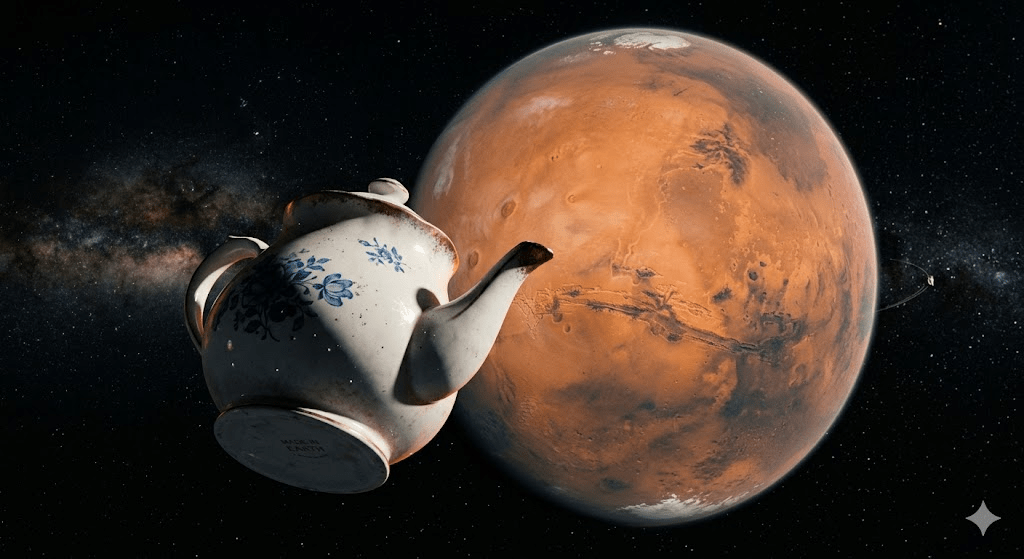
Image generated by Google Gemini

The Sadness of the Ark Encounter is Sadness for All of Us

Recently, the Ark Encounter in Kentucky had a measles exposure due to an unvaccinated visitor visiting the park. You may wonder what the Ark Encounter is… It is simply an extension of the Creation Museum in Kentucky which is run by the group, Answers in Genesis. I’m not going to provide a link to either of these facilities or AiG because, simply put, they are 1) anti-science and 2) anti-religious. They are anti-science as they essentially support no real science. They state they support “creation science” which is a misnomer and is a fruitless endeavor in confirmation bias. They are anti-religious in that they only support a narrow view of religion and, honestly, a narrow view of Christianity. Being anti-science can kill people; being anti-religious (especially from a Christian perspective) can cause bigotry especially if it is associated with politics and nationalism.

XKCD comics

Both the Ark Encounter and Creation Museum get about 1 million visitors per year from tourism estimates. It is unclear if this 1 million number is correct, but if one divides the amount by 365 (not counting seasonal variation), an unvaccinated person with measles may have exposed approximately 2740 people to a very bad and potentially deadly infection.

Measles is one of the most infectious viruses in the world. The virus kills approximately 1-3 of every 1000 children who are infected and not vaccinated.  Measles has been shown to cause life-altering permanent neurologic disease in 1 in 1,000 children who are infected and not vaccinated. It is terrifying to consider that 25% of children who are malnourished and are infected with measles will die. Considering the food insecurity rate in Kentucky where the Creation Museum and Ark Encounter are located, the potential mortality rate for Measles is concerning. For example, one can consider this graph from Feeding America.(https://map.feedingamerica.org/county/2023/overall/kentucky).

I have so many thoughts here:

One: Bad science typically begets bad science. This statement is quite true. Of course, one could point out that good science can be ignored while bad science continues. An example, to some degree, would be what happened to Galileo Galilei in the setting of his proving the heliocentric model. In the situation of Galileo, further studies proved his point and the idea of Earth rotating around the sun was eventually accepted notwithstanding that further research over time showed that our sun is one of billions of suns in the Milky Way galaxy and our galaxy is one of billions of galaxies in the observable universe. Social and religious pressure initially prevented but could not stop scientific observation. What I am stating here is different. I am stating the following: bad science such as that promoted by the anti-vaccine movement self selects for more anti-vaccine nonsense. Bad science such as that promoted by the anti-evolutionary movement self selects for more anti-evolutionary belief nonsense. These nonscientific belief systems have their own insular journals, have their own insular “experts”, and have their own insular “scientific” meetings. The results lead to promotion of dangerous anti-science belief systems in federal funding systems (especially in the United States) and a decline in life-saving medical therapies such as childhood vaccinations.

Graph from the New York Times

Two: Bad theology helps bad science. Bad theology such as wooden and weak literal interpretation of the Bible leads to a poor subjective understanding of how science works. If you think that praying for God to prevent measles in your child is how to treat this infection instead of vaccinating your child, then you have poor theology and very poor understanding of science. Have you considered that God was behind the miracle of childhood vaccinations? This poor understanding may not be your fault. You may have had poor education in public or private school. You may have been taught horrendously terrible theology growing up. I have posted about the following example in the past. When my children were young, we sent them to a Bible camp in northern Utah very close to the Idaho border. It all seemed to go well until some random pastor gave a sermon about evolution being wrong since pterodactyls have been seen flying around Idaho. I will limit my cussing here, but the response from my wife and from me was, “This is 100% excrement.” Our children were removed from the Bible camp because once a religious community is anti-science about one well-known concept, the community tends to become anti-science about other concepts. Experts have defined the increasing number of anti-science beliefs in some religious communities as the “spillover effect.” Good references are here and here.

Pterodactyl from 150 million years ago. It is NOT flying over Boise, Idaho. Image from the National Dinosaur Museum.

Three: We need better science communication. Here is a constant complaint of mine. At least in academic institutions (i.e, universities), there is minimal ability to get academic promotion and/or tenure by participating in public outreach. Sure, I personally have reached “full professor” level at my university, but my promotion was simply due to publications (lots of journal articles, a few grants, one edited textbook, one editorial board membership with associated writing). Patient care was emphasized to a degree as I was bringing in revenue to the institution. Medical education for medical students, residents, and fellows also was considered, but medical education is never considered a big component of “RPT” (“retention-promotion-tenure”). Outward facing speaking to the public has pretty much a nil component in any of my promotion packets. The problem does not just occur with my university. It is a nationwide problem in the United States. Perhaps in countries like Switzerland, public outreach is valued in academic culture. However, in many universities, the importance of scientific outreach is not considered valuable. In the world of trying to promote scientific understanding in the realm of Christianity, there are limiting cases of success here. Perhaps Francis Collins would be a well known exception.

Random university photo

Four: Strive to be a better Christian / be a better religious person when understanding science. I can speak for Christianity. Jesus is very clear. When one is caring for the poor, the ill, the needy, one’s mind so go back to specific verses in the Bible such as Matthew 25:40 or Luke 6:31. Not providing correct scientific education regarding how the world works would go against what Jesus has commanded us to do. Not vaccinating your child so that they get sick and potentially die from an easily preventable disease would go against what Jesus has commanded us to do. Not vaccinating your child so that they get sick and potentially cause others to die (infants, people undergoing chemotherapy, people with autoimmune disease, people with organ transplants, etc.) would go against what Jesus has commanded us to do. Interestingly, Quran 4:36 has parallel type statements (“To parents is owed kindness, as also to relatives, to orphans, to the needy, to a neighbour who is a relative, to a neighbour who is a stranger, to a companion by your side, to a traveller and to your slaves, God loves not the swaggering and the conceited…” Quran 4:36, Tarif Khalidi translation).

Loving others as Christ loves us…Kindness to the “other”… It seems that God wants us to promote good science not only in the setting of academics but also in general society and in our religious settings.

By the way, the Dr. Joel Duff’s Youtube channel has expressed my thoughts much more clearly. I would recommend the video, “Ken Ham’s Ark Encounter: More Effective Than Billy Graham? (Really?)” as an example. Link: https://www.youtube.com/watch?v=kt2ldTMStz8

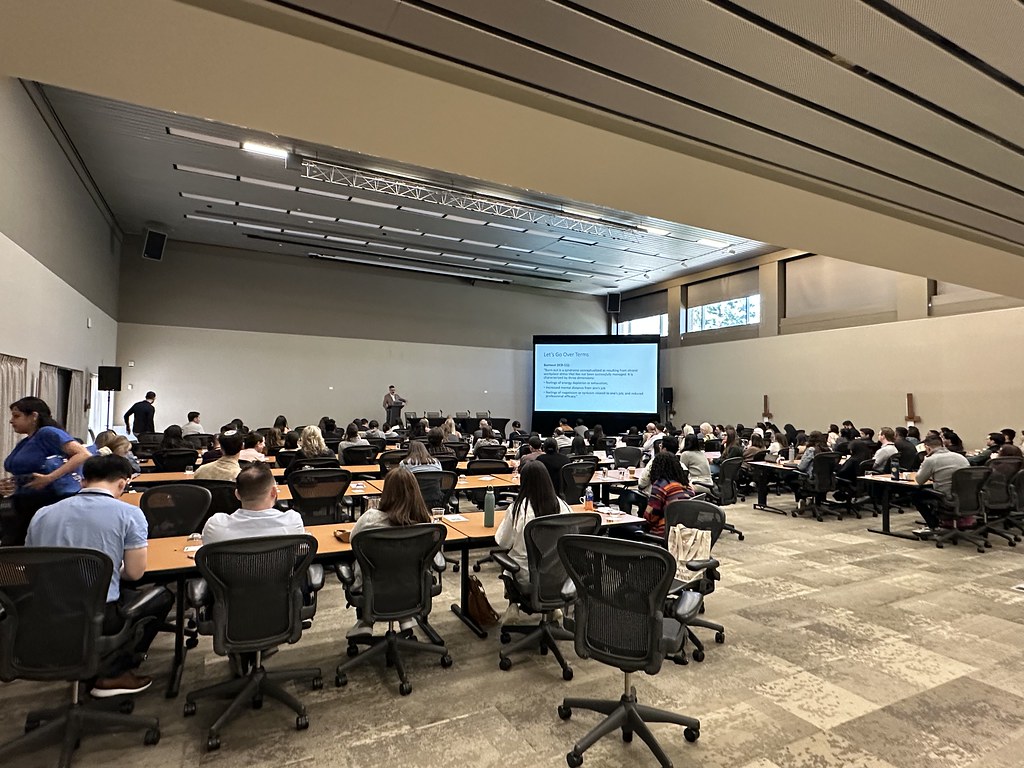
Image generated by Gemini Advanced
A Good Review of Why Biblical Literal Reading is Problematic

The title of this post probably should be the summary of this post. Recently, I have read the article “Should Literal Interpretation Enjoy Default Status?” published in the journal, Perspectives in Science and Christian Faith. I am a member of the American Scientific Affiliation, so I get articles sent to me before they are officially published. This specific article will be coming out soon. It is written by John W. Hilber who teaches at McMaster Divinity College.

Literal Interpretations of Scripture often are very problematic. It is quite easy to see why a “plain reading” of the Bible by Christians is fraught with errors. I want to go over some of his main points.

Literal interpretations of Genesis mess up what is known and what is being discovered about the world: Per Hilber, “‘literal interpretation by default’ is also the reason some Christians in science hold steadfastly to young-earth creationism in spite of what their knowledge of the scientific evidence might otherwise lead them to believe. They are convinced that proper submission to biblical authority is bound up with literal interpretation.”

But what is the correct literal interpretation of the Bible? The King James Version? The NIV? The Good News Bible? An English translation derived from interpretations of Hebrew and Greek? What your pastor tells you over the pulpit is the correct literal reading? Augustine has written that an understanding of the natural world is a very helpful way to experience God. Thus, NO literal reading is necessarily required. For example, in his Sermon 68, he states, “Others, in order to find God, will read a book. Well, as a matter of fact there is a certain great big book, the book of created nature. Look carefully at it top and bottom, observe it, read it. God did not make letters of ink for you to recognize him in; he set before your eyes all these things he has made. Why look for a louder voice? Heaven and earth cries out to you, ‘God made me.’” I find it interesting when fellow Christians tell me that Augustine is wrong here. I mean, this is a big church father who was highly educated. The average churchgoer is absolutely sure Augustine is wrong about God’s presence in nature? Hmmm…

Augustine of Hippo

Inference: Per Hilber, “…speakers use words to create a context within
a broader cognitive environment in order to guide listeners to infer the speaker’s informative intentions
.” In other words, Biblical passages (for example, those written in the English language) are written for clarity; for the “needs of the listener“; for the need of being clearly stated. Translators of today’s modern Bible versions are writing for clarity and not for literal interpretation. Modern wording in a Bible probably never expresses the original meaning of the Hebrew and Greek texts exactly. A good article about context in language is here.

Non-literal expressions of time: When we look at time intervals in the Bible, many of the associated passages fall into the category of “utterances” which can be defined as “…metaphorical interpretations of a word combination whenever a metaphorical interpretation was available.” Here is a poor example. I get very bored when waiting for my car to get serviced. I might say (and probably have said), “It took 3,000 years for the dealership to get my car ready today.” Actually, knowing myself, I probably have said this statement many, many times. In the Bible, especially in the Old Testament, there is good research to suggest that such time blocks (for example, God’s 6 days of creation and 1 day of rest) were meant to be metaphorical. There is interesting fMRI evidence that our brains are set up to use non-literal inference when processing literal meanings. In other words, when I say, “It took 3000 years” (see above), you can interpret my statement as “It took a long time. John was probably bored.”

Image from Space.com

Fear: Hilber writes, “Some fear that if Genesis is not literally interpreted, then truth telling, the veracity of Scripture, and even the core of confessional Christianity are threatened.” I don’t know what to say here. Going back to Augustine, he was pretty clear that time intervals in the early chapters of Genesis are extremely unclear. In order to understand this aspect, consider section 3.8 of Augustine’s De Genesi ad litteram imperfectus liber. A good translation is here. Augustine makes it clear that literal translations of the early Genesis chapters are fraught with problems.

Is there fear when a church leader tells the laity that there is only a literal translation of the Bible? I very much think so. This fear, I believe, is of the unknown. The love of God from a Christian perspective is perhaps terrifying. I cannot imagine such a Divine Entity loving me and all things eternally and in real time. This is beyond any structural understanding of our reality. In Paul Tillich’s Dynamics of Faith, he clarifies what the word, “myth”, actually means. It means “mythos” or “stories of the gods.” Why can’t this word be used in Christianity? The myths presented say in Genesis or Exodus are very much the stories of God’s interaction with reality — beyond our human understanding.

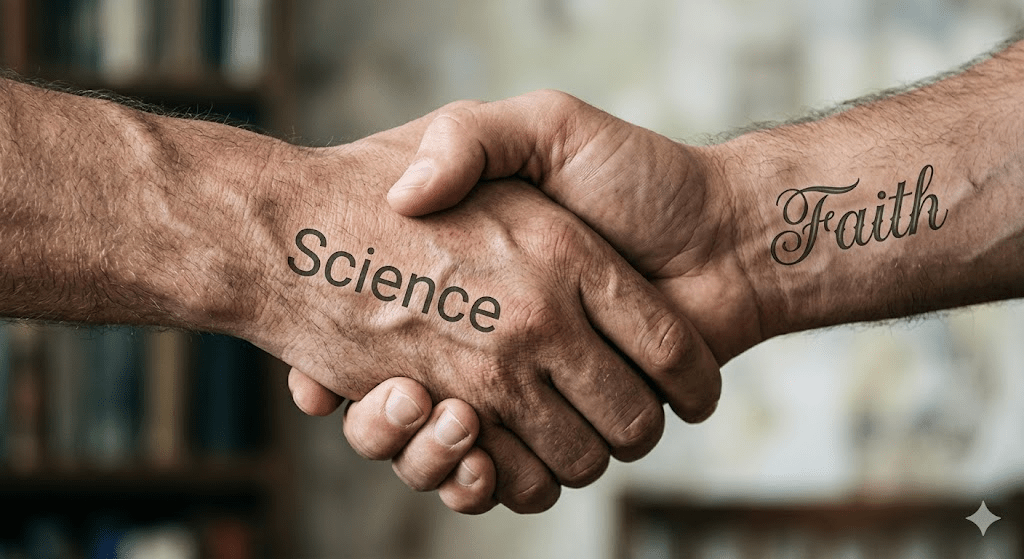
A) God who loves reality (including you and me) unconditionally and B) God who loves eternally including this exact moment in time leads to C) perhaps the best way to understand God which is D) done by reading the Bible as an interpretation but not as a wooden, fragile literal reading.

image created by Gemini Advanced