I subscribe to the journal, Theology and Science, published by Taylor & Francis. Most articles in each issue are fairly interesting. In the latest issue, I read, “A New Hope for Christian Eschatology in Cosmic Perspective: Beyond the Predictions of Standard Big Bang Cosmology” by Hyung-Joo Lee. The author has expertise in theology (PhD, Graduate Theological Union) and cosmology (PhD, Korea Advanced Institute of Science and Technology). His article (unfortunately, behind a paywall) provides theological ideas about how to think about God while living in a universe that appears, based on current science, to have an unsatisfactory end point.
Our universe arose from the Big Bang, although physics equations break down when we try to understand the time before 5.39 x 10^-44 seconds after the Big Bang started. Additionally, the cosmic background radiation shows that our universe is homogenous in every direction. We know that the universe has been expanding and apparently expanding faster, in every direction over the past 13.8 billion years. What eventually happens to the universe?
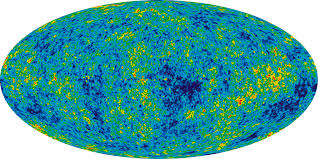
Cosmic background radiation (image from Wikipedia)
Well, the universe may keep on expanding forever and ever and ever and ever and ever. This is a “flat” or “open universe” with no curvature and with the consequence of all useful energy being used up. The universe will eventually reach a temperature of absolute zero. Nothing happens at that point. All is dead.
On the other hand, the universe may eventually collapse back on itself. I believe that this is the minority view of cosmologists. When it collapses back on itself, the universe is simply destroyed. This is a “closed universe” model. Similar to the “open” idea, all is destroyed. All is dead.
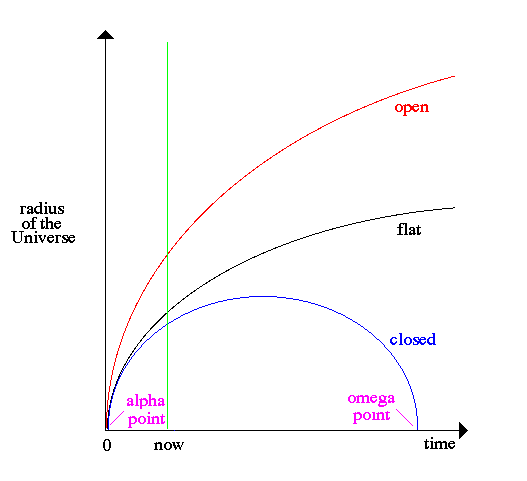
Image from the University of Oregon
Both ideas seem to go against Christian eschatology or what happens when all of this ends — from a Christian perspective. An interesting article is here. It is rather depressing to me to think that any possibility, no matter how remote, of my being remembered will be forever gone. The possibility of our species or our planet or even our galaxy being remembered being forever gone may be traumatic to consider.
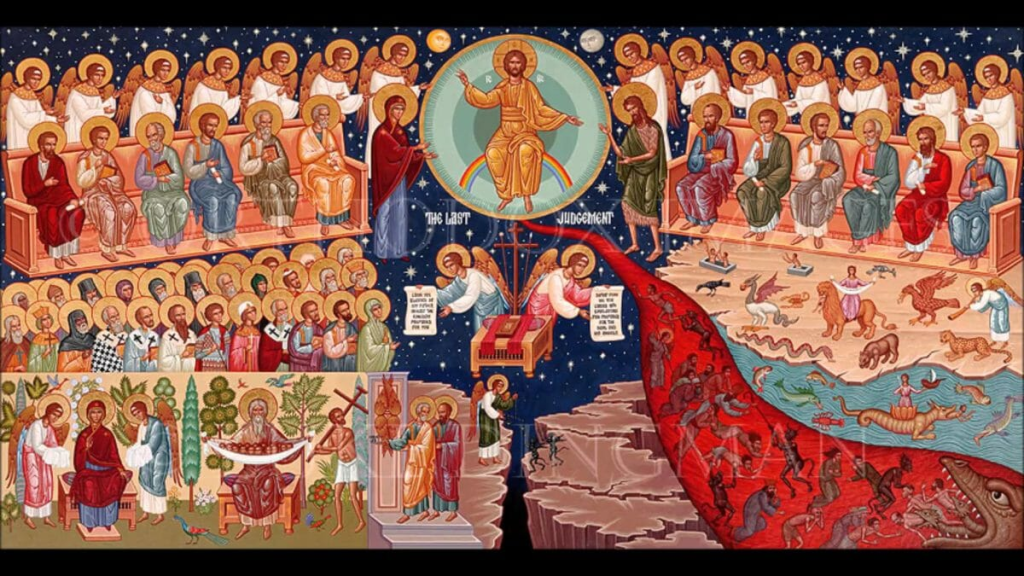
The Last Judgment
Lee challenges this assumption of all simply ending. Using the work of others, such as Robert Russell and Wolfhart Pannenberg, Lee discusses the idea that physical theories may be “descriptive” and not “prescriptive”. In other words, our physical theories in relativity and quantum mechanics are indeed brilliant but may be describing a reality while not yet reaching the actual reality of what is occurring. There is a long tradition here as described here and here.
Lee then proposes the following:
We know the universe is expanding faster and faster in all directions. Over time (really immense time), the quantum fields in such a gigantic space will still be present. I’m no physicist, but I would define a quantum field as points in all of space in which particles and forces arise simply as excitations of such fields. The electromagnetic field is such a field. The Higgs field is another field. There are others. These fields are possibly statistical (as far as we know currently). Thus, there is a chance, no matter how small, that something could arise in these fields over immense time and immense space.
A particle could arise with such fields over time in a large area of space. From a statistical standpoint, even something complex could arise from these fields. The Boltzmann brain is such a conjecture — not provable. Thus, perhaps even a new Big Bang could arise in such a setting. Heck, from a theological perspective, a “new heaven and a new earth” could arise (Revelation 21:1).
Boltzmann brain (image from Beyond Universe)
Lee looks at the theoretical cosmology idea of quintessence here. Quintessence is a theoretical idea that some type of field is associated with the universe expanding differently depending on the location. Such an idea is opposed to the current idea of the universe forever expanding per the Cosmological Constant.
Let’s think about such an idea in the realm of process theology or the more divine love-oriented open & relational theology. 1) If fields can vibrate to potentially produce anything (a conjecture), 2) if things (comparable metaphorically) to Boltzmann brains can occur in the setting of immense time and large space, and 3) if quintessence allows for the universe to not “die” by forever expanding or by collapsing, then there is the possibility of eternal creativity.
From a process theology / open & relational theology standpoint, this idea matches Christian eschatology. Those who work in process theology as well as open & relational theology use the idea of God desiring (not forcing) novelty or creativity as part of God’s nature (process theology) or as part of God’s nature of love (open & relational theology). Such ideas are basically a type of eschatology occurring over deep time and perhaps eternally. God is forever creative. God’s love desires, but does not force, creativity.
In my book, A Theology of the Microbiome, I express some of these ideas as follows:
“Finally, when one considers the idea of a “Boltzmann brain,” there
is the possibility that a new universe could form even as our current
universe continues onward with increasing entropy and less useful energy
over time. In the far future, thermal equilibrium is predicted to be
reached everywhere. Despite this event eventually occurring, there could
be a real, but incredibly small statistical chance, that particles would move
close enough to each other so that entropy would decrease momentarily,
and structure would form. The “Boltzmann brain” idea suggests that innumerable random particles in an immense universe with thermal equilibrium
over vast time could, simply by statistical chance, form a “brain”
for a few moments that would experience reality. The brain would then
dissipate into particles again as increased entropy once again took over.
Could a large fluctuation of such particles create a new universe in the
far future? It would be highly improbable but mathematically possible.
Dark matter changes, as well as other mechanisms, have been theorized
as potential causes for a new universe in such a setting. Also, the theory
of cyclic cosmology suggests that a new universe would occur regardless
in the extreme long-term future. All such ideas can aid one when thinking
about the unstoppable increase of entropy in the presence of eternal
creativity.”
Consider purchasing my book. : )
So…I like this article.
At the same time, I have some pushback.
1)Boltzmann brains may not be possible if there are no fluctuations in quantum fields (i.e., if quantum mechanics is essentially deterministic). A good reference is here. Determinism would rule out creativity both objectively and subjectively.
2)Here is my biggest problem. I think science and theology can help each other but cannot stand in for each other. I’m not a believer in non-overlapping magisteria per Gould even though Gould is one of my heroes. Science informs theology so that we understand aspects of God better in the setting of potential divinity in the world. I’m rather cataphatic here. Most of the world is religious, and good theology informs science in the setting of morality or ethics. For example, does God want us to have nuclear weapons? Does God want us to be anti-vaccine? Does God want us to ignore famine? Does God want us to ignore war? Does God want us to deny climate change? I think the answer is decidedly “NO.” Thus, Lee’s work adds on to the perspective of God’s continuing desire for creativity (process theology) via divine love (open & relational theology).
I do not think it is in human capacity to understand what happens when we die or when a “new heaven and new earth” arise. As a Christian, I can believe in the hypostatic union of Christ Jesus, but I cannot understand it fully. I never will. I hit a wall beyond which no comprehension is present. We can make metaphors, but we are limited by our human brains — both objectively and subjectively.

Lee’s article is very good and should be read.
Good theology recognizes brain limitations of our species — both objectively and subjectively.
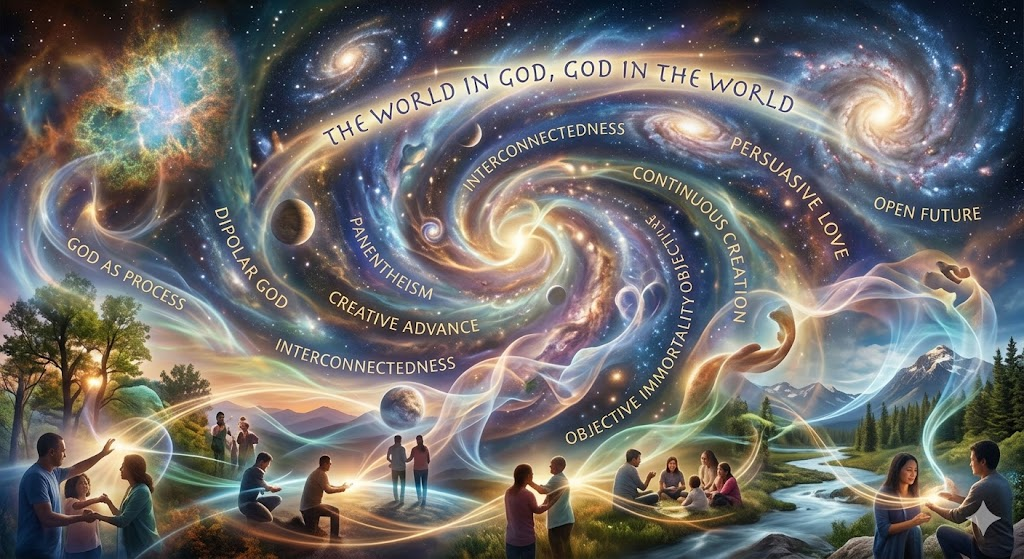
Image made by Gemini Advanced

