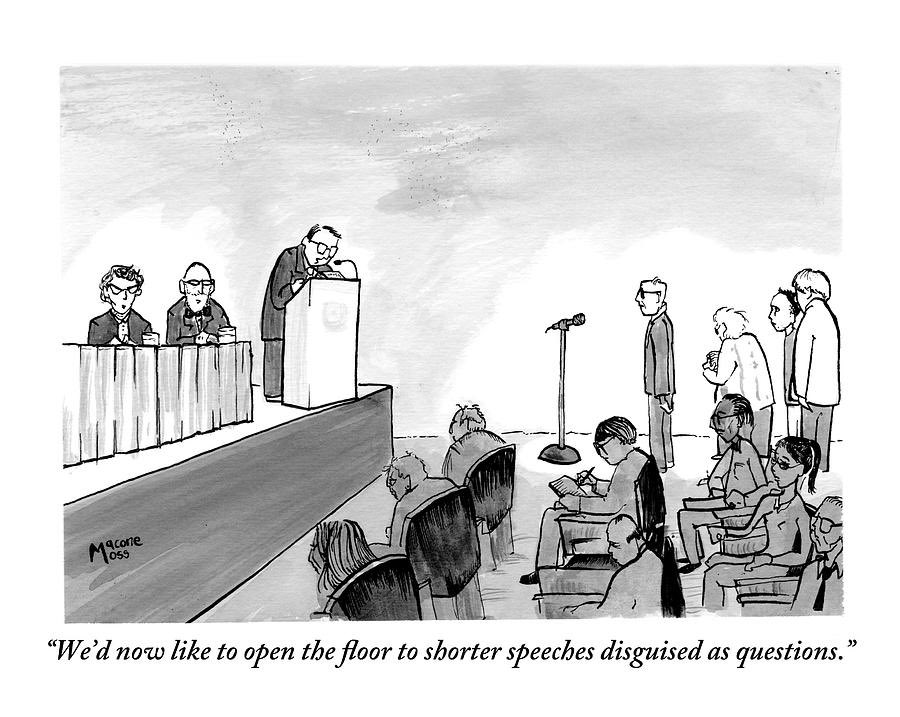
It is kind of a truism in medical conferences (and all sorts of academic conferences) that some people pretend to ask a question after a presentation, when in reality, they just want to give a mini-talk themselves. Typically, such “mini-talks” are ways for people to act like they are important. “More of a comment than a question” is the equivalent of trying to take over a meeting. The statement has become kind of a humorous meme about scientific meeting Q&A periods after a presentation.
Unfortunately, I somewhat did a “comment more than a question” recently on Substack. Matthew Segall has a great Substack account. It is expansive and quite wonderful in the realm of explaining philosophy especially regarding the realm of metaphysics. I highly recommend following his account.
On April 27, Dr. Segall interviewed a person associated with the Discovery Institute. I don’t want to identify this person directly (you can watch the interview) as this individual falls into the camp of Intelligent Design which, in my opinion is a rather spurious belief system. I would rather criticize Intelligent Design (ID) than the individual.
Dr. Segall did nothing wrong. His interview was completely fine. He was much more patient than I could ever be. He was pointing out how different belief systems can converge and diverge. Dr. Segall is an expert in process philosophy which can align theologically with process theology (PT) as well as open & relational theology (ORT). I find myself in the camp of PT and ORT. PT / ORT are definitely religious in orientation and they are very pro-science. People like me may believe in God, but we also have no issues with randomness in evolution, Big Bang cosmology, the weirdness of quantum mechanics, accepting the spectrum of human sexuality, acknowledging the problem of evil, etc.. I’m not sure I believe in non-overlapping magisteria as I quite sure that science can inform one’s belief in God.
ID is very different. ID is basically a Young Earth Creationism (YEC) adjacent movement. ID may state that the universe is old and perhaps biological evolution happens, but it then runs off the rails as being science adjacent. ID often relies on the term “irreducible complexity” in which biological mechanisms or structures are so complex that there is no natural mechanism to explain how the complexity occurred. Additionally, once ID says that a mechanism/structure is “too complex” to be explained, then the obvious answer is “God did it. Don’t ask any more questions.” ID also seems to be very much into guided evolutionary processes from an anthropomorphic perpective. I’m not talking about ideas surrounding evolutionary pathways (such as convergent evolution) which may have underlying physical laws. Convergent evolution is definitely real, and it may have an underlying physical law basis not yet understood. What I am talking about is the awful continuing movement in the United States (and to some degree in other countries) to trying to replace science with specific types of religious thought which includes fundamentalism, YEC, and ID. When one tries to put such constrained religious systems into the realm of science by defining fundamentalism / Y.E.C./I.D as a type of “science”, one will start going down the road of the anti-vaccination movement and climate change denial.

Convergent Evolution, image from the Natural History Museum (London)
So…my comment is more than a question. After watching the interview between Dr. Segall and the person who represents the ID movement, I posted a long comment which I will break down below. Again, Dr. Segall did nothing wrong. He was exposing people to a belief system that they may not be aware of, and I am all about public exposure of belief systems and free speech. He was letting people form their own opinion. I think what he did was wise. I’m just writing this post to expand on my subsequent opinion which I posted on his Substack account.
A. “Good interview, Matt! Intelligent design (IMO) has not progressed since 1998. 1) No matter how hard we try, we cannot prove / disprove God. ID is a tiresome continuation of this argument.” I agree that Dr. Segall did an excellent interview. I did some background work, and it does appear that the ID movement likely started in 1998. I’m sure the book, Darwin’s Black Box, by Michael Behe influenced this movement. The book is well written (I read it when it first came out), but it has some fallacies especially when it comes to ideas surrounding irreducible complexity. In my opinion, humans need to move on from debating if God exists or does not exist. We have so many other problems going on in our world politically and environmentally. I’m a Christian and believe in God. However, I can’t prove that God exists. Atheists can’t prove God doesn’t exist. And the conundrum is perfectly fine. Ultimate meta-physical questions such as the existence of God / No God are metaphysical questions that are influenced by one’s upbringing and societal influences over time. ID is a continuation of this argument and makes the argument even sillier in the setting of pseudo-science.
B. “ID is not Popperian so its validity to, say, biology, chemistry, medicine, etc. makes it definitely not a scientific field. It can be a theological or philosophical construct, but it cannot be science.” Personally, I believe that there is a line that exists in the setting of falsifiability in science, but the line is dependent on the scientific field. Medicine (my field) is very, very hard because the human body is complex, and we need very objective research to identify a body mechanism or pathology, to prove that a lab test works, or to prove that a medication works. One can read the New England Journal of Medicine to see how complex such research can be. By trying to be as objective as possible, a medical study allows for falsifiability. The problem is that medicine is filled with quacks throughout the world who promote pseudo-science that borders magical thinking (chiropractors and homeopaths come to mind). Their work allows for no falsifiability and is essentially “magic.” Chemistry research is very strict in its protocols. Thus, outcomes in chemistry research can typically be falsified, if needed. Karl Popper has been very clear here about falsification in science.

Karl Popper
However, there are fields that are science yet not Popperian. Theoretical physics such as in the field of string theory and Everettian mechanics come to mind. Such fields are still science as they are exploring the edges of what humans know. Ideas in theoretical physics often cannot be falsified because the objective data would need be obtained with high energy experiments beyond current human capacity. I get that aspect. One thing that theoretical physics does not do is state that the answer to complex questions in the field of physics is God. Medical research does not state a patient is cured due to God, yet chiropractors often talk about “body energy” — whatever that is (likely magic). ID as well as YEC typically state evolution happens due to “God.” Sorry. God is a very important concept for humans. God is a very important theological concept. BUT God is not a scientific concept.
C. “The continuing appeal to ‘irreducible complexity’ by ID always runs into walls when we are discovering how the eye has evolved, how flagella have evolved, how DNA may have formed, how cytoskeletons may have formed, and on and on. ID seems to always ‘move the goalpost’ once we make scientific progress on a subject once deemed irreducibly complex by ID.” I’m the first person to state that I don’t think that our singular species on one little planet in a unremarkable solar system in an unremarkable galaxy will solve every scientific problem in the universe.

The “pale blue dot” of Earth seen from Saturn. Image from the BBC.
However, that fact doesn’t mean that we shouldn’t try to advance science. And we have made progress. We have a great understanding about eye evolution. We have a great understanding about flagella evolution. We are starting to understand how DNA came about. The evolution of the cytoskeleton is becoming more clear. Indeed, if one follows ID writings (which is a painful endeavor), ID simply moves on to another subject without ever acknowledging the science that has been done to go against their hypotheses. It is an unending cycle of willfully ignoring work that has been done by the scientific community. ID is very frustrating here.
D. “ID is a weird variant of positivism. Instead of saying that proof only exists when we experience a concept via the sensory process (i.e., measurement), ID states that proof [of God] only exists if we can’t measure a concept.” Positivism basically means that a thing is true if it can be objectively proven to be true, preferably by the scientific method. Any other potential topic such as God would not be true since the concept is not provable. Metaphysics is not compatible with positivism. A good review article is here.

Rudolf Carnap, a famous proponent of positivism
I like to think that positivism abounds in objective ideas but fails in subjective thought. It also may fail in some parts of science, such as theoretical physics (see above). ID is kind of a variant or even, dare I say, a reciprocal of positivism. Instead of stating that facts are true only if we can prove them through deduction or observation as in positivism, ID states that one specific “fact” (i.e., evidence of God) is true if we haven’t been able to observe / measure a concept. This ID fallacy easily can be seen in the concept of “irreducibly complex.” One simply cannot say “God is here” if one cannot find a solution to a physics/chemistry/biology problem. Time and research progress have not been considered! As I have shown above, prior ID ideas surrounding the evolution of the eye or the flagella have been shown to be demonstrably false.
E. “As you know, I’m a religious person. I have a hard time believing that ID is helping people believe in God.” Some atheists (not all of course) may read this post and be shocked to learn that I am a Christian. But I am. I have been a Christian for a long time, and I find that working in the field of science has increased my belief in God. What do I mean? Working in science has allowed me to see amazing progress, especially in the medical sciences. Seeing patients now recover from once deadly diseases allows me to have awe about the human body as well to be impressed as to how humans have advanced scientific knowledge. This “awe” makes me think that God being the strut in a matrix of complexity and progress makes sense. Readers of my blog know that I think there is the presence of a Creator although such a Creator is not involved in forcing human progress (God may simply lure). Quantum physics, biological evolution, the cosmic background radiation are all examples of my personal experience of “awe.”
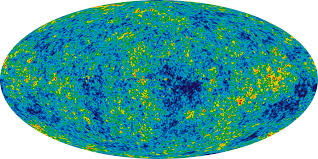
Cosmic background radiation. Image from Wikipedia.
However, in the interview with Dr. Segall, the representative for the Discovery Institute states that the public is finding their work helpful. Now, such a statement is interesting and may not be accurate. Data have demonstrated that churches that are antagonistic to science are causing young people to leave church. In a manner similar to “Release the tapes!” (see the 1972 Watergate break-in), places like the Discovery Institute and the Creation Museum never seem to release their data as well as how such data was collected when they make such claims. In other words, “release the data!” I strongly believe that places like the Creation Museum, the Ark Encounter, and the Discovery Institute more than likely do the exact opposite of what they are claiming. A good video which supports my thoughts is here. Just release the data and how the data were collected.

Science done well improves the human condition. Theology done well also improves the human condition. Our species and the planet always does well when science and theology inform each other.
And please read Matthew Segall’s Substack account. It truly is informative and excellent.
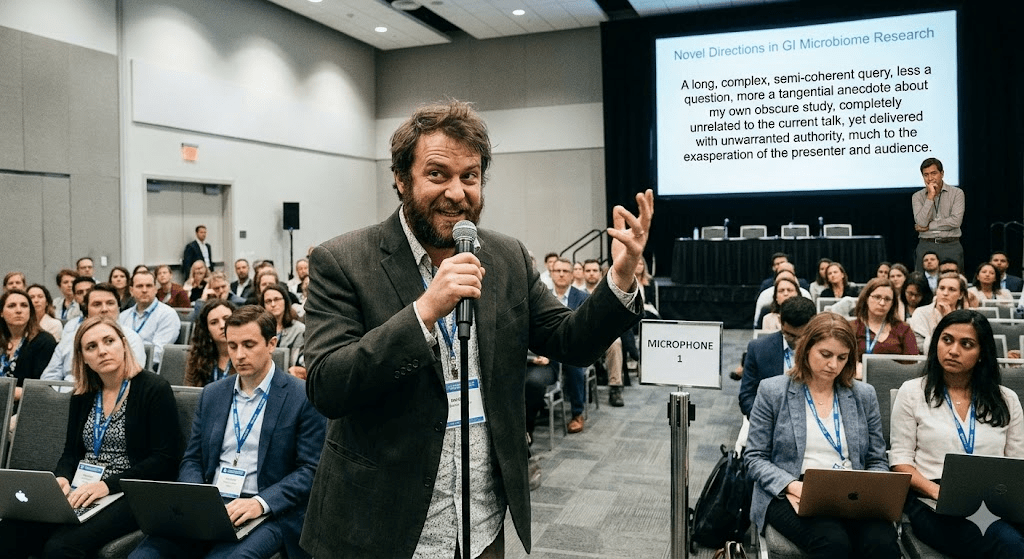
My AI image of “More than a comment, than a question.” Image made by Gemini Advanced.

