This past weekend I was a speaker / moderator / advice-giver at the 2nd year fellows’ conference for the North American Society For Pediatric Gastroenterology, Hepatology & Nutrition (NASPGHAN). NASPGHAN is the international association of all pediatric gastroenterologists from Mexico, the United States, and Canada. As background, a “fellow” is a trainee who subspecializes after residency. In the case of pediatric gastroenterology, a fellow spends 3 years in training (after a 3-year pediatric residency) before they can sit for their pediatric gastroenterology board exam and become an official pediatric gastroenterologist.
This year, I taught at the 2nd year fellows’ conference in Inverness, Colorado. I have taught at the first, second, or third year conferences something like 10-12 times in my academic career. It is always rewarding. This year, my talk was titled, “Balancing Work and Life?”. I have given this talk many times before. Basically, the lecture is about working as a pediatric GI fellow (which is a VERY hard job) while trying to balance life outside of work.
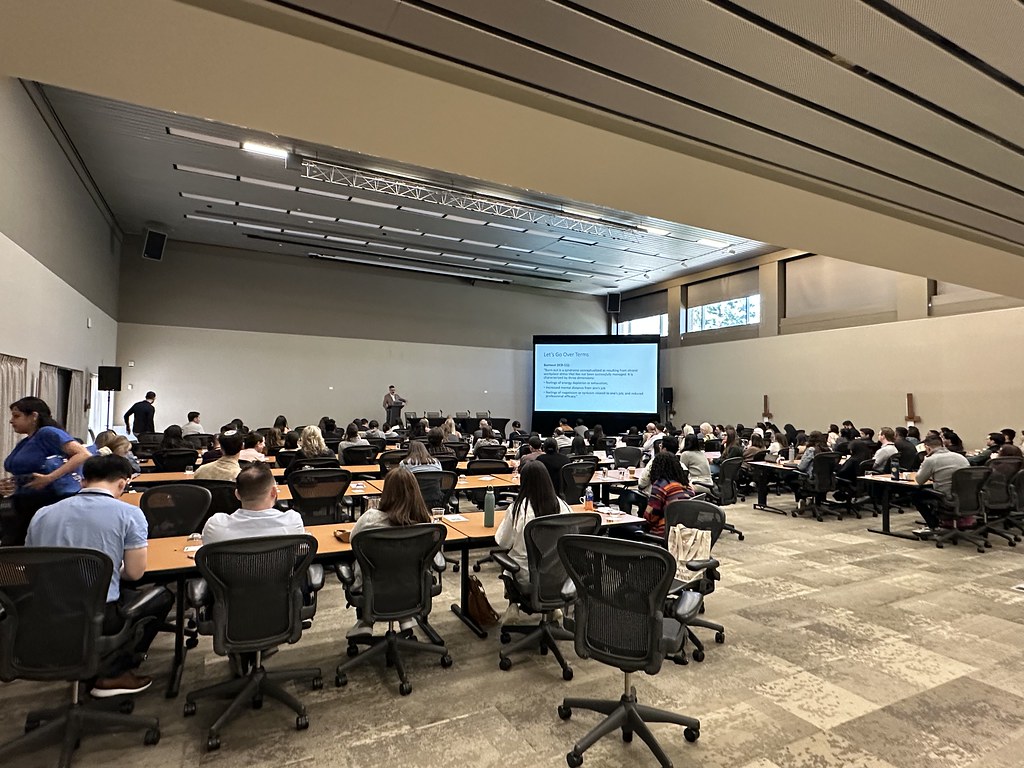
Me…speaking at the fellows’ conference this year
I added one slide to this year’s presentation. In the slide, I added the figure below which I made on Google Gemini.
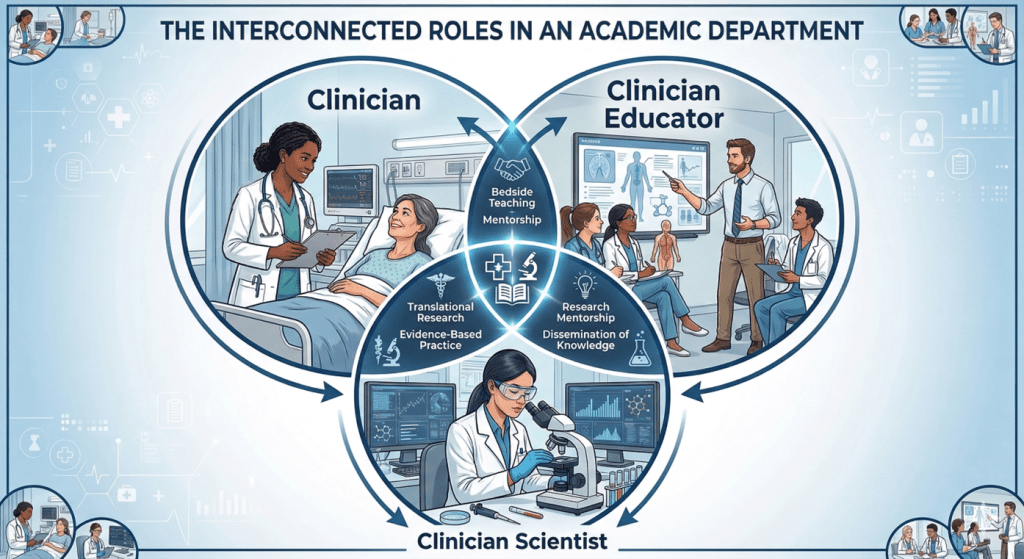
Academic medicine works best when there are 3 equal parts contained within it. The three parts are: 1) Clinical work (taking care of patients), 2) Clinical education (teaching medical students, residents, fellows, and even other faculty), and 3) Clinical and basic science research.
Think about what would happen if one of those interacting parts went missing. Medicine would suffer. In fact, medicine is currently at risk of significant deterioration (at least in the U.S.) when we think about how medical education has slowly been degraded over time. Medicine also is at risk of deterioration when we think about the massive reductions in NIH funding. Of course, clinical work declines when science in general has become less trusted in the United States with the horrible rise of the anti-vaccine movement as well as other problems.
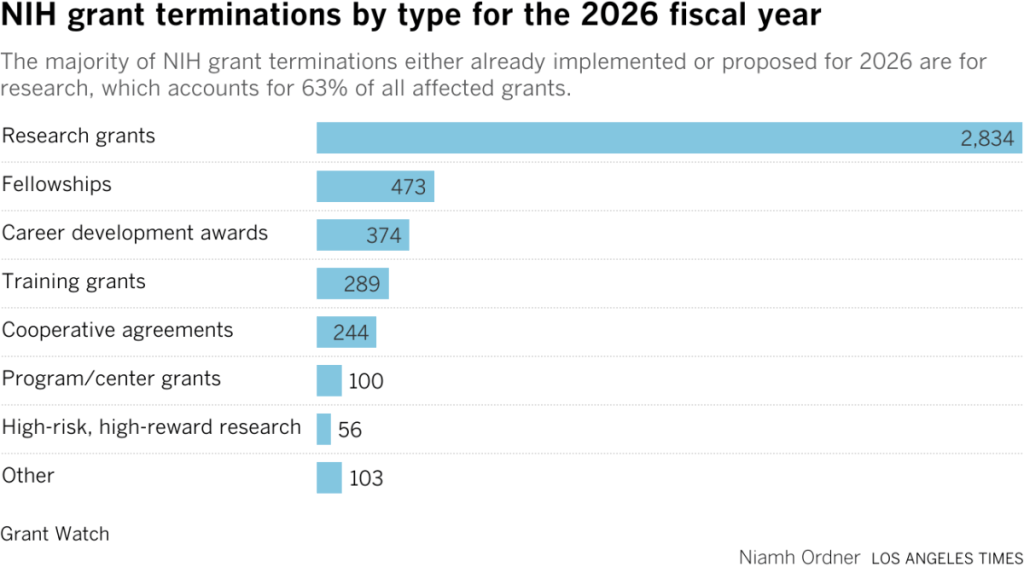
Graph from the Los Angeles Times
Thus, the 3 wheels of academic medicine (clinical, education, research) work best when working together like a well-run clock.
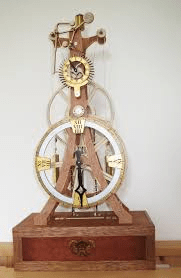
A three-wheel clock
Let us extend this idea to another realm? What about theology and specifically, what about the interaction of science and religion? Does a well-run clock metaphor work here? Absolutely. The problem currently is how viable this interaction exists when considering how science and religion currently engage with each other. There is no “war between science and religion.” This so-called war is quite silly as humans have always been objective (sensory based regarding the environment, science, engineering) as well as subjective (metaphysics, art, literature).
So…I have made this Gemini image for this post.
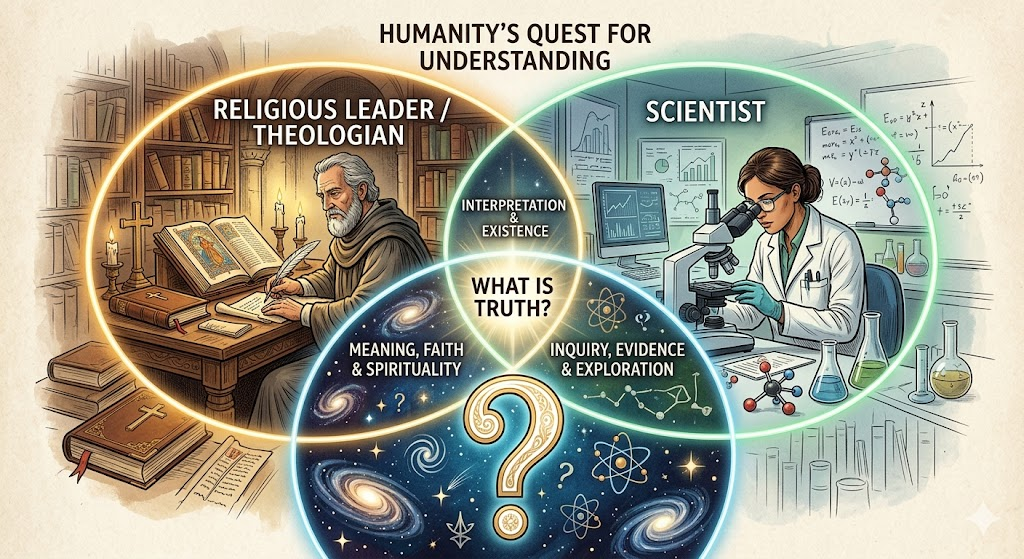
We need some kind of interaction between the real and ideal…between the objective and subjective…between science and religion. The problem with doing this interaction well is similar to the problem of doing academic medicine well. If one of the circles is not emphasized, the whole prospect of increased human understanding, cooperation, and love can be damaged. I put a “?” in one circle as I think one of the essential interactions of this model is currently missing in the world. Such resultant crippling effects can be seen in how terribly we treat each other when we try to make life difficult for people of different religious backgrounds, ethnicities, human sexualities, etc. Such crippling effects also can be seen when humans use religion to deny the importance of scientific concepts such as global warming, biological evolution, and miracle of vaccines. Finally, such crippling concepts can be seen in the setting of war.
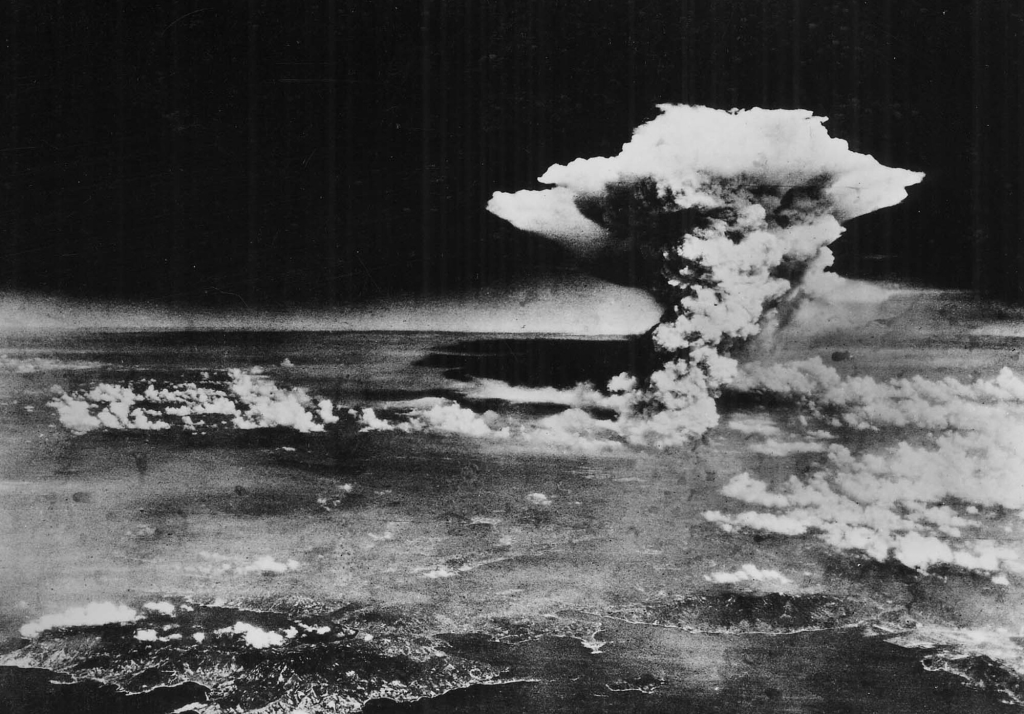
Atomic bomb at Hiroshima, Japan. Image from University of Pennsylvania.
Religious institutions that do not provide at least a minimal but accurate science education risk having their religious leaders or laity believing an inaccurate fact-based belief system as opposed to dealing with of the real problems of the world.
Scientific institutions that do not provide some education about the subjective belief of our species risk sounding pompous and uninformed regarding how most humans (not all, of course) want some type of divinity in their lives. This aspect also leads to an inaccurate belief system which blocks progress when dealing with the real problems of the world.
We need a good interaction here. Of course, some religious institutions are great at understanding science, and some scientific institutions are great at understanding that people are often religious.
What we need is better translational work between religion and science. Theology often can be helpful here, but theology is not helpful if the theology is poor. I believe that in the current political climate of our country as well as in many parts of the world, translating between these two spheres of thought is more needed than ever. There are people who work in this intersection of belief systems. I try to do work at this intersection — sometimes well, sometimes not well. These 2 belief systems are not diametrically opposed. They can be synthesized into ways which improve the human condition, the condition of other species, and the condition of our planet in many ways. Such synthesis can include:
- Advancement of science
- Improved funding of science / funding of science education.
- Improved education of non-scientists about the importance of science
- Improved education of accurate science
- Increased religious engagement with science to potentially improve the ethics of science
- Increased religious engagement with science to properly educate religious groups in the setting of a church, mosque, temple, or synagogue.

The album, “Hemispheres” by Rush. Even though the album was produced in 1978, the A side of the album still is very relevant today. Also, I am a huge Rush fan.
Perhaps this critical connection between science and religion, when done well, may be one of the most important things that our species should be doing currently. I don’t know. However, the pathways leading to potential disease prevention, poverty prevention, war prevention, and prevention of pollution or global warming all seem to stream mightily from this interaction.
 Phi-The-Sci: Equilateral Musings