Graduates from the Open & Relational Theology program at Northwind Theological Seminary do an on-line journal club every few weeks. This past week we read “Evolution: Like any other Science it is Predictable” written by Simon Conway Morris and published in Philosophical Transactions B. Luckily, this article is open access. Here is the link.
Dr. Morris is a widely known paleobiologist who has done groundbreaking work on the Burgess Shale which is a rock formation in the Canadian Rockies. The Burgess Shale is a geological area that provides immense information about the Cambrian Explosion which is when life on Earth likely began to diversify very rapidly.
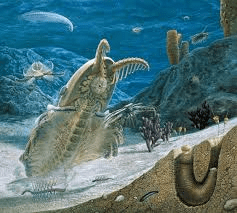
Cambrian Explosion — Image from Nature
Morris has written many articles and books. One of his interests is trying to determine if biological evolution has specific laws — similar to physical laws. Two aspects are to be considered here: 1) Do species become more complex over time? and 2) what does convergent evolution tell us about the potential of nature to repeat itself? His ideas suggest the potential for biological “laws” and thus perhaps concise mathematical statements about patterns in evolution and in life. There have been some attempts at making laws in biology such as Bergmann’s Rule.
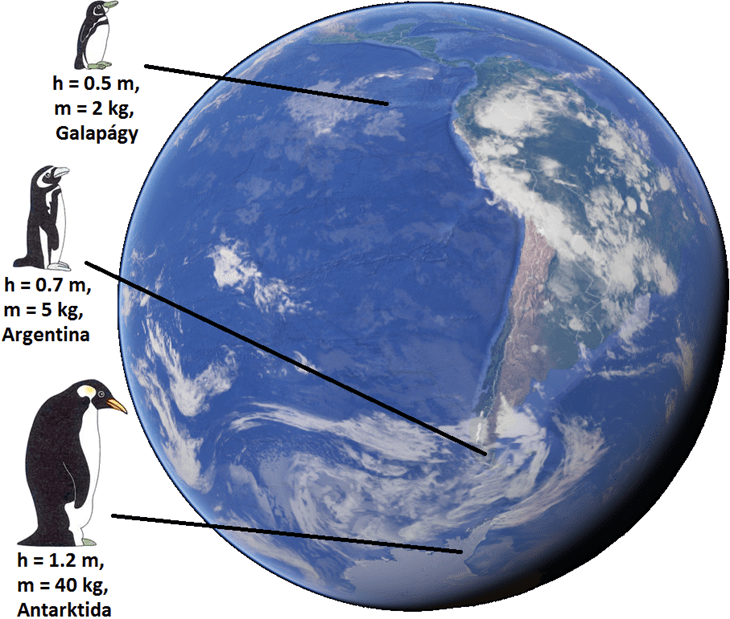
Example of Bergmann’s Rule — Wikipedia
You can read Morris’ RSTB article for yourself since it is open access. However, I found certain aspects fascinating.
A. Morris is a better writer than I am. Here is a main part of his thesis: “The basis of this view relies on the phenomenon of evolutionary convergence. This concept is, of course, not only entirely familiar to evolutionary biologists, but also provides
some of the strongest arguments in favour of adaptational explanations. However, much less appreciated is the ubiquity of this convergence, with examples spanning the entire biological hierarchy from molecules to social systems and cognitive processes.”
This statement is interesting. Basically, he thinks evolutionary convergence extends from biology but perhaps to social systems which could be part of group selection. Theologically, one could state his idea lends itself to God being deterministic.
However, consider the concept of Open & Relational Theology (ORT). When considering ORT, one is exposed to the idea that the future is open to God. God also is relational to all of nature. This relation is one of creativity, and this creativity encompasses all of its many forms, including the potential of evolutionary convergence. In my book, A Theology of the Microbiome, I discussed the theological concept of “lim Δ;” i.e., “a limit [lim] to change [Δ].” I state, “As an example, limits to creativity are observed throughout nature. God has the attribute of desiring eternal creativity while existing in time and in an open future. As part of this desire, God prioritizes nature’s freedom even if nature itself puts limits on its creativity.”
I think ORT and lim Δ work well metaphysically with evolutionary convergence.
B. Morris states, “Thus, when we consider the origin of the birds, the story of Archaeopteryx and its theropod connection, not to mention the spectacular
evidence of subsequent bird evolution in the Cretaceous…” We recognize Archaeopteryx as a dinosaur with wings and feathers, but did you know that birds already existed in the Cretaceous before the tragedy of the K-Pg event? Yes, Archaeopteryx (a transition fossil) and animals that we would recognize today as birds co-existed. Here is a good article explaining this discovery. The air was a niche space to be filled and was already being filled with insects and ancient flying lizards like the pterosaurs. In other words, evolutionary convergence has a long history.
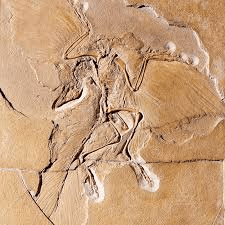
Archaeopteryx — image from Live Science
C. Another paleontologist that I respect greatly is Stephen Jay Gould. Gould did many amazing things in his lifetime, and similar to Morris, they both write like English professors when discussing science. Just brilliant. Gould believed that if one replayed the “tape of life”, different outcomes in life would occur. Personally, I think Gould’s idea makes perfect sense. However, there is some possibility that he is wrong.
Richard Lenski has a long and distinguished history of growing E. coli (the bacteria) over time and isolating subsequent colony generations from each other to follow evolutionary change. It is a long story, but basically he has found evidence that life, at least among bacteria, tends to repeat itself. He (and others) have found that when older E. coli generations are isolated and exposed to similar stressors (for example, exposure to citrate), the subsequent generations in general figure out a way to utilize citrate. They don’t die off. These isolated strains all proceed in a similar manner through their generations and through time. Good references to read are here and here. This evidence seems to point to the idea of convergent evolution. Bacteria are not charismatic megafauna, but the work of Lenski and others suggests the potential for evolutionary convergence and directionality occurring in larger forms of life. Perhaps God lures but does not force life to go in a certain direction?
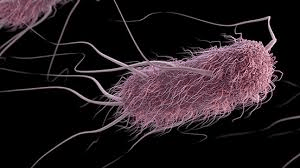
E. coli — Image from the CDC
D. Morris states “Just as the present evidence indicates a monophyletic
origin for animal musculature, so too the nervous system is restricted to the eumetazoans. Once again, however, we can see significant precursors that point
to a deeper inevitability. Thus, it is not particularly surprising to find among the sponges, which evidently lack any nervous tissue, a series of proteins that (with
some notable absences) are otherwise central to the post-synaptic configuration in higher animals (Sakarya et al. 2007). These proteins have been identified in a
distinctive group of flask-shaped cells and the fact that they display molecular mechanisms that are also the hallmark of neurogenesis…”
If evolution does eventually lead to a neurological system, then is evolution directed towards eventual conscious awareness? I have no idea, but it is fascinating to consider. Such a suggestion would seem to be metaphysical in context. In the setting of the theological (and philosophical) idea of “panpsychism” or perhaps “panexperientialism“, then all small droplets of experience might combine and lead to things such as human consciousness. The evolution to human consciousness would take probably millions if not billions of years as life comes out of non-life materials and biological evolution proceeds. If God is in the mix here, then panexperientialism (which I prefer to panpsychism) would be the effect of all of nature having some type of experience with the material as well as with God. Since God is in / around / through all entities (panentheism), the idea of all creatures communing with God and every entity communing with God would make sense.
Perhaps the idea of directionality towards an eventual nervous system and even consciousness matches what has been explained by Information Integration Theory (IIT). I don’t know.
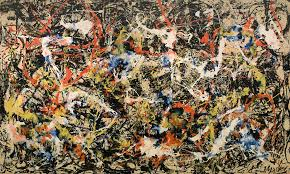
“Convergence”, Jackson Pollock
My conclusion: I believe in God, and I am a Christian. However, I don’t know if we can take the potential for evolutionary convergence or evolutionary directionality as evidence for God. I have no clue. I worry that humans are built to look for patterns — perhaps we see a pattern here in biology (expressed by Morris) that does not exist. For example, we think we see patterns in the art of Jackson Pollock when they really may not be there.
However, Morris’ ideas are fascinating from a scientific, philosophical, and theological perspective.
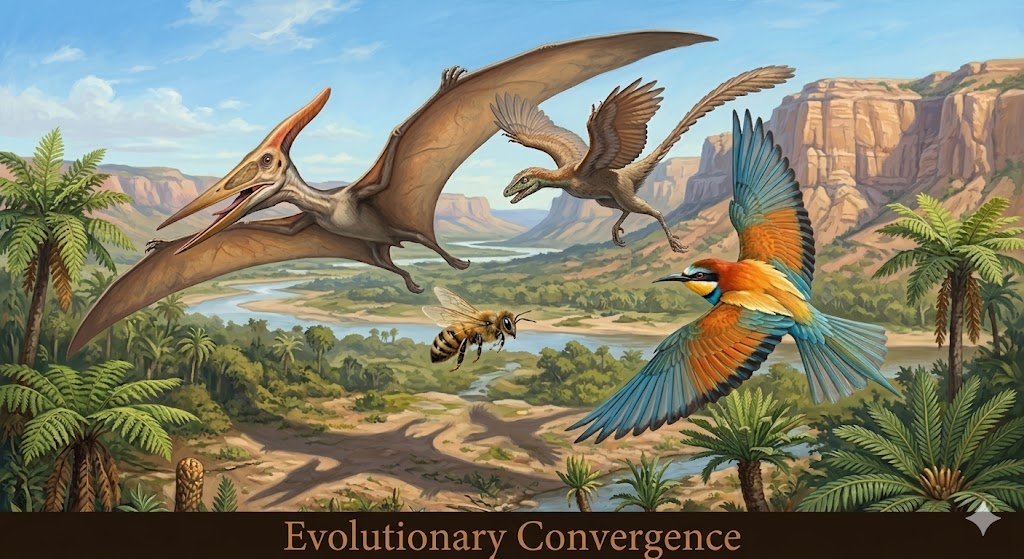
Image generated by Gemini Advanced

