This week, I read the Ryan Burge Substack post titled “The Two Dimensions of Religious Belief in America.” This is a good Substack to follow, by the way.
In the post, he looked at data from the Pew Religious Landscape Study to see how Americans tend to look at their faith from an overall view. By an “overall view”, I mean he looked at the very basics of faith. You can read the post to see how his statistics were obtained.

The “10,000 foot” view
As someone who has done some survey research myself (not with the same expertise as Dr. Burge), I do realize the limitations of getting accurate responses, at times, from surveys.
The full article is behind a paywall. I would recommend paying for access. However, to summarize… It seems that Americans fall into 2 big categories: Those who are very doctrinal (i.e., absolutely sure God exists); those who are existential (i.e., may certainly believe in God but have lots of questions). Existential — Me, me, me!
His findings show that although Americans are becoming less doctrinal and existential over time and thus less religious (again, you have to trust the survey), the younger generations in our country are drifting into more existential beliefs.
The weird thing is that the existentialism is occurring in groups that I would not expect to be thinking in such a way — for example, Latter-day Saints, Jehovah’s Witnesses, and Muslims. That being said, my Muslim friends are fairly existential so I speak from ignorance when I state I am surprised. I’m not a Latter-day Saint, but I live in Utah. I often am surprised at the number of my Latter-day Saint friends who are very existential in their beliefs. Again, I speak from ignorance.
The other interesting thing that he found in his study was that people who are more religious (such attending church services more frequently) tend to be more existential than doctrinal.
What do I think? I am starting to believe that world religions are not going away but are changing dramatically. I base this opinion strictly on what I am seeing in Utah where the LDS faith is really changing. However, such disruptions have been noted on the world scene. See here and here.
Perhaps some of these changes are based on what we see when we look at data on the “nones.” Most nones believe in some type of ultimate reality. Understandably, the ultimate is and should be poorly defined. The hardcore orthodox no-change-allowed religions are declining. The hardcore “new atheism” ideas are declining. I do think new ideas are sprouting in theistic and atheistic crowds that are not so combative. I am 100% willing to admit I am wrong.
Why is there change? I made this list.
Social media: I hate social media although I am on it. However, a benefit of social media is that it is making the world “smaller” with people’s exposure to other religions.
Mixture of cultures with migration: I think this is a good thing. I enjoy exposures to other cultures that are healthy.
AI: I’m not an AI doomer who thinks we are going to end up with a Terminator future. I think AI will provide exposure to other belief systems far more than even social media does currently.

Evolution: There is no “religion gene.” There is no on/off gene for complex ideas like religion or philosophy. However, we may have many, many genes working together in a complex manner that make humans necessarily religious most of the time. I would emphasize “most”, not “all”, because religion is not always beneficial. See here and here.

Epigenetics: Culture surely is an epigenetic phenomenon on a grand scale. Religion could be epigenetic. Religion also could be just an accident in human evolution that has no adaptationist advantage.
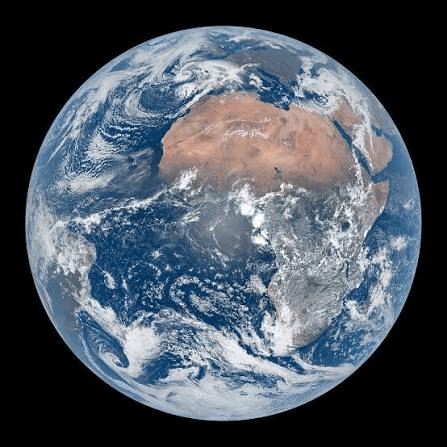
Science: It is very clear that as we learn more and more science, our view of divinity changes. As a simple example, think about how ideas surrounding God have changed as we have gone from thinking about 1) the Ptolemaic idea of the Earth to 2) heliocentrism to 3) the single-galaxy universe to 4) now knowing that we live in a universe (at least, the observable universe) with billions to trillions of galaxies. Quantum mechanics has changed how we think about God. Modern medicine has changed how we think about God (we are living longer and not as exposed to death). Unfortunately, military science has changed how we think about God.

I have no idea where all of this change is leading to. I do think, however, that we need to recognize this change and to start coming up with new ideas to help our species land in a relatively good position for long-term. H. sapiens is very warlike which is a tragedy. Maybe we can use the tools of change in a positive way to make our future metaphysics more peaceful and loving.
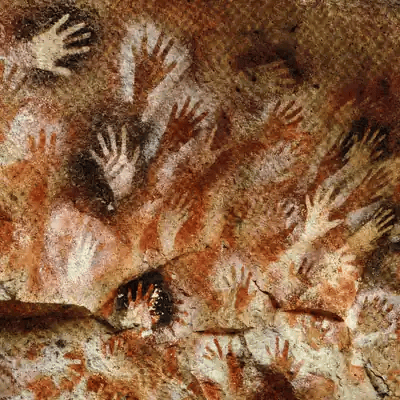
Cueva de las Manos, Río Pinturas

