It has been a while since I last posted. Honestly, life has been hectic. I have a job that understandably takes up much time. I also had to go back to my mother’s house in Texas to clean out some things for her. Early fall in Texas is basically the Sahara Desert in regards to the heat, and my working in her garage for a few days wore me out.
While I was there, I picked up a few items for safekeeping.
The biggest things that I kept had to do with my father. He died in 2015 due to a car accident in the setting of dementia. He had suffered from dementia for probably over 10 years when I look back at it. It took me some time to work through his death. He was a very well-known military historian in the United States, especially in the 1980s and 1990s. It was terrible to see his decline especially since he was a loving husband, father, father-in-law, and grandfather. He lost not just cognitive ability over time but also his emotional control. These difficulties have haunted me for many years, and I bet there are readers who have experienced similar things within their families.

Texas State University – San Marcos
I DO remember my father at his peak — always interesting, always funny, always protective of his family with all its mainly positive but sometimes negative aspects. I loved the man.
As I cleaned out his last remaining boxes of various items, I found letters that I had always heard about. My father had correspondences with Francis Crick, C.P. Snow, and James Michener. Some of the letters were quite short; some were rather long in his lifetime.
Here is a letter from Francis Crick. The story goes that my father heard a radio broadcast or perhaps a TV interview in which Crick was disparaging about the study of history. My father got it into his mind that he should write Crick to correct him of his error here. The study of history is profoundly important. The reader may know that Crick was known to have a prickly personality. He wrote my father a short letter back (1992).
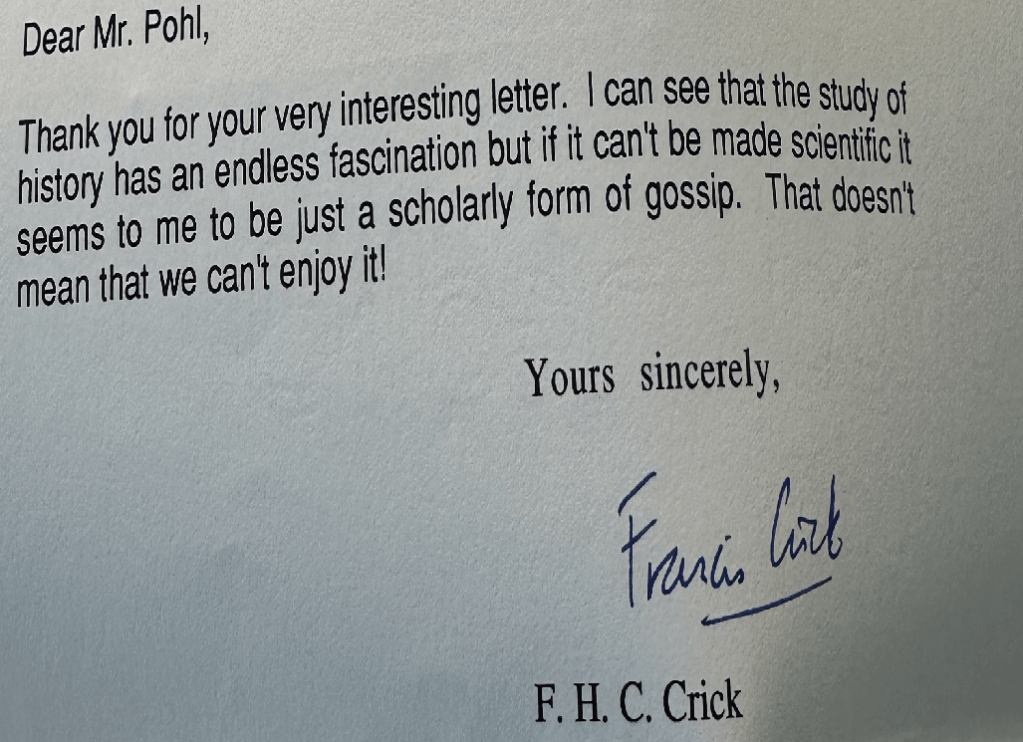
The funny thing is that my father was not offended. Crick called my father “Mr.” knowing full well that he was a tenured full professor. It was hilarious! My father told me, “I’m not insulted! I got a signed letter back from Francis Crick!”
Then there was C.P. Snow.
It is a long story, but C.P. Snow was invited to give a talk at my father’s university. I have written about this visit before in God and Nature Magazine. Afterwards, Snow and my father carried on a long letter correspondence as this was a time before email.
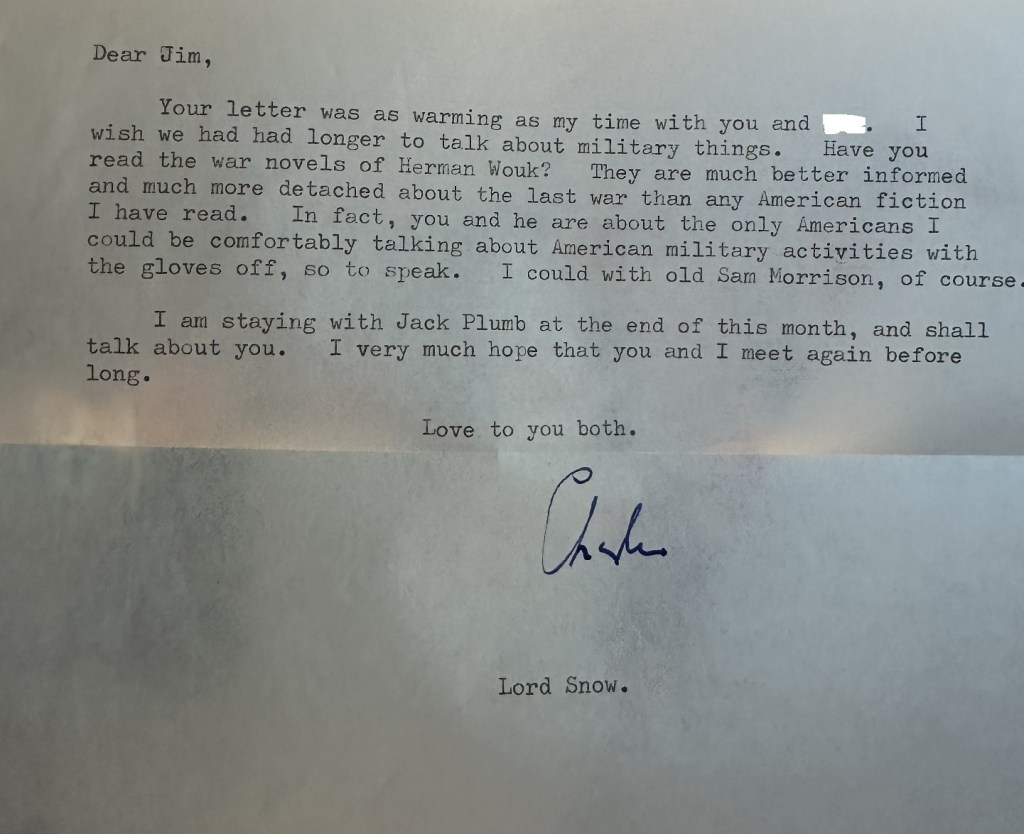
Even though he was “Lord Snow” at the time, C.P. Snow still signed his correspondence to my father as “Charles.” I love that.
I also found my father’s oral history which has been preserved at his university’s archives. The oral history project isn’t available online yet, but my father had saved a paper copy which I read through and took home.
I knew quite a bit about my father, but I DID NOT KNOW that he wanted to be a historian of science initially and not a military historian. However, he apparently was quite gifted with military history when he was getting his PhD, and that is the direction he went for career. I do find it interesting that much of his historical work had a science-y flavor to it (gallons of fuel, tons of ammunition, angles of army maneuvers, exact timetables).
My father and C.P. Snow (from https://godandnature.asa3.org/pohl-third-culture-in-church.html)
I guess all of these things make me think of the ideas contained within process philosophy. I like to think of this process as the multitude (perhaps infinitude) of past events coming together (a “concrescence”) into a single reality (an “occasion of experience”) in real time. That moment of reality then becomes the past which is part of the multitude of past events which affect all future events. Time is essential here.
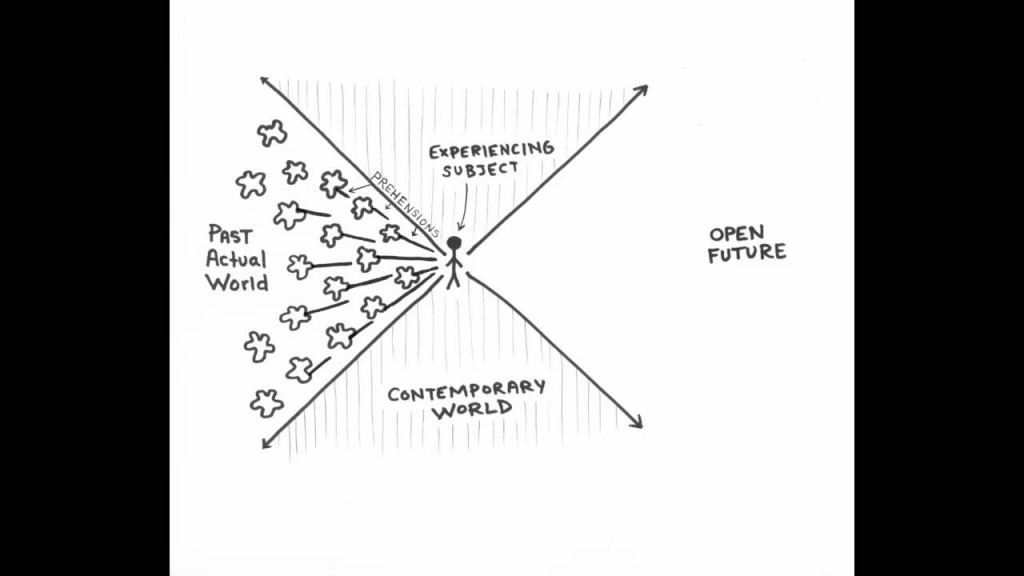
Image from Open Horizons (https://www.openhorizons.org/twenty-key-ideas-in-process-thought.html)
Now that I have my theology degree, I have come to look at so much of life — joys, tragedies, successes, failures — as simple points of experience that become part of one’s background as one moves forward in time and in life. I believe this idea is much more true than any idea of a static reality.
It was nostalgic to find all of these old letters as well as my father’s preserved oral history. These small things influenced his life just as much as these letters and my father’s life have influenced me.
In keeping within the ideas of process theology, I do think God lures for us to be creative. God does not force but instead desires or wants us to be more loving / caring / creative / novel. In my father’s case, I think this lure was exemplified by how much his students loved him (he received many teaching awards). I think this lure was exemplified by how he treated his family. He was never perfect, but he was a damn good man.
I’m hoping some of that lure continues to persist in me.