I apologize about the delay in blogging. I was on an extended trip to Ireland. I would like to say that I was being very cultural and immersing myself in Ireland’s rich history (I did quite a bit of this), but I really went there for a college football game in Dublin.
What I always appreciate about Europe, including Ireland, is its rich and very old history. The United States where I live is such a young country, notwithstanding the ancient presence of Native Americans in North America which is incredibly important.
I want to talk about some old artifacts (one quite ancient) that I saw in Ireland.
In Galway, I visited Saint Nicholas’ Collegiate Church which was built around 1320. Although now a Protestant church, it has an amazing array of overlap in its Catholic and Protestant history that still exists today. That overlap should be a blog post in itself.
While at the church, I visited its graveyard. I like visiting old graveyards simply as a reminder of one’s mortality. Some of the graves at Saint Nicholas’ Church were centuries old. As a result, the grave markings and headstones often were very eroded to the point that the words on the grave markers were very eroded and difficult to make out. Some of the graves, I assume, had completely dissolved away through time.
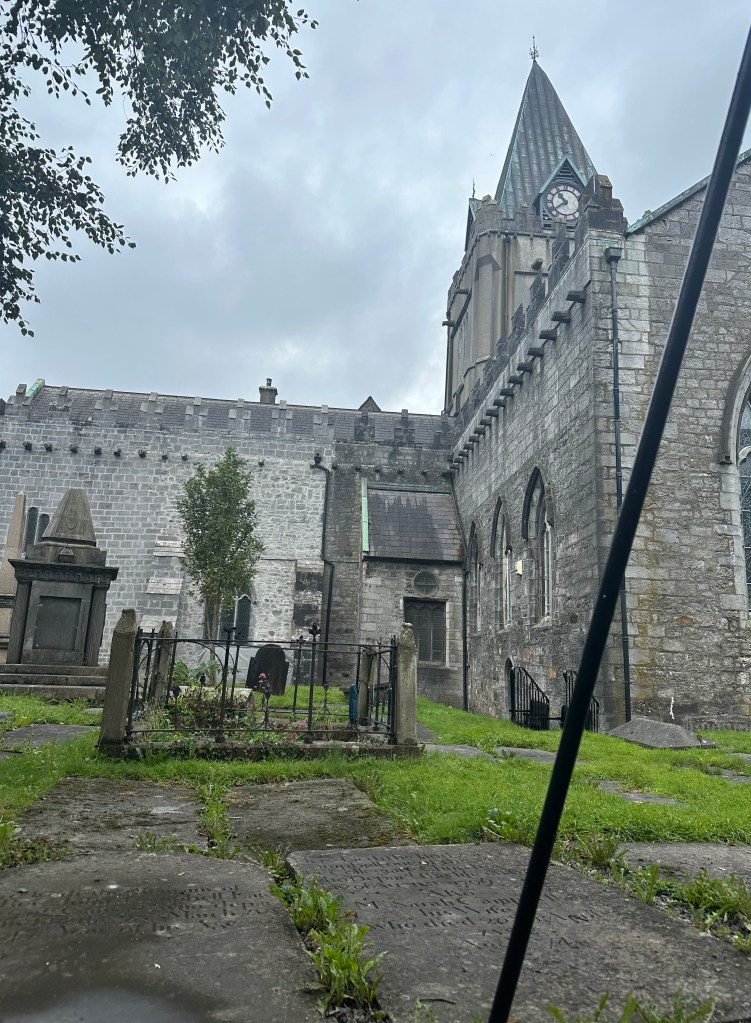
A picture from the graveyard behind the church. You can see the weathering on the headstones.
The other place that was interesting was my visiting of the geology building at Trinity College in Dublin. I was on a tour of the university (highly recommend), and the first floor of the geology building had a few fossils and crystals. One of the fossils belonged to the Ediacaran Period (around 635-541 million years ago). The Ediacaran Period existed before the Cambrian Explosion. Some people playfully consider this time period a “Garden of Eden” as it is very unclear what type of predatory behavioral was occurring during this stage of early life on the planet. Helpful references are here and here. I also recommend this well-written book.
Specifically, I was looking at Charnia masoni which I think is the first Precambrian fossil ever to be recognized.
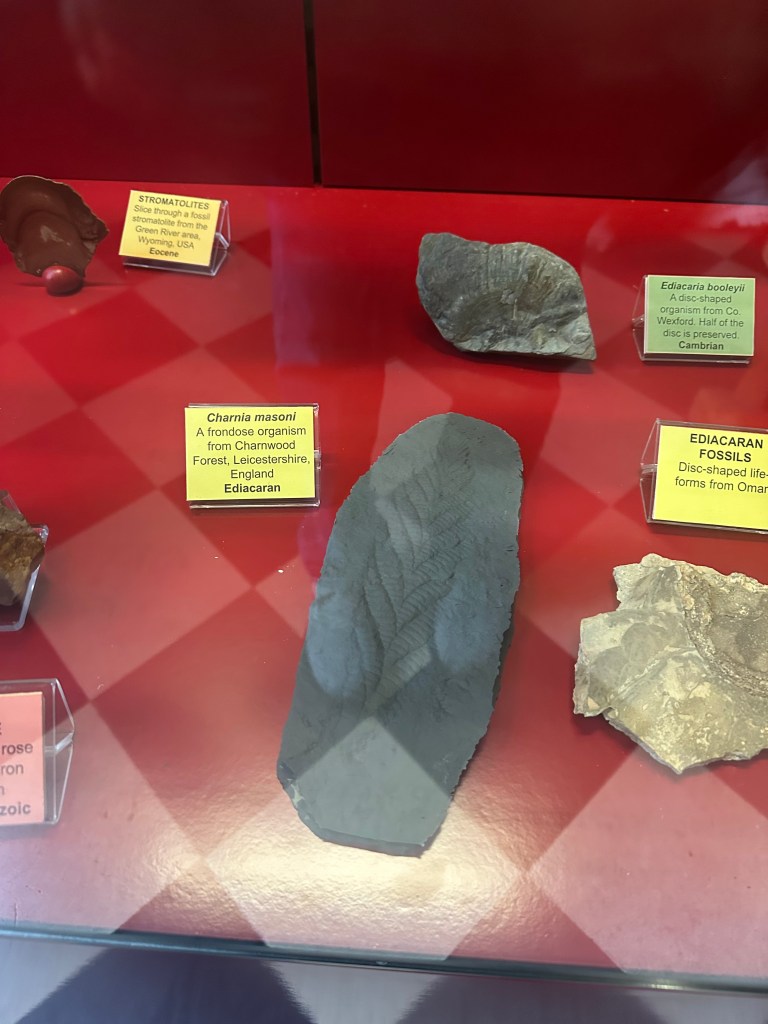
The Ediacaran fossil (Charnia masoni) that I saw at Trinity College.
My understanding is that Charnia sp. probably were very ancient animals. They stuck to the ocean floor and used their “fronds” to filter feed. These animals eventually went extinct, and the cause of their extinction is unclear.
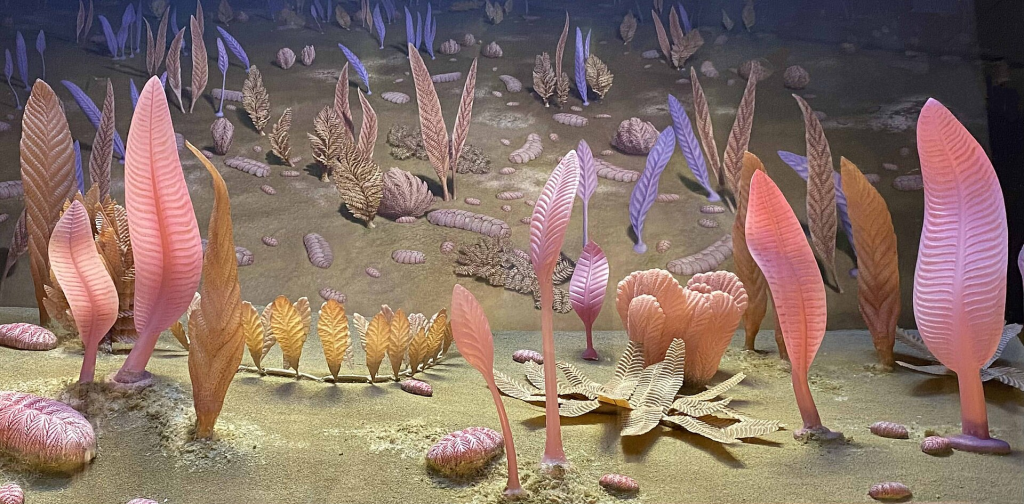
Charnia diorama, from the Smithsonian.
Can I make some sort of metaphysical connection here in the setting of the church graveyard and with the Charnia fossil? Perhaps. I have come to think that the persistence of experience is an essential part of nature. I’m not talking about the possibilty of an afterlife or ghosts. I’m stating that there is always experience throughout nature and throughout time.
From the first nucleosynthesis and star formation in the early universe to progressive entropy potentially in the setting of dark energy expanding our universe forever, there is always some type of experience. The universe experiences all such things.
I’m also not talking about consciousness necessarily. Yes, animals such as H. sapiens have consciousness, and experience contains consciousness. In this setting, I am simply discussing experience.
Perhaps I would agree with Friedrich Schelling that experience is an essential part of non-rational nature. Schelling would probably say this “ground” leads to self-manifestation; I would argue that the “ground” is experience itself. Experience is always present — everywhere and in real time.
So, I (John) experience in real time. I experience in my short life span as the universe experiences. Basically, the universe experiences me, and I experience it. I will die, but my life on this little planet will be a part of the overall experience of the universe.
I also think that most phenomena in the universe only experience for a short period of time compared to the universal whole. Animals don’t last forever. Plants don’t last forever. Stars go away. Perhaps there are some exceptions such as protons and black holes, but knowledge is limited here.
Black hole image from the NASA Jet Propulsion Laboratory
In the setting of my trip to Ireland, I saw two entities that demonstrated the short-lived experience contained in the expansiveness of all creation — a graveyard and a fossil. The people in graveyard once experienced life in Ireland. The Ediacaran fossil once experienced life in an ancient sea.
When I walked the grounds of the graveyard and saw the Charnia fossil, I wondered if my walking through the graveyard and seeing the fossil was a continuation of this experience. I experienced the names on the grave markers. I experienced seeing an extremely rare fossil. Did the graveyard and the fossil provide a continuation of experience from the past, even from the distant past? I think so, mainly in the setting of my senses (touch, sight).
Experience: It exists. I don’t know if we can scientifically prove that experience continues throughout time. Also, I don’t mean immediate experience. I mean a long-lasting potential for experience of all entities to continue in certain settings. The universe or overall nature always experiences. We get to be a small part of this experience.
The entities contained within the universe / nature have the possiblity of experience to continue. Is this panexperientialism? I think so.
There also is potential for our limited experience. I had the potential to eventually walk in an Irish graveyard. I had the potential to see a fossil that was hundreds of millions of years old. I could have missed my flight to Ireland. I could have just forgotten to look at the graveyard. The Charnia fossil was somewhat tucked away in a display. I could have skipped over it. I just happened to see it and experience a small bit of what early life on our planet was like. This ground is not dumb luck or synchronicity or determinism or human free will. This ground is experience itself as well as the potential for experience.
Readers of my blog know that I work in the area of process theology and open & relational theology. As a potential part of my genetics / epigenetics / upbringing / society / culture, I obviously will put a theological pin into the cause of this ground.
However, if you think about it, experience can be ingrained in nature and does not need God for it to be important.
I need to think more about this subject.
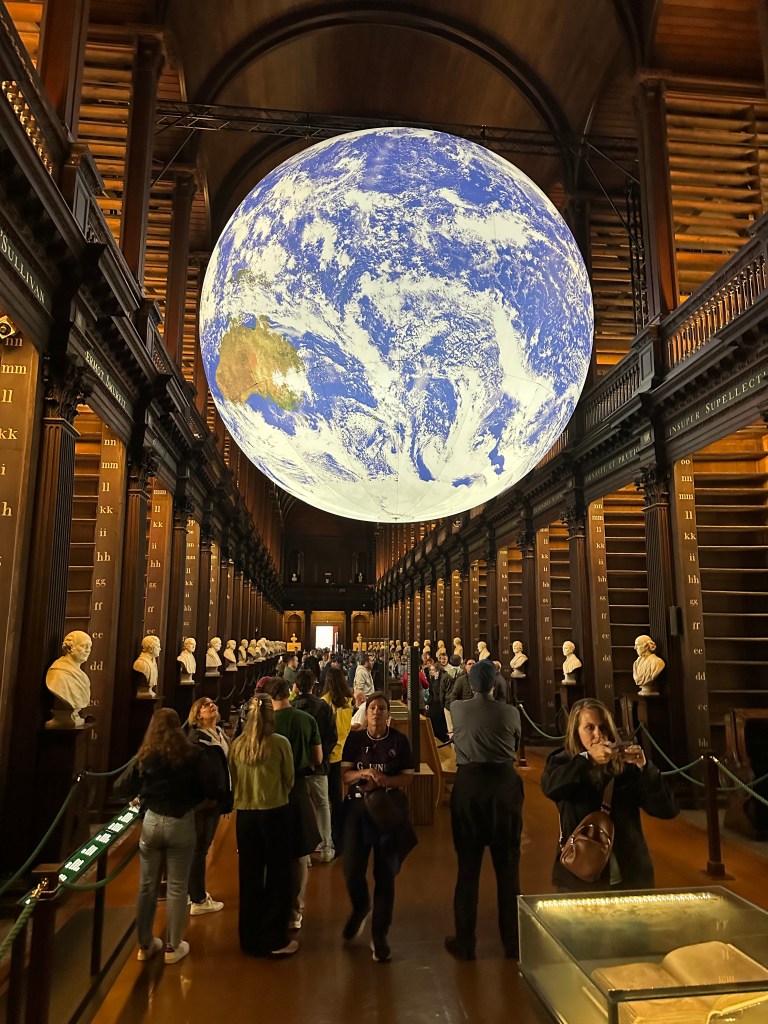
The Long Room at Trinity College with the Gaia installation. A quite beautiful part of campus.
 Phi-The-Sci: Equilateral Musings