I returned last night from Theology Beer Camp 2026 in Kansas City. The event was held at Pine Ridge Presbyterian Church, which is a wonderful facility. Theology Beer Camp itself was a 3-day event preceded by a 1-day pre-event conference on Open & Relational Theology. I was a newbie to the whole beer camp thing, and I really enjoyed myself. The beer provided by local microbreweries was absolutely fantastic. I would recommend going to this event in the future if the reader has the ability to do so.
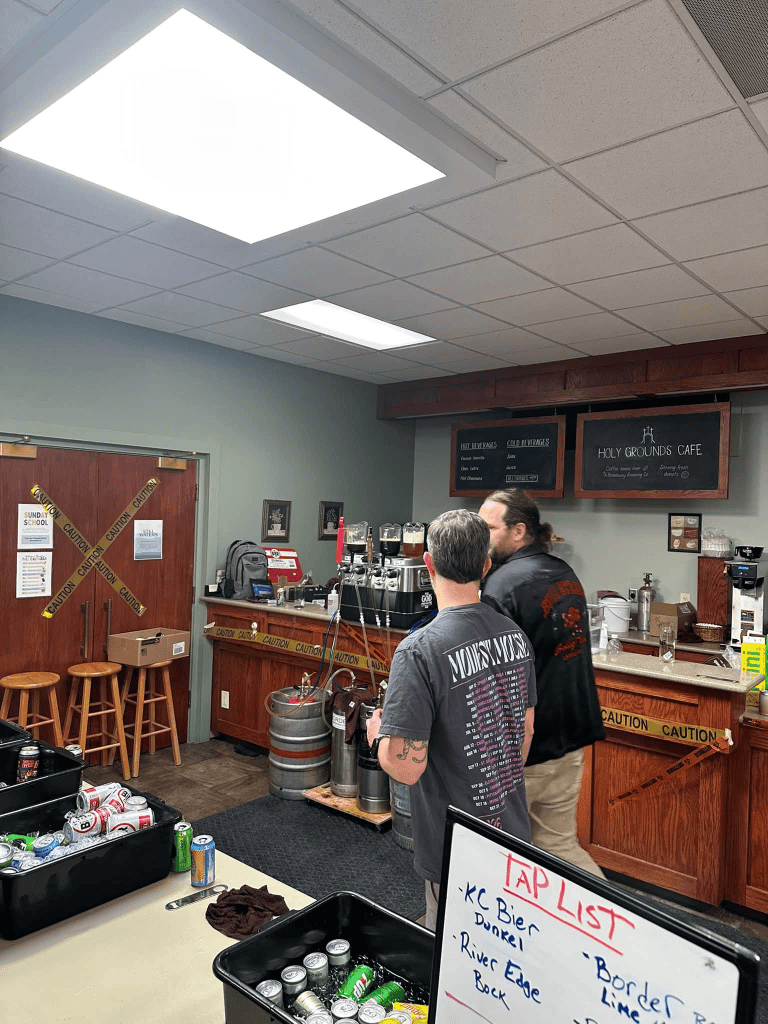
Wonderful local microbrewery offerings at the event
In this blog, I thought I would put down a few concepts that I heard during Theology Beer Camp / the Open and Relational pre-event. My list of concepts is not exhaustive. These are the ideas that I found fascinating / intriguing / motivating.
A- Jonathan Foster had a wonderful quote that I wrote down during his talk at the pre-event: “Love is patient; anti-love is impatient.” He is a good follow on Substack, by the way.
B- During the pre-event, there was a discussion as to if creatio ex nihilo makes sense in the setting of 1) eternal creativity / novelty as seen in process theology and 2) eternal creativity / novelty through love as seen in open & relational theology. In this setting, God would have created the universe out of nothing with “nothing” being very poorly defined. I have posted about my problems with creativity and novelty in the setting of denying creatio ex nihilo in the past. Really, my problems are minor. Simply put, what we observe is refined over time in the setting of science. Examples include the progress made in the known realities of biological evolution, quantum mechanics, cosmology, and the spectrum of human sexuality. On the other hand, what we cannot observe also can be refined over time, but lack of observation invites a spectrum of subjectivity. Examples include angels, demons, heaven, hell, the multiverse, cyclic cosmology, and string theory. Some of these ideas listed that cannot observed also may be extremely valid and should be studied; some may be more steeped in cultural intermixing of myths. I cannot go beyond creatio ex nihilo without some clear evidence from the field of astronomy. At this point, the multiverse and cyclic cosmology are interesting theories based on zero evidence. I am willing to change my mind here, of course.
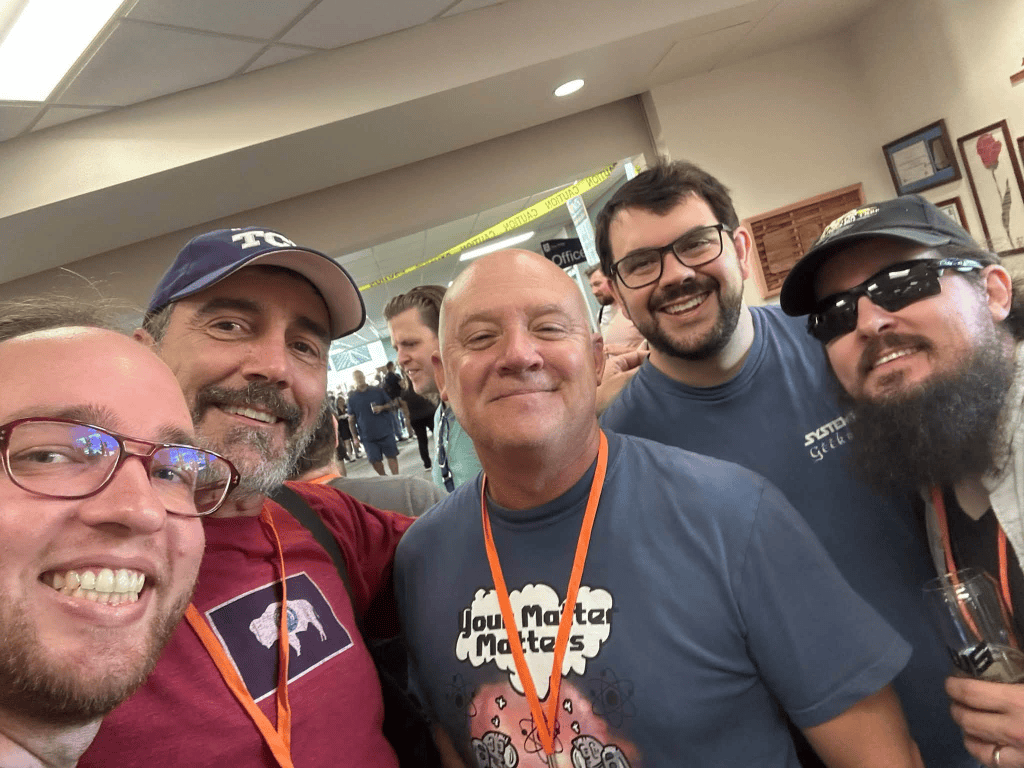
Hanging out with old and new friends
C- During a main stage talk titled “America at 250: The Genealogy of Religion’s Dissent”, the speakers Bill Leonard and Diana Butler Bass emphasized something that I have found problematic in much of American Christianity. Specifically, U.S. politics and its dangerous mixing into religion is now even a bigger fight than how we baptize Christians. Baptism fights have always been dumb; political fights in Christianity (“Are you a Republican?” or “Are you a Democrat?”) are even dumber.
D- I learned about Primitive Baptist Universalists located mainly in Appalachia. Wow, the spectrum of Christianity is surely fascinating!
E- Reportedly Samuel Beckett’s favorite word was “perhaps.” Now, chew on that idea for a while when considering process theology and open & relational theology.
F- Cornel West. There is not much to say here. He is one of the best speakers that I have ever heard. Even if you do not agree with him theologically or politically, his ability to have a crowd pay attention to him is nothing less than amazing. I wrote down a few of his quotes from the conference.
“Courage is a prerequisite for love.”
“The history of Christianity is of one organized greed and weaponized hate.”
He also made some good points about Plato’s influence on Christianity in the setting of Plato being a slave owner. In other words, Platonic writings and their influence on Christian thought is based on a historical figure (Plato) who was wealthy and owned slaves. Plato was a far cry from Jesus. I like to read Plato occasionally so I am going to have to remember this aspect.
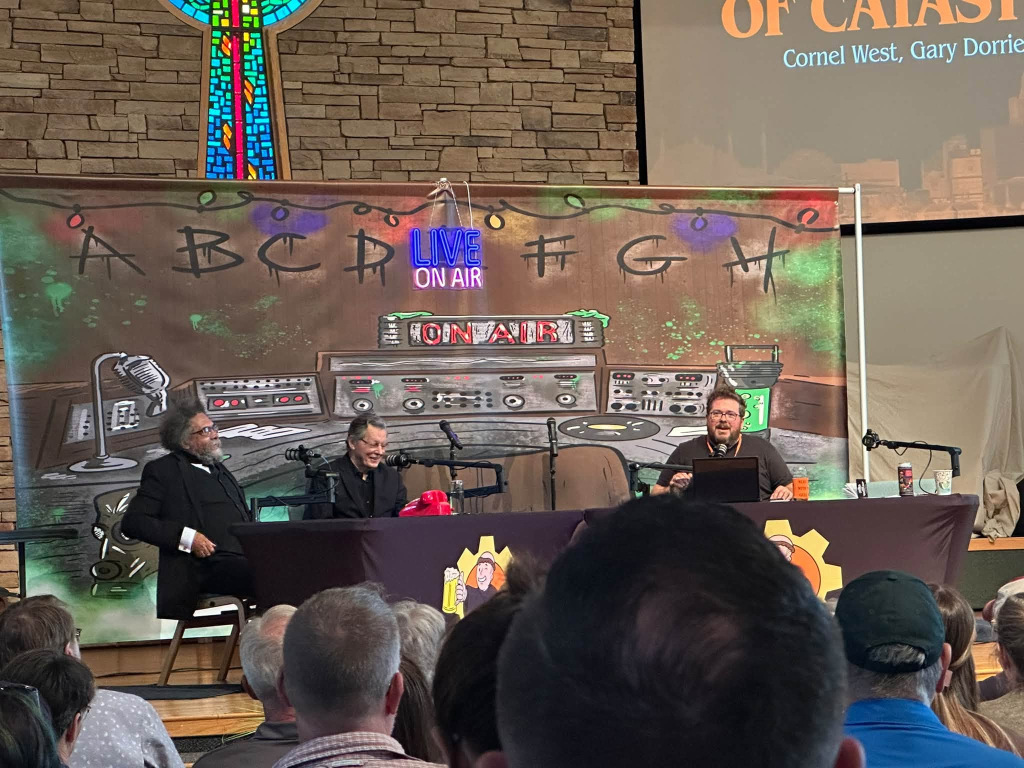
Cornel West and Gary Dorrien speaking (moderated by Tripp Fuller)
G- Ilia Delio, the Franciscan sister and theologian, also gave an amazing main stage talk.
She thinks we are entering a second Axial Age likely due to social media and AI. This sounds interesting, but the whole idea of an original Axial Age is controversial.
“We went from orthopraxy to orthodoxy.” This is a great Delio quote as she emphasized that the love of the “other” is slowly being de-emphasized in many quarters of Christianity today. Further, she emphasized that 1) ancient Greek thought, 2) the Augustinian interpretation of “original sin”, and 3) Constantine’s incorporation of Christianity into the state apparatus have caused much of Christianity to lose its way. I very much agree with her.
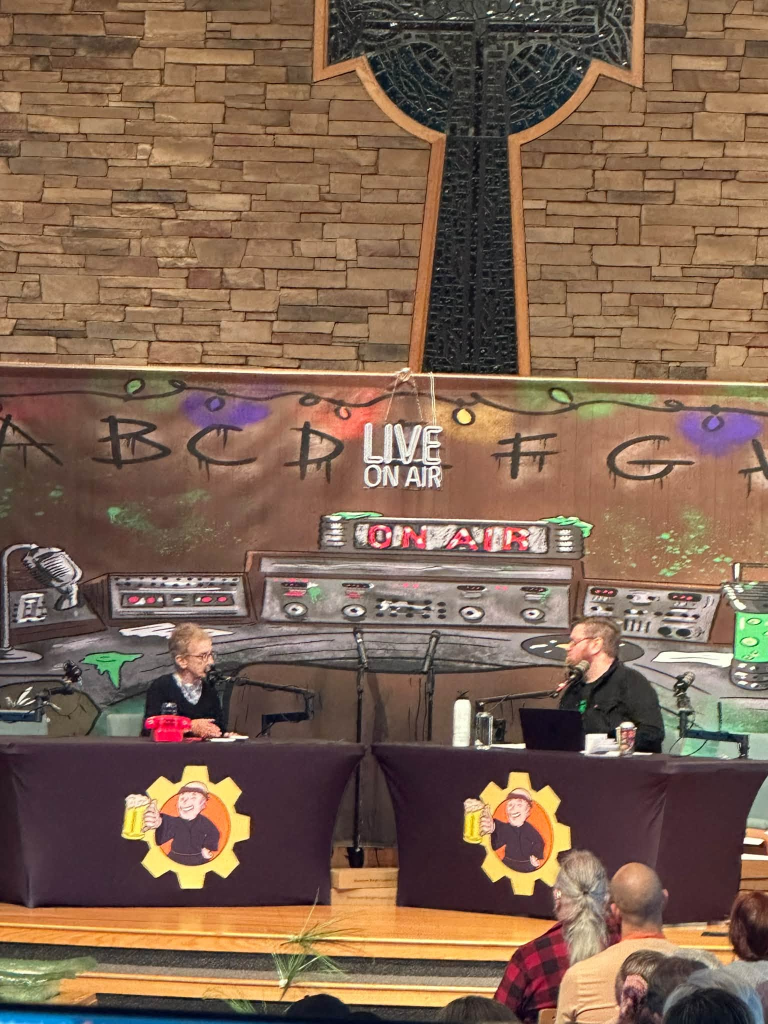
Ilia Delio talk moderated by Dan Koch
H- I went to a talk about Reinhold Niebuhr. It was very interesting as he is a theologian with well-documented good points and bad points. In other words, I think it is helpful when we can all be shown to be simply human, even if we are great theologians. As I listened to the talk, I could not help but find a parallel between his ideas of Christian realism and the absurdism movement when it came to when and where force for social ills should be applied. It seems that inconsistency abounds here…but that is just my opinion.
I- On the last day, I went to a conference on how to preach about process theology in church. I’m not a pastor, but I have given sermons in the past when asked by clergy. I came away with the helpful idea that many pastors, ministers, etc. know what process theology generally is composed of and how it can be helpful. The laity, however, have no clue about this subject. A bridge is sorely needed here.
J- In a prior Substack post, I stated that my good friend, Chris Hanson MD, and I gave a talk at the event on why Christians should consider childhood vaccinations a gift from God. On the same day as our talk, Westboro Baptist Church protested outside our church building. Weird coincidence. Westboro appears to not be experiencing God’s lure for the good. I said a prayer for them.

Westboro protesters. They weren’t very nice.

The light cone. Perhaps one of the best metaphors for process philosophy and process theology. Image generated by Gemini Advanced.

