Quick Note…I will be speaking at IRAS

Hi guys, just a quick note.

I will be giving a talk at the Institute on Religion in an Age of Science this Wednesday 5PM EST, 4PM CST. It is free to attend on line, but you have to register. 
https://starisland-org.zoom.us/webinar/register/WN_KZRy4193TSm74JeaegFLzw#/registration

Information about my talk is below.

God in Time

I’m going to link to my recent book again (“A Theology of the Microbiome“, SacraSage Press). I do this 1) because I write about these issues in detail in the book and 2) I need to market the book (right?).

In my book, I go into detail about process theology which is a theological model that I very much find matching to the natural world around us and in us. One of the better things about process theology is that science is good. All science helps us understand God in real time since God contains nature, and nature’s actions are not controlled by God.

As such, God is involved in the world prehensively (present in all occasions in real time), panentheistically (encompasses the universe and all entities through time), and panexperientially (experiencing all).

In many ways, a cousin / derivation of process theology known as Open and Relational Theology (ORT) probably appeals to me more since (in this theory of theology) God can lure for creativity while never actively demand or forcing change. This lure for creativity is a “divine lure” or an ever-present lure by God for creativity. I define such a lure for creativity as a “lure for the good” or “lure of God’s love.” See the amazing work from Thomas J. Oord about ORT.

Also and in my book, I use Stephen Wolfram’s ideas of cellular automata and hypergraphs to explain change throug time. Wolfram is a great writer who I respect very much from a philosophical and perhaps metaphysical perspective. Wolfram’s ideas are mathematical and have theoretical physics implications. They definitely are not theological, but Wolfram’s emphasis of time flow in reality has always been striking for me when considering process theology and ORT.

I am going to comment on his recent essay, “On the Nature of Time.”

One issue that Wolfram points out is that we describe space and time as “spacetime” (per Einstein). Space and time are necessarily together. This is true as far as we know now. A good review of spacetime described by the journal, Nature, is here.

Curvature caused by the Earth in space time (image from freeastroscience.com)

However, we feel time. Time seems to flow.

Per Wolfram’s recent essay: But ultimately the progress of time is always associated with some choice of successive events that “computationally build on each other”. And, yes, it’s more complicated because of the possibilities of different choices. But the basic idea of the progress of time as “the doing of computation” is very much the same. (In a sense time represents “computational progress” in the universe, while space represents the “layout of its data structure”.)

What does this mean metaphysically? The actual “doing of computation” requires time. There is never instant computation. Thus, I take it to mean that time is real but not static (as in a static geometric universe). If our universe is block, static universe, I do not understand why we would FEEL time from a sensory perspective. There does not seem to be a brain anatomic structure, microstructure, or defined neurologic mechanism that would help us to perceive time in a static world structure.

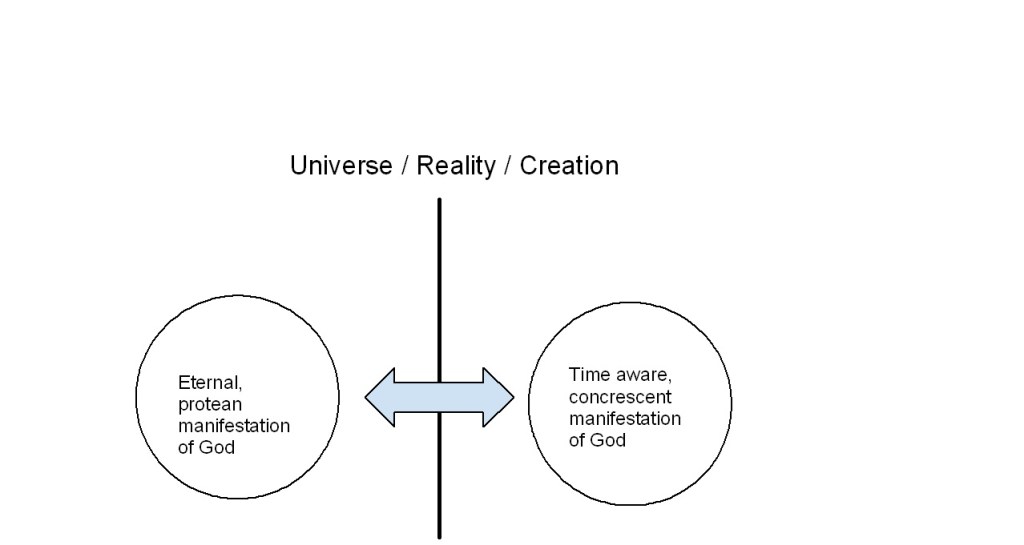
So, although spacetime is real, perhaps space and time are open and closed like a two strands wound around each other. Spacetime means that we know space and time are essentially and eternally linked. Space and time also being considered as separate allows us to appreciate space and time as two essential but separate structures. Spacetime would be ojective; perhaps separting space and time would be subjective. Being open and closed could be concurrent. A mathematical example would be a clopen set (a cool name BTW).

Image created by Meta AI

Wolfram states further in his essay: And at some rough level we might imagine that we’re sensing time passing by the rate at which we add to those internal perceptions. If we’re not adding to the perceptions, then in effect time will stop for us—as happens if we’re asleep, anesthetized or dead.

I have had deep anesthesia for a serious surgery in the past. Indeed, time did seem to stop or disappear. This suggests consciousness is important for time.

Where do we go with such ideas theologically? In the setting of Naturalismppp (prehension, panentheism, panexperientialism), we assume assume a priori (really, theologically deduction a priori) that God is in the time flow. God experiences time just like every entity, including every human. Thus, God would experience both the geometric structure of spacetime as well as the separation of space and time at each moment — objective and subjective together similar to a type of monad. Since space is curved and time is slowed by massive objects, God would experience all of these different times from the past and into the future. Time is relative; God is sensitive to the relativeness of time.

God experiences what we experience in time. This is panexperientialism in an ultimate form.

As God experiences time from past to present, God is aware of the possible although God does not make the possible. This concept is basic to the idea of prehension and concretion as seen in process philosophy as well as in process theology. God may have a lure for creativity that is a passive influence, and such a “divine lure” has been discussed in this blog and other resources. I find the divine lure an important concept in my theology work.

Finally, if all of reality (nature, universe, multi-verse (if a mult-verse exists)) is in God, and if reality experiences time, then God experiences all of time, including all of spacetime with its weirdness in the physics equations. This is panentheism.

So, let’s do a bit a of mathematical symbols which will represent a subjective, theological idea although space, time, and relativity have definine mathematical objective structures. Again, the subjective and objective working toegher…

Naturalismppp =

God experiencing prehension in nature without interference in real time =

God experiencing panenthism in nature without interference in real time =

God experiencing panexperientialism in nature without interference in real time =

Naturalismppp =

Time is essential for all reality, including God’s reality.

God is caught up in time just like every entitity from every electron to every human to every galaxy. If God is love (which I strongly believe), then God experiences love for each entitity in real time and throughout eternity regardless of the universe’s future.

The prophet Isaiah may have wrapped up my random thoughts into a much nicer bow: Though the mountains be shaken and the hills be removed, yet my unfailing love for you will not be shaken nor my covenant of peace be removed.

The sun will expand and absorb the Earth (5 billion years from now). The universe will expand so that we won’t see other galaxies around us (“us” will be long gone — 150 billion years from now). The universe will progress into total entropy (trillions of years from now). God’s love will be still there.

This is simply a fascinating embrace of science (time) and theology (Divine Love).

Image created by Meta AI

Another Tiny Cut in Academic Medicine

*Death by a Thousand Cuts

First, I want to be positive, and I want to talk a bit about my current work in theology. If you have been reading my blog, you know that I am very much into stimulating the artistic / subjective part of the brain since much of my life is centered in the medical science / objective part of my brain.

image from Springer Healthcare

First, theology… A good thing about academic medicine is that many universities utilize “community engagement” as part of academic advancement in non-tenure positions. Although I am a full professor, I am non-tenured. This position may sound strange to people who are in academics but who do not work in medicine. Typically, physicians who work at an academic medical centers / universities are salaried simply because they provide and generate revenue for patient care just like any private medical office you might drive by. I see patients — I bill for my care — I keep my job. It is actually quite hard to lose a physician job in such a setting since I generate money for the academic medical center / university, and I should be a positive revenue stream. I could get tenure, but I’ve seen friends in medicine who work for the tenure track. It involves extra paperwork, and I honestly have not seen any difference in their day-to-day work.

Thus, my community engagment for many years has been trying to reach out to religious groups in order to talk about the importance of science in the setting of religion. The “war” between science and religion makes absolutely no sense theologically, philsophically, and metaphysically. The worst of the worst among religious people as well as non-religious people have made up a fight that doesn’t need to exist.

My engagement work in this area includes on-line religious journals, Youtube videos, and my recent book. I have never been punished by my university for this outreach (and I work at a publically-funded university).

Although I do this work outside of my job, this part of academic medicine is very good.

Now the sad part.

Academic medicine has changed vastly since I entered medical school in 1991. There are many good things — better drugs, better openness about mental health, better surgical outcomes.

The bad thing is that academic medicine and private practive are becoming the same thing. Research and medical education are dissolving as medical schools and their respective universities chase after dollars from clinical care.

Clinical care in academic medicine pretty much trumps everything these days. Funded research is hard to do if not impossible to do with a busy clinical practice. More and more journals are charging extraordinary amounts to publish articles often at the expense of the journal author(s). Finally, much has been written about the demise of medical education.

So…The December issue of the Journal of Pediatrics has an #openaccess article about pediatric endocrinology fellows transitioning from training to the full-time faculty work force. A “fellow” in medicine is someone who is training for subspecialization. For example, I am a pediatric gastroenterologist. My residency was in “pediatrics.” My fellowship afterwards was in “pediatric gastroenterology.”

The article is titled “Measuring Up: Do Pediatric Endocrinology Fellows’ Career Expectations Align with Workforce Reality?” It is worth the read. Here is a summary:

  1. Article data came from a survey of pediatric endocrinology fellows in the U.S. and Canada using a 15 part questionairre in 2024.
  2. Most of those fellows surveyed wanted to go into academic medicine. This makes sense. Most pediatric subspecialists go into academic medicine in the U.S. and Canada (unlike adult subspecialists).
  3. Fellows wanted 61% of their time to be spent on patient care. The other 39% would be available for teaching and research. Their actual time in patient care for their new faculty jobs was 75%. That 75% does not allow for much time in the areas of teaching and research. In my experience such a “free” 25% involves taking care of patients through the 24-hour ubiquitous electronic medical record demands. That 25% involves contacting patients, contacting other specialists, dealing with insurance companies, and dealing with often absurd departmental and overall university mandatory forms. It is of utmost importance to be in contact with patients and specialists when needed, but it eats up that 25% quite a bit.
  4. Ideal free time to pursue non-clinical activities (education, research) was 39%. The actual free time for their new faculty jobs was 18%.
  5. It should be noted that 9% of fellows were being offered jobs with less than 50% clinical care time. These would be considered research jobs. However, let me tell you have this career works. When one takes a job like this, the young faculty has a very short time period to get an NIH K award for initial funding. Sometimes a university provides seed grant money to aim for a K award, but this is not a universal benefit. The K award then needs to be transitioned to a R01 award in order to be an indepedent principle investigator. If you don’t get on this track quickly or if the grant opportunities disappear, then you are moved over to the busy clinical patient care track. I have worked at a few academic medical centers during my training and in my career, and in my experience, most of the physicians on the research track just end up just seeing patients as their career evolves over time.
  6. A total of 87% of fellows thought they would have a long-term research career. Let’s be honest. If you have 18% free time and can do medical education with the addition of good, funded research, then you are a genius. My friends with MDs who have gone into full-time research typically work longer hours and make less salary than those who are mainly seeing patients. Full-time research for an MD is very, very hard. Some of the best junior MD researchers that I have known have ended up switching to clinical medicine in 5 to 10 years. It is all very tragic as they often have ideas that could change the priorities of their fields.
  7. The Discussion section of the article is quite good. You can read it yourself. I did see the following statement in it: “As some authors have envisioned, finding financially sustainable ways for physicians to participate in research beyond the ‘traditional’ physician-scientist model may be a meaningful way forward.” My friends, I can tell you that some variant of this statement has been put in articles about the loss of physician researchers over the past 20 years.

graph from the NIH

Someone once said “What is the use of dreaming of a better world when we can’t even fix our own?”

If the problem is not fixable, then we just need honesty in our medical training at the medical student, resident, and faculty level. We all see the academic medicine job ads in medical journals with the following statement: “Clinical and basic science research opportunities available.” This wording should be translated as “Clinical and basic science research opportunities available on your own time, outside of work, with little help of getting funding by the institution, at the risk of alienating your friends and family while getting burned out.”

An oldie but goodie book on this topic is here:

I’m not exactly sure what end-stage capitalism consists of, and I know there is a variety of soft definitions. However, in the setting of academic medicine, 1) the push for more and more clinical revenue with 2) less emphasis and funding for medical education and 3) less opportunity for good research leads to 4) all of us being replaceable cogs in the healthcare economic machine. Clinician with hopes and dreams comes in; clinician gets burned out; clinician drops out; new, young clinician with hopes and dreams comes in; ad infinitum & ad nauseam.

image made from Meta AI

RFK Jr. and Evolutionary Disadvantage of Ignorance

*God is sorrowful

I’m a physician and a theologian at this point in my life. I have a medical career at an academic medical center. I also have a DThM for which I have done some writing, including on this blog. One part of my career is mainly objective (medicine) and one part is mainly subjective (theology).

As a result, I often become interested in where science and faith intersect. In a more basic sense, I am very interested in where human objectivity and subjectivity intersect. Fundamentalist religious folks as well as scientism folks would assume that the objective and subjective should never intersect. This is madness as our species has been both objective and subjective for millenia.

The human objective / subjective interaction likely has a genetic and epigenetic component. If one assumes that God is a part of nature (as in natural theology, process theology, or open & relational theology), one can see natural aspects of humans as both organic and metaphysical. We can make particle colliders (organic), and we can or cannot believe in God (metaphysical).

Let’s take war as an example. War is terrible, costly, and immoral. “Costly” is objective. “Immoral” is subjective. However, war also has a genetic cost. I’m not an expert here, but there is a debate if war in H. sapiens is part of a way to remove less fit genetics from the gene pool versus becoming just a terrible part of human culture over time not related to genetics. Margaret Mead has said, “Warfare is only an invention — not a biological necessity.” A good article discussing this perspective is here (sorry, has a paywall). The idea of war being associated with an initially violent species versus an initially peaceful species has interesting arguments either way, and the arguments will wade into philsophical and theological waters.

Normandy Landing

Ideas surrounding human evil and war leads to the controversy of “original sin.” I use the word “controversy” because original sin is more than likely a Christian concept as it is not considered as frequently in Judaic understandings of the Old Testament. We can point to Augustine in his defining of original sin, but very quickly we also find arguments for and against his theory (see Tertullian and Origen). A good review article is here. In a modern setting, original sin seems to be just a theological concept prior to the understanding of genetics.

However, we do see moral evil as in warfare. We see pandemics. Pandemics are a natural evil, but the vaccine denialism, and frankly, science denialism complicates pandemics and increases the death rate by adding moral evil to natural evil. Perhaps moral evil + natural evil equals some type of logarithmic increase in evil (with evil being demonstrated as the uneccessary loss of life — human or otherwise).

In my recent posts, I talked about my trip to the Galapagos Islands. I saw many marine iguanas there, and interestingly, they have pretty stable populations until times of El Nino in which weather conditions can lead to high death rates. It is all very tragic, but imagine the death rate of these animals if we, as humans, didn’t preserve the islands (a UNESCO World Heritage Site), killed the animals indiscrimately, or allowed continuing man-made global warming?

A photo I took of marine iguanas on Fernandina Island (the Galapagos)

How do my random ideas here related to the anti-science push in U.S. top governments picks (such as JKF, Jr.)? Some people have described this anti-science movement as a “post-truth society” which seems extremely accurate.

Tragically, RFK, Jr. is highly uninformed. I am trying to be gracious enough to think that the mulitiple tragedies in his life have contributed to his conspiracy mind set. But he is uninformed, a conspiracy theorist, anti-science, harmful to good religious ideas about caring for the other, and simply wrong.

So, regarding our country’s current anti-science leanings:

  1. Natural evil (earthquakes, forest fires) will occur. There are ways to prevent the totality of such devastation with human science and intervention. The subjective and objective come together in a potentially beautiful way here.
  2. Moral evil, in my opinion, is simply based on ignorance and not some sort of genetic evil quality. Epigenetics such as cultural racism, religious fundamentalism, woo spirituality, and nationalism contribute detrimentally to one’s personal imprinting of morality.
  3. I think H. sapiens probably have always been tribal. Our tribalism allows large numbers to fight off predators and “the other.” Perhaps this activity allowed members of the group to successfully reproduce. However, was this activity moral to the other group next door who needed resources? It may have been evolutionary helpful from a gene transfer sense (objective) but not from a moral sense (subjective).
  4. Human warfare accelerated during human cultural development. I do not think the need to kill others in large numbers is not due to evolutionary pressure. I think it involves the hatred of others with different cultures, religions, sexuality, etc. This hatred is based on ignorance. I believe this idea. I don’t know if it is true, but it seems to make sense. The objective and subjective come together here.
  5. We have always lived in a world where a metaphorical Eden was possible. Even today, if our various societies would work together for peace or for a stable planetary environment, we would advance so much more culturally and scientifically. I think that presumption could be made with objective modeling. I think this presumption is based on love which is a wonderful subjetive idea. The objective and subjective come together here as well.
  6. Thus, this “original sin” is simply ignorance. This ignorance often is based on a refusal to learn although it can be based on an inability to learn. The refusal to learn abounds in world history — think about discrimination based on not understanding different religions, discrimination based simply on melanin, and discrimination based on the sexual “other.”

From a theological perspective, I strongly believe that God does not work this way. I fall into my religious metaphysics from a Whiteheadian perspective in that I think God desires infinite novelty (thus, change). However, I also accept Teilhard de Chardin’s argument that there an overall goal for the good even if we, as humans, cannot define an ultimate divine good. Evolution may have a goal. On the other hand, it may not necessarily have a goal but may have a divine lure in place to potentially make the world better. “Having potential” is different than “having a goal.” I think God lures for the good in all of nature — from atom to human to galaxy. Humans in particular can freely choose — “the good” versus “ignorance.”

My country is currently very much in the throes of choosing ignorance. This is a sin. The consequences worldwide are potentially devastating. We still have time to choose good. If we fail, God will feel sorrow for our country and perhaps our species but will also lure for the good somewhere else in space and time.

image created by Meta AI
The God of Strings

I’ve been a fan of Peter Woit out of Columbia University for some time. I know almost nothing about theoretical physics, but his critique of this field is of interest to me. In many ways, he feels a bit Popperian in that he can be disdainful of physics that have no ability to ever be proven. More importantly, I think he brings up issues in science that can be expanded to other regions of knowledge, including theology.

I would recommend his blog, but a good summary of his work can be found on his 2008 ArXiv article titled “String Theory: An Evaluation.”

Basically, Woit points out that string theory is amazing as a mathematical construct, but it may not work at all as a physical theory (actually, he thinks it is a failed theory).

Some quotes from the paper:

This situation leads one to question whether string theory really is a scientific
theory at all. At the moment it’s a theory that cannot be falsified by any
conceivable experimental result. It’s not even clear that there is any possible
theoretical development that would falsify the theory
.

“String theorists often attempt to make an aesthetic argument, a claim
that the theory is strikingly ‘elegant’ or ‘beautiful’. Since there is no welldefined
theory, it’s hard to know what to make of these claims…”

“Given the lack of experimental or aesthetic motivation, why do so many
particle theorists work on string theory? Sheldon Glashow describes string
theory as ‘the only game in town’, but this begs the question. Why is it the
only game in town
?”

“String Theory” from New Scientist

His solutions provided in the paper are quite good, and you should give it a read.

Where am I going with all of this? So much of human knowledge has both a subjective and objective assigned to it. In process philosophy as well as in process theology, one would argue that subjectivity is a vital / essential part of the univere. I would agree. Let’s talk about Woit’s paper in relation to science and religion.

SCIENCE: I cannot speak to theorectical physics, but in my world of academic medicine, we must be Popperian. Taking care of humans will not advance without real research (basic science and clinical) that can not only be duplicated but also have the potential to be disproven. Anti-vaccination propaganda, homeopathy, useless chiropracter techniques will persist unless we are Popperian. I have previously written in my blog about how real academic medicine risks dying on the vine without time for research and teaching in the current setting of institutional incentives for clinical care only combined with a strong anti-science movement in the world (due to poor education) and the influence of pharmaceutical companies. This is an objective truth. A subjective truth contains how a singular physician deals with her individual patients. Cancer is sadly common; the way a patient deals with a diagnosis of cancer or other devastating diseases always is unique.

THEOLOGY: Theology is severly subjective in many ways. Every human that has ever lived has had a unique view of God / No God. We worship in communities in subjective ways. We can be told to worship or believe the “right way” to get to heaven when there is no experiment to determine that a specific method of religion leads to contact with the Divine. However, theology (and theologians) can be a corrective salve. When we, as a profession, use the latest data from science, history, philsophy, and many other important fields, we can help change how the world views God. For example, we now know that we live on a tiny planet in a standard galaxy intermixed with probably 2 trillion galaxies in our KNOWN universe. Ptolemy had no clue here since he put our planet in the center of the universe. This statment is not his fault as he did not have the benefit of modern science. Indeed, our theology has had to change just on that one fact alone and not counting innumerable other scientific discoveries. Here, theology can work in important objective facts into how we view God.

Ptolemy

My conclusions:

  1. Woit is correct in that it is hard to define some niches of science as “scientific” if there is no objective, experimental component present.
  2. Many parts of science, like medicine or engineering, need objectivity to be helpful to our species. There may be subjective components, but objectivity is important.
  3. Religion and thus theology have a strong subjective aspect. However, understanding the reality of the modern world as well as understanding of science as it is unveiled in the future requires an objective component. Our understanding of God will change. Always has. Always will.
  4. Subjectivity and objectivity equally are important in our understanding of reality. Our goal as humans is to know and to learn when to emphasize one over the other even when both are present.

image created by Meta AI
Galapagos via Eden

This is my second post about my recent trip to the Galapagos Islands. I have been wanting to write more on this blog, but my schedule is very busy at work. I am working on an upcoming lecture (which appears to be a big deal — more later), and I am in the starting stages of putting together Christmas cards for the year.

As I stated in my last post, the Galapagos Islands were amazing. Simply amazing. The ecology and geology of each island was so vastly different. Different islands experienced different weather conditions based on different island currents. There was minimal human activity present.

A Boobie who thought I was a very curious creature.

The Galapagos Islands are a UNESCO World Heritage Site. As such, Ecuador enforces strict laws regarding how humans interact with nature on these islands. On the vast majority of the islands, NO human interference is allowed. Some of the islands have had no human presence for decades. There are walkable trails that can be accessed, but one has to go with a guide. Absolutely no touching of the wildlife is allowed. Significant interaction with the wildlife leads to loss of access to the islands and even potentail arrest. I was fine with this legal requirement.

For example, at Parque National Galapagos, we saw many birds. Since human interference has been extremely limited, birds such as Boobies did not fly away if we approached them (6 foot limit!!!). They were not scared of us, and some would approach us with curiosity. We were not predators to them but were simply another animal. The passive interaction between these birds and myself seemed to be a metaphor for the Garden of Eden which, of course, is a beautiful metaphor itself.

Another rule on the Galapagos Islands is that humans do not remove dead animals. Absolutely control by nature is a requirement. A dead body stays where it stays. Crabs, insects, bacteria, the tide, etc. deal with the body as it remains. The dead body changes in time.

Remains of a sea lion on Santa Fe Island

This continual presence of death around the islands seemed somewhat Edenic to me as well. The corpses and skeletons were rare but present. Birds, sea lions, iguanas, and tortoises walked through and around the dead without concern or stress. Their lack of fear of the dead made me feel comforted. I thought about Genesis: “God saw everything that he had made, and indeed, it was very good.” It was not perfect. It was good. Very good.

In process theology (and in its cousin, open and relational theology), change is the ultimate reality. Thus, time and change are first principles. God is in the flux of change, and God recognized change and perhaps is influenced by change. Birth occurs. Life occurs. Death occurs. All is change, and “…it was very good.”

Theodicy always will be a tough issue for religion, and there are no easy answers. However, I believe that reality 1) is not black and white and 2) is suffused with change. God may, in fact, lure for the good. This is the “divine lure” written about by many philosophers and theologians. This divine lure is the lure for creative change, and if creativity is good (which I think is true), then overall change (not specifically change at one particular instance at one moment in time) is good. God does not directly interfere but lures for the good. God lures creation. God loves creation.

Gary Dorrien has been explicit here: “Religion is pointless without God, but modern science negated traditional ways of conceiving God’s existence. Wieman argued that whatever else the word ‘God’ may mean, at bottom it designates the
‘Something’ upon which human life and the flourishing of the good are
dependent. It cannot be doubted that such a Something exists. If there is
a human good, it must have a source. The fact that human life happens
proves the reality of the Something of supreme value on which life depends.”

Theologically speaking, I would argue that God is always there luring for the good. All levels of nature can accept or deny the lure and move forward in time, but the still small voice of God is continuously present.

We all die — bacterium to human. However, there are ideas to consider. I would recommend Mirjam Schilling’s fine work in this area. Pain is a type of warning signal that can be heeded. Death prevents overpopulation, and overpopulation is associated with even worse pain and more death. Perhaps there is a positive aspect for suffering in that it is preventative against even worse outcomes to occur. Humans currently have the ability to reduce suffering worldwide — in our species as well as others. The divine lure is present eternally and in real time. The divine lure is asking us to consider the other with the other consisting of all aspect of our world.

We should always consider the lure.

I took this picture one day in the Galapagos Islands. It seemed ethereal to me.

The Galapagos: Use and Disuse

Well, it has taken me some time to get back to the blog. I recently have spent 9 days out in the Galapagos Islands (Ecuador). If one is able to go visit this wonderful place, please do it. There are so many things that I could write about regarding ecology, biology, and geology of this region. The panoply of island geology, fauna, and flora; the dedication of the people of Ecuador who care for these islands, different constellations seen in the southern sky from this region of Earth… Simply amazing.

During my trip to the islands, I brought along Charles Darwin’s On the Origin of Species (Penguin, 2009). The book was initially published in 1859. I read the book while in the Galapagos to get an idea about what Darwin was thinking when he visited these islands and was mentally fermenting the idea of biological evolution.

Darwinian evolution typically involves the priority of traits that can persist based on survival through the generations of a species over time. The Darwinian synthesis included genetic change (typically mutation) leading to phenotypic (molecular or structural) change.

image from Cambridge University Press

I think that many people do not realize that there is an important influence here oft forgotten — epigenetics. Simply put, epigenetics are the outside influences that change gene expression. Methylation of DNA (adding a methyl group to DNA) leads to clinical changes associated with brain function and the development of colon cancer. A great review is here.

Back to to the On the Origin of Species… Darwin uses the term “use and disuse” frequently. In other words, the use of a biological function or the disuse of a biological function leads to survival based on the particular situation of that species. Such examples include “…use and disuse seem to have produced some effects…” (p. 412). “Effects of external conditions – use and disuse, combined with natural selection…” (p. 125). I did a quick “find and edit” function on a PDF of this book and found 13 instances of Darwin writing “use and disuse”.

a picture that I took of a Galapagos hawk (Buteo galapagoensis)

Why is this idea important? Well, I think many people hear about Darwin and assume his theory of evolution containing “survival of the fittest” was an early explanation of genetic variation since genes were not discovered as of yet. Gregor Mendel was to clarify all such concepts, of course.

However, Darwin is very clear that “use and disuse” has to do with the environment, and, indeed, many things can be epigenetic in cause, including the altitude, diet, humidity, toxin exposure, and on and on and on. In other words, evolution has a genetic component and an equally important epigenetic component.

Theology: Where does this lead us? In the theological and philosophical concept of prehension, many such outcomes are available before an event occurs in real time. If God desires free will at all levels of reality (i.e., no determinism), then change can occur at ANY level — genetic or epigenetic. The important wording here is “can occur”. Nature obviously put limits of creativity. Turtles do not fly. Further, if God desires free will at all levels in nature, then nature can freely (remember — God desires free will in such a theological model) put limits on creativity. In my recently published book, I have come up with a theological term here — lim Δ — a limit [lim] to change [Δ].

So, evolution is indeed a true and validated scientific fact. The idea of a “war” between religion and science is absurd in so many ways. Theologians and laity can use modern science, including evolutionary science, to consider God and creation in new ways since change over time is a very basic part of our existence.

picture that I took of the Galapagos land iguana (Conolophus subcristatus)

Bohm (the Person) Confuses Me

I was doing some side reading on Bohmian mechanics a few days ago. Now that my book has been published, I have been asked to do a few talks. In such a setting, I want to understand quantum mechanics a bit better. I comprehend the concepts, and I can do some (and by “some”, I mean minimal aspects) of the math involved. However, I do find the interpretations of quantum mechanics fascinating — the Copenhagen interpretation, the Everettian model, the de Broglie–Bohm model…lots and lots of philosophy here.

David Bohm

David Bohm (1917-1992) always has been interesting to me. His life is a story in itself. My understanding is that his interpretation of quantum mechanics was deterministic.

An individual particle may “start” in a random location, but its location is determined by the wave itself. This is a “pilot wave” that determines where the particle will end up. I have no problem with this theory being deterministic as many physicists have tried to see if the randomness issue associated with the Copenhagen interpretation can be ruled out. Statistical randomness at the very base of reality seems odd as an physical thing. In my work as a theologian, I like the statistical inferences of classic wave-particle duality since I can upscale it to non-scienctific ideas. For example, I have a huge problem with the theological interpretation of a deterministic or Calvinistic God. I have looked for ways to uphold theologial ideas surrounding God’s love and the downstream effects of freewill.

Recently, I read a post about how process philosophers / theologians became friends with Bohm. Now this interaction is odd because process philsophy has quite a bit in common with the Copenhagen interpretation while Bohmian mechanics is deterministic.

I then found some recording of David Bohm through the Krishnamurti Archive. Jiddu Krishnamurti (1895-1986) was an Indian philosopher. He apparently acheived a degree of cult status worldwide although he didn’t like gurus. He had some cool quotes: “I maintain that truth is a pathless land, and you cannot approach it by any path whatsoever, by any religion, by any sect.” Very cool, indeed.

Bohm developed a relationship with Krishnamurti. He also developed friendships with process philosophers. I have tried to wrap my head around how a person who came up with a simple, beautiful interpretation of quantum mechanics which may be right but also may be wrong could then develop friendships with people who perhaps saw nature more subjectively.

I have some thoughts about how this could have happened:

  1. People of completely different backgrounds, religions, cultures, etc. can become fast friends. This is a simple explanation. Friendship is important in our species.
  2. People change and their belief systems can change. I have seen such changes very much when it comes to personal statements about metaphysical systems. Perhaps we all perdurants.
  3. Perhaps there is more randomness in the interpretation of Bohmian mechanics than we realize, and Bohm saw this issue. I think more work is needed here.
  4. Finally, I think Bohm is a model of how to think about the world as one gets older. I would probably disagree with some of his subjective belief systems, but I think it is of utmost importance to think about one’s subjective convictions as one gets older. Humans have lots of beliefs which can never be proven. Science is awesome, but Paul Feyerabend has pointed out that we aren’t exactly sure what we mean when we say “science.”

Science, philosophy, and theology — an apparent infinte amount of subjects to explore!

Diagram of what a two-slit experiment might entail (from Foundations in Physics) which contains a great, open access review.

I Received a Comment

My little blog is linked to Medium and Substack. I’m gaining some followers. I don’t have many, but a small number is fine as 1) I am using these platforms to practice my theology writing after my DThM degree (which is becoming a fine hobby for me) and 2) I appreciate the concept of time. In the future, my work may stop, diminish, or expand. Regardless, I am happy with my work here at this moment.

I received a comment on one of my social media sites (I refuse to use the bird site) in which the commenter was amazed that some Christian theologians now consider God as not necessarily omnipotent. He wasn’t angry. He was just confused. Well, I think that an idea of God solely being love while not being deterministic works quite well in the setting of current scientific understanding and in discussions regarding theodicy. Theodicy, in particular, is a tough topic.

One thing to consider is that ideas of God do change over time. A simple review of the history of religion in our species shows that there has been much change. The change will continue to occur until the Sun absorbs our planet unless we become an interplanetary species. Who knows? Change in theology and religion is hard for many people who would prefer it to be static and fundamentalist in nature.

Cases in point:

Neoplatonism (300-600 CE and perhaps existing later): Here, we see a Christian belief system in which God matches Platonic philosophical versions of the Divine. God is separate from nature but pure. God only can be appreciate from a meditative standpoint. The theory of creatio ex nihilo is accepted. There are many more aspects here to consider. I have just listed a few neoplatonic ideas.

Deism (1700s -1800s): In many ways, this idea is the penultimate “clock maker” God theory. God starts the ball rolling (think of Newton’s deterministic laws) and is not involved with any aspect of reality afterwards. Thus, God is the first cause, and no real relationship to God is needed or profitable after that. A belief in deism was quite prevalent among the United States’ founding fathers. It matches well with the Enlightenment.

    However, time changes. Culture changes. People migrate. Science develops. Art and literature enter new eras. Change is an ultimate reality. Entropy (at least in our local universe) is increasing.

    Theology changes as well and not just in Christianity.

    Medicine (my field) is using genetics and immunology to completely re-shape how we care for patients. Physics and astronomy are completely changing how we see ourselves in the universe. The understanding of biological evolution has had a huge impact on science and society. Ptolemaic ideas are as extinct as the dinosaurs…and, yes, I know, birds are dinosaurs so the metaphor fails a bit.

    In the face of a potentially infinite universe (s?) and apparent randomness at the quantum level, why not consider God as non-omnipotent?

    As a Christian, I do consider God’s sole aspect as love. Love should never be deterministic, and in the theological and philosophical setting of ideas such as panentheism and panexperientialism (see prior posts), an non-omniscient yet loving God makes sense. Perhaps in 100 years or 1000 years, our understanding of the world will change, and our theology will change further.

    If science is the discovery of more facts and more objective truth, then religion will subjectively follow to give us a more clear understanding of God.

    image created by Meta AI

    Misinformation in the Church

    As I stated in my last post, my good friend from college visited over the weekend. He has been a journalist in the past although he migrated to a new career rather recently due to the collapse of the local newspaper as seen in many parts of our country. As we sat down to lunch, my friend, my wife, and I had a long discussion about misinformation in the public square. He (a journalist) and my spouse and I (both physicians) have been on the front lines here….alternative “news” and non-science health beliefs are rife with misinformation. Our talk was a bit pessimistic although we ended up doing a nice walk about town afterwards which was helpful.

    Unfortunately, this misinformation is occurring in churches throughout the United States. This issue is tragic as I am pretty sure Jesus would not want us peddling in lies and falsehoods especially around current events and scientific knowledge. In my own experience both in and around churches, I have seen numerous examples of this problem. Just a very short list:

    A. My children being told that pterodactyls still exist in Idaho. Thus, evolution is not true….beyond gross. Also, incredibly uninformed.

    B. My family being told that any belief in the science of evolution is an example of lack of faith (never mind that fact that several, well-respected organizations exist which promote science in church — BioLogos and the American Scientific Affiliation among others)

    C. The yelling of a U.S. Presidential candidate’s name from the congregation while a pastor gives a sermon…very gross.

    D. The anti-vax movement that has infested many congregations in the U.S. leading to countless deaths. I was involved with some work trying to stop anti-vax crud occurring in churches early on in the pandemic. I do not know how successful this work was.

    Such thoughts lead me to Augustine. There are times I love reading Augustine; there are times that I want to scream at him. I feel that way about Paul as well. Augustine, Paul, and every human who have ever existed are not great all of the time, and I see this aspect in my own life frequently.

    Augustine’s work on Genesis is helpful, however. Many of the points in his work are not super relevant today. However, I read through his work again today and found some things that ring true.

    I admit that I do not know why mice and frogs were created, or flies or worms. Yet I see that all things are beautiful in their kind, though on account of our sins many things seem to us disadvantageous.” There is no personal appeal to his known authority here. The great “I don’t know” is the cornerstone to science. Likewise, it is “disadvantageous” (per Augustine) that we don’t know the cause or reason for many things. Science can help here. Honestly, good literature, an exacting understanding of history, and well-thought out theology also can help.

    He set the light of wisdom to the east in Eden, that is, in immortal and intelligible delights. For this word is said to signify delights, or pleasure, or a feast if it is translated from Hebrew to Latin. It is set down in this way without translation so that it seems to signify a particular place and to make the expression more figurative. We take every tree that the earth produced as every spiritual joy; for such joys rise above the earth and are not caught and overwhelmed by the tangles of earthly desires. The tree of life planted in the middle of paradise signifies the wisdom by which the soul should understand that it is ordered in a certain middle range of things.” I love the wording of “more figurative”. Here is one of the original church fathers stating that a reading of Genesis can have symbolic meaning while not necessitating a literal reading. If you want evidence that a literal reading of Scripture has caused harm, just visit AiG or listen to a Christian nationalist.

    Now let us also look at the verse that they mock with greater impudence than ignorance. Scripture says that, after completing heaven and earth and all the things he made, God rested from all his works on the seventh day and blessed the seventh day and made it holy by reason of his resting from his works. They say, “What need did God have for rest? Was he perhaps tired and worn out by the works of the six days?” They also add the testimony of the Lord, where he says, “My father works up to now,” and by this they deceive many of the uneducated, whom they try to convince that the
    New Testament contradicts the Old Testament
    .” Ahh, two points here. “They” in this segment comprises those who followed ideas surrounding Manichaeism which was a gnostic belief system. 1) The first point is that Augustine uses the days of creation as figurative mechanisms and not literal. Much of his work on Genesis surrounds this topic as he believes that figurative understanding is better food for the soul. I would agree. 2) The second point is that Christian nationalism tends to misunderstand how the Old Testament supports (from a Christian perspective) the Old Testament. Violence is never an answer. Give to Caesar what is Caesar’s… Love God; love neighbor in an eternal lovely dance.

    Simply put, Augustine provides good arguments against literal interpretation of Scripture. Metaphor is extremely important in human understanding.

    Scientific knowledge can bolster beautiful metaphors that exist in theology. A lovely, eternal dance indeed.

    P.S. I wrote a somewhat related topic about this issue in BioLogos in 2018.

    image generated by Meta AI