Models and Theology

An interesting article was recently published in Perspectives on Science and Christian Faith (December 2024 edition). It is titled “Models in Christianity and Chemistry: Truth or Utility” written by William Wood PhD.

Articles in PSCF typically become open access through the American Scientific Affiliation (ASA) website one year after they are published. So, you will need to wait a bit before you see the article in its entirety (unless you are an ASA member like me).

Wood states that a good model is “both useful and true.” There are caveats of course. Objective models in science can become outdated as new data emerges. Bohr’s model of the atom is an example of a model that is outdated.

Wood also states that when theology attempts modeling in a manner similar to science, there are two main criticisms:

1) God is indescribable so the “God data” is never accurate.

2) Theology models risk not being representative of every individual’s relationship with God.

He also states that people who attempt theological modeling through the realm of science are often accused of scientism. Wood is making a good point here. This idea is ridiculous as the last thing those who are scientism-friendly want is theology’s input. I think it is quite obvious that the New Atheist movement and the U.S. Evangelical movement both refuse to accept contributions of religion or science, respectively. I can’t imagine why these two extremes in metaphysics would want to throw out additional ways to observe the world — yet they do.

We already have models in Christianity: the Trinity, the Wesleyan Quadrilateral, the Bridge-to-Life model, Sola Gratia, Sola Scriptura — these are all models. Models exist in other religious traditions as well.

Where do we go from here? I propose two ideas that need further study:

First, the objectivity of nature can provide a subjective bridge to our relationship with God. As an example, the proton is made up of 3 quarks. They are connected by the incredibly powerful strong nuclear force. How is this finding in nature not a metaphor for the Trinity? As another example, Simon Conway Morris (an internationally known evolutionary biologist) has proposed that evolutionary change has limits in creativity. How is this idea not a potential metaphor for purpose in our universe?

Proton made up of 2 up and 1 down quarks

Second, science necessarily advances. If science advances, this means that our objective and subjective ideas about the world must necessarily advance. As observations about the world necessarily advance, theology MUST change as humans gain more objective knowledge. Psalm 8 makes this point when it states, “When I consider your heavens, the work of your fingers, the moon and the stars, which you have set in place, what is mankind that you are mindful of them, human beings that you care for them?” The writer of this Psalm is making an observation (looking at the stars of the Milky Way) and then proposes a theory (God still cares for inconsequential humans). This idea is inductive reasoning. Yes, it is a religious statement, but it is still inductive reasoning often used in science.

    The Pleiades

    There is an opportuity in which we can use natural observation and human subjective thought to make a real difference in the lives of many people of the Christian faith. We can use this same “real difference” to care for the poor, the sick, and even our enemies.

    For example, we can combine such ideas when considering better ideas for the theological concept of atonement theory. Many Christians consider that Jesus’s death on the cross occurred only as a result of “penal substitutionary atonement.” In other words, God took God’s vengeance for all of humanity’s sins out on Jesus Christ. This description of God sounds maleficent. This description of God sounds like God eternally will never comprehend why humans even exist which gets complicated if God desired our species to exist in the first place.

    “Night at Golgotha” by Vasili Vasilievich Vereshchagin (1869)

    However, as we obtain more scientific data about nature and can propose hypotheses about nature in light of known science. We can think about how God’s relationship to our species exists for God “that you are mindful of them.” Perhaps God is always luring for the good. Perhaps Christ died for our sins not because of God’s vengeance but because humans are inherently a violent species. We would kill our God in Christ simply because that is what we do. Perhaps God, even in the crucifixion, still loved us, cared for us, and still lured for the good without forcing us to be good. This divine love is infinite in time and eternal in setting.

    Perhaps our observations through science will give us a better understanding of how God loves every entity in the universe.

    Odds and Ends:

    Please read this editorial titled, “Will They Come for PubMed Next?” I worry greatly about the future of medical science in our country. This article exacerbates my fears.

    Also, my book (“A Theology of the Microbiome“) now has an audio version! This is exciting!

    image created by Gemini Advanced
    A Question from ORTLine

    I gave an overview of my recent book, A Theology of the Microbiome during ORTLine this weekend. ORTLine in an on-line session theology meeting consisting of many authors who discuss their books followed by reviews of their works by experts in the field of Open & Relational Theology (ORT) or in related fields.

    My book was chosen, and I was happy to discuss my book. By the way, the conference is a wonderful way to learn about theology with an emphasis on science, technology, psychology, education, and many other fields. This conference is free from any fundamentalist or nationalist components. Theology, when done well (as in ORTLine), is exploratory, interpretive, and thought provoking.

    One reviewer asked me a very good question about capitalism. If process theology suggests that God desires novelty and creativity, then isn’t capitalism a metaphor for process theology? After all capitalism strives for the “new” to keep the marketplace happy.

    Here is an expansion of my answer:

    Keep in mind that process theology is a cousin of ORT. Process theology is derived from process philosophy with these essential components: 1) change is the basis of reality, 2) time seems to be fundamental, 3) God desires novelty. ORT goes on to suggest that the future is open. God does not exactly know the future although perhaps God may know statistically (read my book here). God also loves every entity in nature since God is “relational.” Such “love” is a desire for “creativity.”

    So, what does this mean in the setting of capitalism? I would say no relation exists between process theology / ORT and pure capitalism.

    First, Alfred North Whitehead (the modern proponent of process philosophy — not theology) stated in his book, Process and Reality:

    God and the World stand over against each other, expressing the
    final metaphysical truth that appetitive vision and physical enjoyment have
    equal claim to priority in creation. But no two actualities can be tom
    apart: each is all in all. Thus each temporal occasion embodies God, and
    is embodied in God. In God’s nature, permanence is primordial and flux
    is derivative from the World : in the World’s nature, flux is primordial and
    permanence is derivative from God. Also the World’s nature is a primordial datum for God; and God’s nature is a primordial datum for the
    World. Creation achieves the reconciliation of permanence and flux when
    it has reached its final term which is everlastingness-the Apotheosis of
    the World
    .”

    Alfred North Whitehead

    One way to read this part of the book is to consider that 1) change is essential in reality and 2) God’s memory of all events is eternal. Eternal — nothing is forgotten in God. Keep in mind that this is God as described by philosophy, so novelty taking place in time while not being forgotten through time makes sense philosophically.

    However, in process theology, one could exchange “novelty” for “creativity”. Creativity is the new, ever-better, ever-more striving, ever-more reaching to goals of ultimate creation or love. This creativity has no limit.

    Capitalism crushes the old novelty. Capitalism strives for the new, perhaps as a form of economic evolution, but the ultimate form will never be reached. Capitalism is simply a human endeavor, and all humans have a limit. Our species has a limit. We will go extinct some day.

    ORT seems to make sense when we consider humans and economic activity. If God is love, and God desires creativity in time, then perhaps Scandinavian countries are a limited metaphor for this divine desire. There is a strong social safety net in such countries. These countries have excellent healthcare systems. Yes, the tax burden is higher, but people in these countries seem to live longer and perhaps are happier.

    image from the World Economic Forum

    We can expand this metaphor to all of reality. Creativity is a divine desire freely given to all of nature. Every entity in nature can proceed with, ignore, or go against God’s creative desire in real time. We see this example in humans every day from how we treat the “other” to our wars and to human-caused environmental disasters.

    But perhaps, just perhaps, God wants there to be some kind of “safety net” for creativity to abound not just on Earth but also throughout the cosmos. One can think about gravity, electromagnetism, the strong nuclear force, the weak nuclear force, the speed of light, and biological evolution as examples.

    Creativity throughout nature may be a combination of accepting God’s desire of creativity “for the good” in the setting of a background of some natural security through physical laws. Scandinavian countries have chosen to secure the health and wellness of their people (and not always well). Nature has chosen to secure the health and wellness of the entirety of its entities for the potential of infinite creativity.

    I think more theological work is needed here.

    Odds and Ends:

    Of note, my book (A Theology of the Microbiome) is now available as an audiobook.

    image created by Gemini Advanced

    The Dipolar Nature of God and the Concept of the Brahman

    My good friend Michael Brennan (substack “Theodivergent”) and I have been meeting every few weeks online to discuss books. We were going over God Christ Church by Marjorie Suchocki. As part of our discussion, we went over her discussion about the dipolar nature of God (as originally described by Charles Hartshorne).

    Hartshorne proposed that God could best be thought of as having two natures. Our natural world and thought processes often seem to be a duality — finite v. infinite, time v. timelessness, atomic v. galactic, subjective v. objective. How would such a duality work in the setting of God? In my book, “A Theology of the Microbiome“, I made this figure.

    Another way to look at concept of Thomas J. Oord’s “divine essence-experience binate Deity.”

    In this model, God is intertwined as two concepts.

    There is the eternal, perhaps outside of time, manifestation of God. This aspect of God contains all possibility. It is not a predictive possibility but simply all that could exist or could happen. In some ways, this is a derivation of Platonic forms. Alternatively, there is the time-aware manifestation of God. This God experiences what happens in real time and in real locations.

    This dipolar God does not force. This dipolar God experiences reality which matches so many of the concepts of process theology. Ideas surronding the dipolar God also matches the cousin of process philosophy, open & relational theology (ORT). ORT states that the future is “open” (God does not know but God could predict), and God is “relational” (God relates and loves at every level of reality). ORT makes the God described in process theology more personal (at least to me).

    As an example, Homo sapiens evolved over time. The primordial aspect of God (left of my figure above) is full of possibility. H. sapiens could have evolved into another species early on in species history. H. sapiens could have become extinct early in its development. H. sapiens could have had a permanent stoppage of brain volume growth at an early stage leading to lack of writing, culture, science, and blogging. All of those aspects have been available in God’s primordial aspect.

    The actuality aspect of God (right of my figure) is God intertwining with the past, present, and future. God experiences in real time from the quark to the galaxy. One could assume, from a religious perspective, that God “lures” for the “good.” This luring is God desiring creativity or perhaps novelty in real time. The “good” is “creativity” or “novelty.” I am saying that “the good is should” in that each entity has the ability to be creative, to advance, to improve the surrounding ecosystem, and to be good to one’s neighbor (from a human perspective). Perhaps reality should strive for creativity, but reality with complete freedom often is not creative. Bad things happen.

    I am not Hindu, so my writing here is uninformed. However, when I consider aspects of Vedantic Hinduism, I do wonder if the Brahman is a theologic concept that is a corollary to the dipolar deity, especially when considering God’s primoridal nature.

    The Vedantic tradition seems to consider the Brahman as “reality that grounds matter, thought, and meaning.” The reality that grounds all may be considered as a monadic structure for which all is interconnected and, in some sense, is arising from the same ground. From a process theology perspective, the monads are perhaps the intense, eternal milieu of the primordial aspect of God which, in unity with reality, builds God’s experience and interacts with nature. The monad structure of a divine primordial state outside of time perhaps is inversely shaped by events in real, finite time. These events in reality lead to God’s experience.

    Perhaps Hinduism and Christianity touch here. Vedantic tradition suggests that the individual may have an ultimate goal to realize the individual’s oneness with Brahman. Likewise, the Christian aspects of process theology suggest that God is with us in the setting of panentheism and panexperientialism. Relevant Bible verses can be seen in Philippians 2:13 or John 15:4-7.

    In a similar way, perhaps our species has some metaphysical goal of connecting with God. Perhaps in our evolutionary drive to live and to produce new humans, we have some inherent drive to carry on in nature as we wish to see God’s continuing actuality as our goal. Perhaps this drive can be reduced (and equally as important) to the cellular or DNA level with mechanisms of replication and the inherent entropy of DNA mutation continuing on in the processes of life. Perhaps this drive can be expanded to culture, society, and our planet.

    Of course, people do bad things, and nature has horrific consequences. This is theodicy, for which there is no solution.

    I have no objective answer for the bad things that happen. I never will. No one will. Perhaps, then we have to look at the schematics of faith. We all have a faith system. We believe in God. We don’t believe in God. We don’t care. All such ideas are faith systems. Faith is an interesting construct — see a great resource here. Faith requires the subjective. Religion is filled with subjective, yet important, concepts. How does subjectivity help here?

    Hinduism has the dharma which has the potential for peace and nonviolence. Christianity preaches peace. Process theology from a Christian perspective believes that God wants creativity or novelty. God invites us to participate, and this participation involves peace and nonviolence.

    My conclusion to this post provides 3 ideas for further exploration:

    1. Intersectionality between different faiths is always interesting.
    2. More work in theology may be needed for clearly delineating the dipolar nature of God. Is this idea possibly present in other religions? Should this idea be emphasized more in my faith stream (Christianity)?
    3. Peace. Non-violence. A loving environment. Loving the other. These ideas are always good in religion.

    Odds and Ends:

    1. Nature has an open access article on ritual stone throwing by Chimpanzees. They may be building cairns. This behavior is fascinating (see https://www.nature.com/articles/srep22219).
    2. A great article in Perspectives on Science and the Christian Faith (PCSF) recently came out titled “Models in Christianity and Chemistry: Truth or Utility.” It is not online yet, but typically PCSF articles become open access after one year (link: https://www.asa3.org/ASA/PSCF/2024/PSCF12-24dyn.html). I may do a future post on this article.

    image created by Gemini Advanced

    The Metaphysics of Human Gestures

    Recently, I read through an article in  Educational Psychology Review. It is titled Learning from Gesture: How Our Hands Change Our Minds. It is a great open access article. I’ve been reading The Experience Machine by Andy Clark. This book clued me into the research in this area which has led me to read more about human gestures and learning.

    Simply put, human gesturing plays a huge part in human learning and communication. One can consider the ways in which our hands operate while we are speaking. Such gesturing is an extension of our cortical patterns involved in learning. We learn by hearing sounds, such as by hearing the words of a teacher. It appears that hand gesturing extends our capacity for learning which involves a completely different realm of sensory input (vision, touch, etc.). For example, the authors of the paper point out (see my gesture there!) that children who have a disconnect between their gestures and oral understanding of a concept tend to benefit from more instruction about that concept.

    Children who are introduced to a moral concept and then subsequently gesture more appear to have significant awareness of complex nuances when moral issues are discussed.

    There are so many metaphysical ideas to consider in the setting of gesturing and the human experience. The brain might have a conscious experience that is purely subjective while raising one’s hand in celebration is a concordant objective experience in time and space. Thus, the subjective and objective experience are united as one — brain and hand, for example. The objective moving of the hand even appears to open up memory resources of the brain while one is speaking.

    It is even more fascinating to consider that when an individual’s spoken expression is combined with their gesturing, the combined effect improves comprehension of the listener.

    This human comprehension of listening and seeing in unison involves the rods, cones, and ganglia of the retina; the cochlea and cranial nerve VIII of the ears; the speed of sound (about 343 meters per second in air); and the speed of light (299,792,458 meters per second in a vacuum). Thus, the human experience involves (1) time and (2) what we perceive involving all of our senses. Human exactness of experience will never be perfect due to constraints of sound and light in the limitations of time. We will never experience the exact NOW.

    Also, in the setting of our hands and fingers being involved in gesturing, we have to think about how our hands interact with the environment — enclosed in a room or interacting outside; temperature; humidity; and air pressure. The molecules at the tips of our fingers must necessarily interact with the air molecules of the environment while our hands / fingers move or wave or our vocal cords produce sound waves. The air moves. Sounds are made. Light is absorbed. From both a philosophical and theoretical perspective, the atoms, molecules, skin bacteria, and a human entity all experience every gesturing event. The human experiencing of learning can be extended to the idea of panexperientialism. Panexperientialism suggests that some degree of consciousness (although I would rather stick with “some degree of experience”) occurs at all levels of reality.

    Panexperientialism suggests that all of reality from the singular electron to the universe as a whole experiences. What you do when you interact with others around you is an experience. If you express hate, then those around you experience hate. If you express love or kindness, then those around you experience love or kindness. If “love of other” is an act of creativity (which I strongly believe), then kindness, understanding, and a potenital goal for novelty in all Creation can be acheived even if it is at the level of one quark.

    God certainly experiences what we are doing when we communicate orally and physically. This concept is the theological basis of panexperientialism. God does not force, even for the good. However, God may lure for the good which has the potential for creativity. God never forces. God does lure.

    So, teaching others well, both objectively and subjectively, is good. Learning, both objectively and subjectively, is good. We need to use our human forms to aim for the good while realizing our limited humanity in time and space means that we will sometimes fail.

    image created by Meta AI

    Helping the Other in Weird Times

    My country (the United States) is just going through a weird / awful / bizarre time. Even if I keep the politics out of the discussion, the anti-science movement in my country is truly insane. It always has been a problem in American churches, especially since the 1900s. Christian fundamentalism has hurt science, hurt religion, and hurt society. Fundamentalist movements in other religions have done likewise. The anti-science aspect of Christian fundamentalism now has spread into secular society. Other countries are experiencing this problematic issue as well, but Americans tend to be large and loud when we decide to act like idiots. For example, up to 700,000 Americans died during the U.S. Civil War over the issue of slavery. We killed almost one million people over a moral issue with only one correct answer — slavery is wrong.

    So, yes, I am very depressed about Robert F. Kennedy, Jr. being nominated as head of U.S. Health and Human Services. I am a physician and specifically a pediatric gastroenterologist. I have seen the deleterious effects of lack of medical care, inability to access medical care, and refusal to access medical care. I have seen the devastation caused by children who do not get vaccinated. I am super hopeful that RFK Jr. backs off on his anti-vaccine views. Perhaps he will just work on improving the food industry. Who knows?

    Even in my home state of Utah, I recently have corresponded with the Utah House Chair of Health & Human Services about a state bill giving parents more freedom in denying their children access to the newborn screen. Unreal. The newborn screen is a simple blood test that can diagnose very severe diseases early in an infant’s life in order to 1) begin medical therapy, 2) extend a child’s life, and 3) give the child a healthy life. I can’t imagine why a parent would deny their child a chance to get screened early (with subsequent treatment) for phenylketonuria early, cystic fibrosis as well as myriad of terrible, preventable diseases.

    I will say that the Bible’s book of Ecclesiastes is probably one of the most powerful yet least read books in the canon. It presents a dark picture of humanity. When I see our species making terrible decisions, this book’s verses come to me.

    2:11 “Yet when I surveyed all that my hands had done and what I had toiled to achieve, everything was meaningless, a chasing after the wind; nothing was gained under the sun.”

    2: 18-21 “I hated all the things I had toiled for under the sun, because I must leave them to the one who comes after me. And who knows whether that person will be wise or foolish? Yet they will have control over all the fruit of my toil into which I have poured my effort and skill under the sun. This too is meaningless. So my heart began to despair over all my toilsome labor under the sun. For a person may labor with wisdom, knowledge and skill, and then they must leave all they own to another who has not toiled for it. This too is meaningless and a great misfortune.”

    5: 8-10 “If you see the poor oppressed in a district, and justice and rights denied, do not be surprised at such things; for one official is eyed by a higher one, and over them both are others higher still. The increase from the land is taken by all; the king himself profits from the fields. Whoever loves money never has enough; whoever loves wealth is never satisfied with their income. This too is meaningless.”

    Depressing? Yes, but pretty darn accurate when one considers how our species treats the weak and oppressed. We not only can be cruel to others but also to other species and to our planet. Perhaps there are genetic or epigenetic aspects or our cruelty. Our human obsession with crazy conspiracy theories? This problem is likely due to evolutionary pressure. You can go down a dark metaphysical hole here when you read or see the news.

    I have no answer for such problems. Human awfulness is not solvable. Theodicy cannot be explained.

    I do have one thought, however. Perhaps during our limited time on this planet, we are given the possiblity of helping the “other.” Yes, it is always great to donate money to good causes. It is great to explain to your friends about the real problems of the world. However, can you give water to a single homeless person? Can you help a lone elderly person across the street? Can you be kind to your nextdoor neighbor even if they disagree with you politically? Such simple things are hard…very hard.

    Jay McDaniel’s essay on butterflies provides an excellent metaphor here. The life of the butterfly is so very short, but in that time period of its life, the butterfly is integral to the ecosystem of the whole world (including humans). We humans often don’t realize that such insects are working in the background. The simple pollination of one plant has downstream creative effects in time which benefit the plant, the plants around it, the soil, the city where the plant resides, and Earth. In many ways, this is panexperientialism — all reality experiencing the good act of that one butterfly.

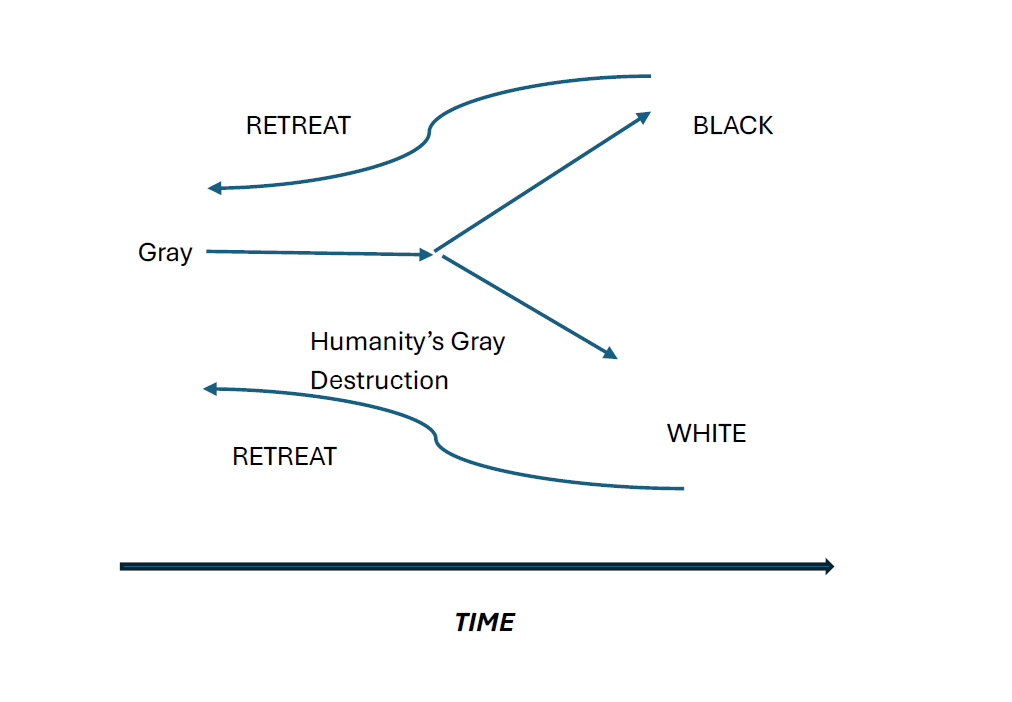
    We, as humans, can mimic the butterfy. A simple act of doing the right thing has huge implications for our world. The “right thing” isn’t necessarily a moral call. It is a call for creativity. It is a call between our species and the divine for the universal experience of producing ever more creativity in time and and in space. I made the figure below (I know it is kind of poorly made) to explain my idea.

    This is not a Christian call to creativity. I may be Christian, but this call for creativity encompasses all religions and encompasses the lack of religion. It is the simple human decency of caring for the other. It may have the natural, evolutionary roots of altruism. It may be a supernatural desire calling each of us to be good to the “least of these.” I think it is the combination of the both as God is in the world. It calls for a Hegelian dialectic encompassing both the objective and subjective aspects of reality and of creativity. We can do more.

    We can be kind. We can be like a butterfly and influence the world.

    Odds and Ends:

    1. I was interviewed for the podcast, “(Re)Thinking Faith with Josh Patterson.” He is a liberal Christian like me, so we talked quite a bit about metaphysics and kindness. I cussed a bit and probably was too opinionated. It should be out soon.
    2. I’m a big fan of the liberal arts. I am currently reading, “The Evidence Liberal Arts Needs”. It is a good book. Consider reading it. Here is the link.

    image generated by Meta AI

    The Metaphysics of Telomeres

    Today is Sunday, February 9, 2025. Although I live in the states, I will not be watching the Super Bowel today. I actually like sports, but I hate long infomercials. The Super Bowl is definitely the penultimate form of infomercial. So, I went to a bar and danced with my spouse last night, went to church today, played some Pickleball this afternoon, and now am sitting and writing.

    I really have enjoyed writing on this blog. I’m not sure it makes an impact, but as I have become older, I have found writing to be more and more relaxing.

    Anway, let’s talk about telemores.

    Telomores are an immensely important part of DNA that many people are not aware of. They are repetiitive pieces of DNA that exist at the ends of chromosomes. They serve a protective function.

    Image of telomeres from UCSF. The telomeres are red. The chromosomes are blue.

    You could metaphorically consider a telomere as the equivalent of a hard hat on a person’s head. If some big piece of equipment falls and hits the hard hat, the person’s head is protected.

    The mechanism involving telomeres is similar. As cells divide, the ends of chromosomes get frayed and are at risk of not functioning. The telomere really is not involved with eventual protein formation — although there are some exceptions. If the chromosomes get frayed at the end during the process of DNA replication, the subsequent fraying or injury at the end of the chromosome just affects the telomere with no real effect on the purpose of the chromosome. Once the telomere is shortened to the point of not being protective , a cell can die or can quit dividing.

    For example, human cells in a culture medium only divide by mitosis for 40 to 60 cylces before they stop reproducing. This braking effect is due to the telomeres being slowly worn away.

    Telomeres are associated with controlling cell division and may have some effect on aging. It makes sense in the setting of aging. Telomeres are slowly removed –> cells quit functioning well –> organs start having issues –> humans age.

    Different organisms have very different telomere length. A kilobase (Kb) is 1000 DNA base pairs. The typical little house mouse has telomere length of 150 kb. Protozoans can have 18 kb telomere length. Humans have a telomere length of 10 to 15 kb. It is weird that mice have such long telomeres. They are eaten by everything, so the longer length probably has to do with keeping their health in prime condition in order to have maintenance of muscle strength and organ function as a way to avoid predation. Healthy mice are less likely to be eaten than sick mice.

    A great review article on telomeres is here.

    Now on to theology and philosophy. In my recent book (“A Theology of the Microbiome“), I posit that reality is both objective and subjective. Seeing red affects the cones of the human retina to allow us to see the color. This effect is objective. The way we perceive red emotionally or psychologically is subjective. I would bet that my feelings about red are different than those of the neighbors on my street.

    Mark Rothko, “Untitled”

    Telomeres shorten with cell division and DNA mitosis. This cellular event is natural and expected. This shortening is objective in observation. However, telomeres also can shorten with subjective change via the effect of epigenetics. Epigenetics cause inherited change in a manner that eventually affects DNA inheritance.

    There is fascinating research in this area.

    Chronic stress in a human likely shortens telomere length due to psychological stress leading to oxidation and downstream telomere damage.

    Adults who suffered maltreatment / abuse as children appear to have shortened telomere length compared to controls.

    Depression may shorten telomere length with more problematic depression shortening telomere length even more.

    Many, many research articles exist in this arena.

    As someone who has studied in the fields of process theology and open & relational theology (see my prior posts), I will make some observations that warrant further theological study:

    1. Telomeres are affected by direct genetic factors (objective) but also by environmental or psychological stress (subjective). This knowledge provides a theological and perhaps philosophical insight into how reality actually works.
    2. I may not be able to objectively keep my / my neighbor’s telomeres from shortening, but I can indeed subjectively help. My neighbor may need food. My neighbor may need shelter. My neighbor definitely needs kindness. My country (and our whole world) currently seems to discount kindness. However, I can be kind to the neighbor or stranger. I am helping their life immeasurably (and measurably when considering telomere length).
    3. Being kind to your neighbor, is probably healthy for you as well.
    4. If I support the concept of panexperientialism in which all of nature has experience. If all of nature at every level of reality has experience, then I can further contend that God is involved in the experience of everything — from quark to quail, goat to galaxy, unicellular organism to universe. God is there in the midst of nature and in the midst of humanity with all of its joys and tragedies. In such a theological model, God realizes when we are being kind to the neighbor or stranger, and the effects of kindness and love go up and down the ladder of experience in nature. A kind act to one individual scales up to culture and society. It also scales down to our telomeres.

    From a Christian perspective, the Parable of the Good Samaritan (Luke 10) subjectively aligns with our daily, objective, real-world experience.

    My summary: Let’s all try to be a bit more kind. Your neighbor and your neighbor’s chromosomes will thank you.

    image created by Meta AI

    You Can’t Cheat Death but You Can Cheat People

    I get particularly angry when fraudsters cheat people out of money, especially when the victim is older or has a mental processing disorder (dementia, for example). Fraudsters are everywhere — at work, in our neighborhoods, and in our religious or social groups.

    Fraudsters are great at convincing people to excessively worry about issues related to death. Their behavior is very devastating as none of us want to shuffle off the old mortal coil too early, and some anxious people are willing to pay large amounts of money for unproven or unethical therapies to prevent death.

    I found this great editorial in Gastroenterology which is the biggest gastroenterology journals in the world. I receive the journal because I am a gastroenterologist and belong to the American Gastroenterological Association. The editorial was interesting because this article has nothing to do with my field.

    The article, “Hacking Death in Dublin” was written by Seamus O’Mahoney who does research in the field of end-of-life care. The article discusses his experience attending the Longevity Conference sponsored by the Longevity Escape Velocity Foundation. I had not heard of this conference or this foundation.

    When reading the article, one quickly gets the impression that O’Mahoney was amazed at the potential for fraud as well as a lack of the conference attendees’ understanding of death. I would agree with him.

    Here are some quotes:

    The longevity biotech industry has a significant intersection with artificial
    intelligence (AI) and cryptocurrency. Blockchain was frequently mentioned,
    as was the ‘tokenization’ of longevity research funding, or ‘tokenomics.’ (I witnessed much mangling of the English language at this summit.) I was struck by how many of the biotech entrepreneurs lacked any medical or bioscience background
    .”

    Ugh. You can pretty much bet that fraud will be involved when cryptocurrency and blockchain are mentioned as a positive. Also, why would one invest in a product when the entrepreneurs have no real science background?

    Aubrey de Grey, who majored in computer science, remarked that ‘the medical profession is at the trailing end of most conversations.’”

    Ugh. Mr. de Grey is expressing a repetitive, tiresome statement. I am amazed how people who do not work in medicine have no understanding about the progress of medical science. Sure, the field progresses slowly at times (like all of science!!!!), but the advances in my time of being in medicine (since 1991) have been amazing! Such comments seem similar to statements made by the anti-vaccine movement in their belief that all healthcare should not be trusted. We do have those physicians who do shady work, but they are few and far between (just like lawyers, engineers, or teachers who do shady stuff).

    A recurring theme of the summit was the industry’s hatred of regulatory
    bodies such as the Food and Drug Administration (FDA) and the European Medicines Agency (EMA)
    .”

    Ugh. I am shocked, SHOCKED, that so-called entrepreneurs hate safety mechanisms. Please note my sarcasm.

    The radical accelerationist wing sees death as an affront, and its defeat as a moral imperative. One young member of this militant group told the summit: ‘We really need to get our shit together! We are dying! Why don’t we go Moonshot or Los Alamos?!’ He argued that all longevity research—its funding, execution, and publishing—should be ‘permissionless.’ ‘Who are they to tell us what to do with our bodies?’ he asked indignantly.

    Ugh. Comments like this from the young man in the article feel like someone who has financial privilege. This young man should go work in a developing country to see what “We are dying” really means. I have worked in Africa. I have worked in pediatric ICUs. I have seen real suffering. Also, this young man seems to not understand the second law of thermodynamics. Yes, we are dying. We are all dying. Everyone will die. Death is natural but perhaps preventable, at times, with good available hygeine, safe food, a clean environment, and prevention of deadly diseases.

    Doubt and uncertainty are at the heart of science, but doubt and uncertainty were not much in evidence at this summit, where the atmosphere was more akin to a cult, a gathering of true believers.”

    Ugh. And “yes”, I have friends and family members who take some pseudo-science ideas as serious as religious dogma. It does seem, at times, cult-like.

    You may be reading through this post and getting more and more depressed. I get it. I’m a practicing physician, and I am exposed to such crazy ideas on a regular basis. We can think about solutions. Some solutions may be global; others may simply consist of convincing a friend of family member about the realities of life and the objective nature of science.

    And the emphasis should be on “reality.” The sad experiences of life (disease, injury, trauma, anxiety, death) are simply reality — nothing less, nothing more. We all may have many experiences during our lifetimes, but we all will die. The religious person, the atheist person, the agnostic person, the person who has no understanding of what death means — we will all die. We may have a belief in an afterlife. We may have no belief in an afterlife. We may state we do not know. In reality, NONE OF US know what happens after death. However, we all should recognize death will occur and be kind to others around us.

    Photo of an ancient Roman cemetery (Wikipedia)

    Interestingly, research has found risk factors do exist for people who have an extreme fear of death. Being an older female decreases the risk; believing in cryonics increases the risk.

    Death anxiety is a real thing. It may lead to hypochondriasis. I worry that individuals with severe anxiety about dying may fall for foolishness as described in the article above.

    One thing that probably helps ameliorate a severe fear of dying is cognitive based therapy. No need to invest money in a longevity scam. No need to scream into the void about how unfair life is. Cognitive based therapy, when does well, can be extremely helpful. Finding meaning in life, regardless of one’s metaphysics, also has been shown to be helpful.

    Another thing to consider is to learn the second law of thermodynamics. Entropy will progress no matter what you try to do to prevent it. Take comfort that everything will reach a thermodynamic equilibrium. Everything that is material will end. The final end may not be the case spiritually or metaphysically, but all useful energy in our universe will end.

    Some people have told me that theology is a pointless endeavor. There are many reasons to disagree with such a statement. Theology, when done well, can be preventative when one is exposed to the next “great idea” hypothesizing about living forever (materially at least).

    Theologians (or people with good theological training) can talk and should talk about fraud — financial, religious, and metaphysicial. Theologians can talk about a better way to exist in a world in which we all die. Theologicans can talk about a better way to understand that birth, life, and death are natural.

    Human society needs to recognize that we will all reach our natural limits.

    image created by Meta AI

    The Moon is a Metaphor for Process

    This post is a quick dip into process philosophy and process theology.

    The Bible has many verses talking about the purpose of God placing the moon in the heavens.

    Psalm 89:37: “It shall be established forever as the moon, and as a faithful witness in heaven”. 

    Psalm 8:3: “When I consider your heavens, the work of your fingers, the moon and the stars, which you have set in place…”

    The Quran has similar verses. For example, in 21:33 — “And He is the One Who created the day and the night, the sun and the moon—each travelling in an orbit.”

    In ancient civilizations, the moon was considered a great light (lesser than the sun) that marked the nights and helped humans differentiate the seasons.

    However, wording such as “established forever” and “set in place”, suggest a world that does not change. In particular, the heavens (considered the abode of God in many religious) does not change since the moon is established in place eternally.

    NASA image

    The 3 Abrahamic religious often state that God is not changing. Aspects of Vendantic Hinduism also propose that reality is unchanging (such as the cosmos).

    Even Albert Einstein provocatively wrote to the family after the death of his dear friend. “Now he has again preceded me a little in parting from this strange world. This has no importance. For people like us who believe in physics, the separation between past, present and future has only the importance of an admittedly tenacious illusion.”

    Image from NobelPrize.org

    It is difficult to determine what he was writing here as general relativity suggests time exists but is relative to gravity. I have wondered if he was describing some personal belief in the afterlife. His belief system is certainly fine. We all have unproven ideas about the afterlife.

    Recently, the New York Times reported that astronomers have discovered that the Earth may have a mini-moon called 2024 PT5. It was likely created by some sort of lunar collision. It has a “horseshoe” orbit which is unstable. It can, at times, be near the Earth. Other times, it is very far away.

    Here is my philosophical and theological argument about such a finding:

    1. My argument is metaphorical only. This metaphor is based on human observation of nature just like the vast entities of metaphors that humans use.
    2. The moon is slowly expanding its rotation away from the Earth at 3.78 centimeters per year. Billions of years from now, it will quit rotating around the Earth due to its distance and weakened gravitational attraction. By that time, the sun will have expanded anyway and will absorb the moon and Earth. The moon is orbiting the Earth. It is orbiting away. It has lost parts of itself due to asteroid collisions. It is changing. It is not “established forever” or “set in place.” Human observation has determined this aspect via science.
    3. The Earth’s moon was created or “set in place” during Earth’s early formation. Other planets in our solar system have more than one moon. Earth, at a minimum, has at least one mini-moon. No mini-moon is described in holy texts. This lack of description is certainly fine as we are reading scriptures from a pre-scientific era that can be loaded with great wisdom but lack the science. The scientific method (which has many meanings) had not been invented yet. You can consider an object such as 2024 PT5 and still marvel at the universe and at God.
    4. Reality is change. Change requires time. Process is change in time. Such ideas the basis of process philosophy, in many ways. If one considers that God is in this change, then process theology comes about. If one considers that God is in the change and God is personal, then open & relational theology comes about.
    5. Charles Hartshorne has described such an understanding of God as “dipolar”. One pole is abstract, consisting of all transcendent potential akin to a manner of holding all potential Platonic forms. The other pole is concrete. This concrete pole is God being in and experiencing nature while nature is in action, in change, in time, and in finitude. Oord has described this idea as a “binate” deity.

    My book, “A Theology of the Microbiome” contains a figure that can help explain this concept:

    Here is what I suggest…. God is full of possiblity. I think all theists would agree on that point. Our religious texts often suggest (not always) that God is unchanging as seen in an unchanging cosmos. This idea about the cosmos is pre-scientific. When one looks at the changes in Earth’s moon (and now mini-moons), one must contend that 1) human observation will change how we view God, 2) God is in the change of nature, 3) nature changes, thus God is changeable, 4) and if God contains love (which I strongly believe), then God desires for us to learn more and more about nature through time.

    Learning about nature objectively (sciences) and subjectively (the liberal arts and fine arts) can give us a deeper appreciation of the eternal yet changing presence of God.

    Image made by Meta AI

    American Religious People Must Oppose the Nomination of RFK, Jr.

    I hate being political on my blog. However, this post is not really as political as much as it is religious. This post is about the importance of medical science. Specifically, my post is about the importance of vaccines and how we need to get the correct message out about how safe they are.

    By the way, although this post is for my fellow religious friends, I don’t want atheists to get a break here. My atheist friends are some of the most caring people that I know, but you guys have your problematic people as well when it comes to science.

    I don’t know how to make this messaging any more clear. Vaccines work. We have over 200 years of great data. Social media craziness has caused significant damage in this understanding. Postmodernism has its benefits, but the ideas behind everyone being an “expert” on everything topic while not trusting experts is simply tragic.

    We have a very difficult personality in Robert F. Kennedy, Jr. who opposes vaccines. Somehow, he has been nominated to be head of the U.S. Department of Health & Human Services. This person is difficult in even more ways if you think about how his influence caused a measles outbreak in Samoa. Also, I think about how he seems to not care about the marginalized when one considers how he has treated the poor in Mexico. I do not know him personally. Perhaps, deep in his heart, he does not want people to die from preventable infectious diseases, but I don’t see this attitude in his actions.

    We seem to have a pretty science ignorant person in RFK, Jr. He doesn’t understand poverty, and he has an anti-vaccination belief system not rooted in science.

    I don’t know what to say. I have been in medicine since 1991. I have seen how vaccines save lives. I have seen children affected with diseases that are preventable with vaccines. I have worked in a developing country where its citizens want vaccinations because measles, whooping cough, and other terrible diseases exist in nature.

    Think about this fact… About 1 in 1000 children infected with measles will get encephalitis. About 10% of these children will then die; 25% will have long-term neurologic injury. This issue is completely preventable with vaccination. It is unreal that we have such terrible misinformation in the world leading to vaccine opposition and subsequent outbreaks. Will it take the recurrence of these worldwide outbreaks with associated death and disability to make this issue more clear to the public, and specifically more clear to my fellow religious people? I do not know. It is so frustrating.

    Fellow Christians, what did Jesus teach us? We should love our neighbor as much as we love God (Mark 12:30-31). Jesus taught us that the sick need a doctor, not the healthy. We can prevent people from getting sick.

    My Muslim friends, the Hadiths speak about not being able to enter Paradise unless you believe in God and love one another. Your wonderful culture brought forth the ideas of the medical encyclopedism which lead to a worldwide understanding of hygeine and the sharing of medical knowledge.

    My Jewish friends, isn’t God quite clear how you should treat the “other” or the “stranger” (Leviticus 19:34)? Your culture brought worth Maimonides, one of the most famous physicians in world history.

    I am sure Buddhism, Hinduism, and so many of the world’s wonderful faiths are quite clear about loving God and loving the other. Science, done well, is an example of God participating with our species in co-creation offor the good. Vaccines are, simply put, a gift from God.

    As a religous American, what can you do? I would offer up to simply contact the U.S. Senators of your state.

    I sent both of my senators a short, non-vitriolic email last week. Vitriol never works. Short, simple facts do work. I simply pointed out that vaccines work. I pointed out that I have seen the benefits of vaccines and that I opposed the nomination of RFK, Jr.

    I would ask you to consider the same type of correspondence with your senators.

    Do I think the emails to my senators will help? I don’t know. I realize that both of my sentators are very busy and have information collated by my staff. I did receive very nice emails back that basically thanked me for sending their offices information. That response is just fine. In the long term, I feel that I have done something to get the information out that parallels my belief in keeping people safe, loving the other, and loving my God.

    Odds and ends:

    1. I recommend this book, “The Evidence Liberal Arts Needs” by Richard Detweiler. I am a fan of the liberal arts. A liberal arts education made me a better physician.
    2. (Sub)text is a great podcast to subscribe to. I liked this evaluation of the 1970 movie, “M.A.S.H.”

    The Sine Wave of Belief

    Lately, I’ve been doing some reading about metaphysical belief systems. We all are metaphysical. Even if one doesn’t believe in God or “the supernatural” (often poorly defined), one’s lack of belief is still a metaphysical system. I would argue that we are all metaphysical in our thought process. We often find ourselves searching for the ultimate cause when given time to reflect.

    God is not provable. No God also is not provable. These two statements are forever incomplete but linked.

    There is a metaphor for our thought system when considering the reality of God or no God. We will reach a barrier that is never provable, never passable, and perhaps eternally frustrating. This “no-go theological boundary” is like a barrier to a particle.

    The particle is defined as our thought on the subject of God versus no God. The barrier is impassable. It reflects our thought regarding God / no God right back to us with no ability to make progression or discovery.

    I am a religious person, considered I would be considered a theist. I have dear friends and relatives who are atheists. We respect and love each other. Research seems to be clear that theists and atheists are very similar in that they are often analytical, have a spectrum of beliefs about non-religious issues, and generally have happy lives.

    So, perhaps the atheist and theist should agree on the point that there is a boundary on believing in God or no God that cannot be studied objectively further. It is a subjective metaphysical system. There is no science experiment or natural observation to prove God / No God. The question of God / No God rebounds back upon us with no further ability to penetrate through a fog consisting of lack of information. This fog is a barrier, fence, or wall that appears to be infinite in possiblity. Humans are finite. The lack of getting to the root of God / No God is infinite.

    Photograph by Ada Wang

    I would subjectively consider that thinking about the possibility of God without objective evidence would be a constant back and forth between “I believe”, “I do not know”, or “I cannot prove.” Alternatively, considering the possibility of no God without further objective knowledge on the subject would be a constant back and forth between “I don’t believe”, “I do not know”, or “I cannot prove.”

    Perhaps God = No God. Perhaps God and No God are the same entity.

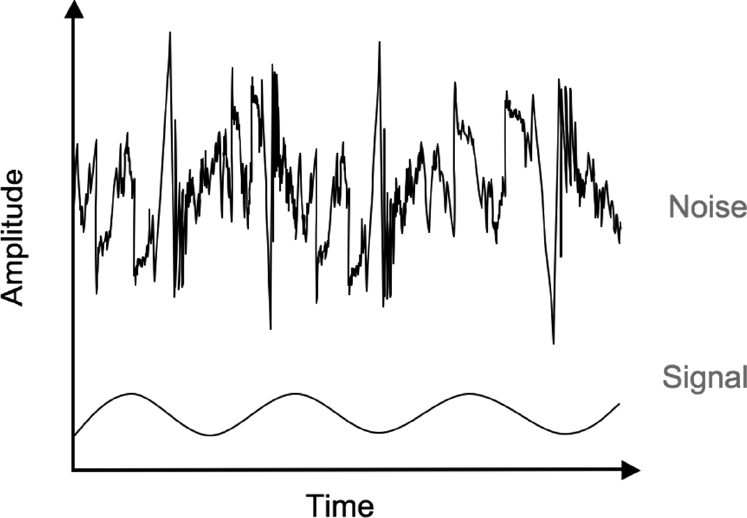
    This back-and-forth between “I believe in God” and “I don’t believe in God” in the setting of “I do not know / I cannot prove” in one’s singular mind or in a conversation between people seems to be an allegorical sine wave.

    Belief ————————————————————> (Time component)

    Non-Belief ———————————————————> (Time component)

    There is a time component here. The belief / non-belief statement is a spectrum. One might say, as an example, “I think I believe in God today but I am not sure” or vice versa. However, whether we are dealing with an individual, a conversation parter, a group of friends, or a culture / society, this spectrum of belief exists over time. The God / No God belief system alternates back and forth in conversation. If time is eternal, then this God / No God wall may be just as eternal.

    At best, this sine wave could serve a Hegelian purpose for a further understanding between the disparate ideas of God / No God. Sadly, humans are very limited when it comes to expansive thought and seem to be built to be tribal. We would rather insult, confine, or kill each other when deciding with 100% subjective security about the answer to God / No God. Our species is tragic here.

    I am yet optimistic that this metaphorical sine wave could be a helpful for human understanding. I have two reasons why I believe this idea has postive consequences.

    First, there is the element of time. Time suggests the eternal potential for change — physical, mental, environmental, psychological, or spiritual.

    Second, the subjective and objective qualities of life and thought always influence each other. Always. Such influences also require an element of time. Scientific discovery affects how we view the world metaphysically, including our views on religion. Poetry, music, literature, and the encompassment of all art influence how we think about science. The Forman Thesis is an interesting read in this area.

    Humans will not always make the right decision in this dialogue. We have a tendency to consider the “other” as “bad” or “ignorant” during such discussions. However, when done right, the realization that one cannot prove or disprove God has the potential for a good discussion using the component of time. A positive discussion here potentially can lead to advances in how humans look at the world metaphysically, especially when it comes to treating our neighbor and our planet with love, understanding, and a goal for betterment of all.

    Odds and ends:

    1. The “Not Even Wrong” blog (one of my favorites) has an interesting post about how Nature journal is using AI for its readers to help them come up with research ideas. Is this good for society? How is this process paid for? Answers are not clear.
    2. Theology and Science journal has an article from 2009 titled “A Mathematical Model of Divine Infinity.” Unfortunately, it is behind a paywall. I like how the article describes mathematical infinities. The modeling provides axioms which is a correct concept. I worry when axioms are considered a parallel to Platonic forms.

    image created by Meta AI