It was awesome to get my first peer-reviewed theology article published. It is now in the journal, Theology and Science (Taylor & Francis Publishing). https://doi.org/10.1080/14746700.2026.2637227
Phi-The-Sci: Equilateral Musings
I like to discuss the subjective and objective and how they often come together. Also, random musings.
It was awesome to get my first peer-reviewed theology article published. It is now in the journal, Theology and Science (Taylor & Francis Publishing). https://doi.org/10.1080/14746700.2026.2637227
I very much enjoy the journal, Theology and Science, published by Taylor & Francis. The latest issue has the following article: “St. Hildegard of Bingen’s Integral Ecology: Insights from Her Trinitarian Theology” written by Bruno Mello. Here is the link…behind a paywall (sorry). I subscribe to the journal, and it is not super expensive. I would recommend checking it out if you are able to financially.
St. Hildegard lived from around 1098 to 1179 ACE. She was a prolific Christian writer and mystic. I’ve always had an affection for the Christian mystics (and for some Islamic mystics as well). As a Christian myself, I appreciate the idea of loving God, believing in the deity of Christ, but not always going along with policies or doctrines of various church bodies even though I attend and am a member of a mainline Christian denomination. Here is an open access article on Christian mysticism.

St. Hildegard
In the article from Theology and Science, the author discusses St. Hildegard’s book, Causae et Curae, which is a medical treatise. In her writing, she uses the term, “Viriditas.” I like what Mello states in the article. He states that although viriditas means “greenness”, it also means, “greening power” of God. Mello beautifully writes, “Viriditas is the golden thread that runs through all of Hildegard’s theological writings…”
Veriditas can be inferred as the creative energy of God, and Mello states there are 4 ways to look at this term through St. Hildegard.
Literal sense: “Nature’s greenness” in all creation.
Allegorical sense: The soul of each human. Humans grow as the soul experiences.
Moral sense: Spirituality and holiness as seen through Christ.
Anagogical sense (i.e., spiritual or mystical): Communion with God as the ultimate “greenness in celestial and divine life”. The Trinity and the Eucharist are examples.
Have you ever removed yourself from the daily grind of traveling to work, sitting through boring meetings, doing the mundane tasks at work? Have you felt trapped by the absolute chaos that is social media? Research suggests that getting into nature makes a huge difference in improving one’s mental health. Going to the beach, hiking in the woods, going into the mountains — all of these places have the benefit of clearing one’s mind while creating peace. In a way, these are mystical experiences and perhaps have the possibility of being spiritual mystical experiences for those who lean towards religion.
For me, getting into nature is a way of communing with the Divine.

I took this picture of pine trees while skiing in the mountains in Feburary.
Humans are odd. You would think religious people would be more accepting of the world’s bounty and beauty (“greenness”) from a mystical approach. However, that is not necessarily the case as it depends on the religious movement (including drilling down into separate Christian denominations) as well the politics of the moment. That aspect is sad.
I have a daughter who lives very close to Manhattan, New York. When I visit her and walk through Central Park, I still can get this relaxed feeling even with other people walking or running close by.

Central Park, image from National Geographic
The idea of the Trinity in Christianity is old and not necessarily based on the books of the New Testament. Early Christian thought leaders, such as Tertullian came up with the concept. It is a beautiful idea, and I find it strange, satisfying, and yes, mystical.
Besides being a theological idea of Christianity, I think it also can be used as a metaphor. What do I mean by this? I have two thoughts.
One: Father-Son-Holy Ghost are all in a divine perichoresis or a divine dance of love with each other throughout eternity. They experience each other. They love each other. Readers of my blog will know that I write frequently about “panexperientialism” which is a common term used in process theology as well as in open & relational theology. It means that all have experience…from the smallest bits of matter to the entire universe. God, through God experiencing time and surrounding all of nature (“panentheism”), experiences all of what we experience. And I mean all — from quarks making particles to humans experiencing daily life to galaxies moving about with gravity. This is God in creation. This is God loving creation. This is viriditas.

Divine Perichoresis
Two: As metaphor but not as a theological concept, how would we think about viriditas here as we experience the world around us? I imagine a metaphor of the Trinity…the individual person (although one also can substitute an individual entity) interacting with all of nature (the universe) as well as interacting with God. If done well, this could be a perception or expression of the Divine Dance. We experience the universe and see its beauty. We love and appreciate God. The universe with all of its beauty and terror recognizes us while reflecting the eternal fire of lure of creativity from God. God loves us and God loves all of nature / the universe.
St. Hildegard was on to something special here even 1000 years later.
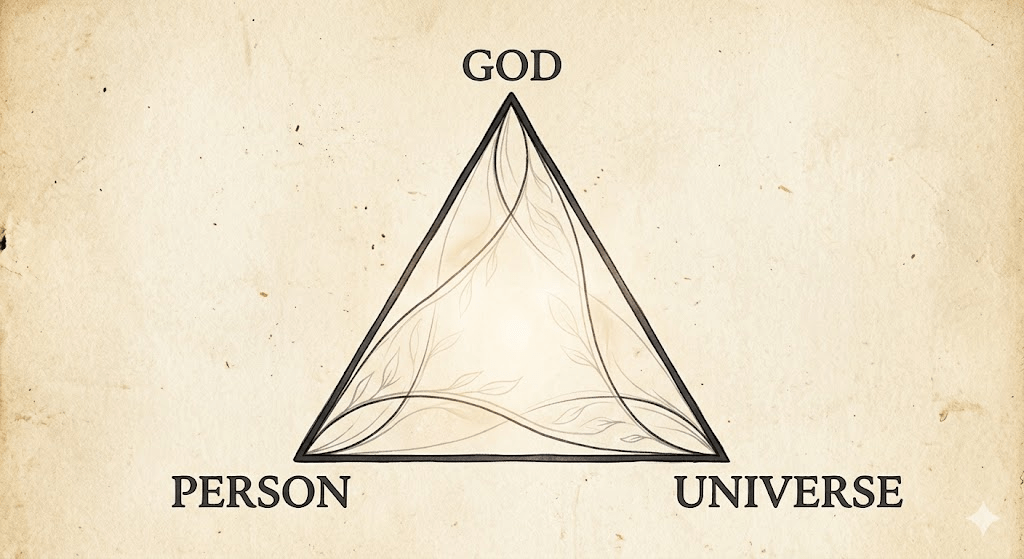
Image made by Gemini Advanced
I apologize for the delayed post. I recently finished a week of hospital call (always a busy time) followed by a short vacation with no computer access.
My vacation was a three-night camping trip at Goblin Valley State Park near Hanksville, Utah. The lovely thing about Utah is that some of the state parks are as beautiful as the national parks here but far less crowded.
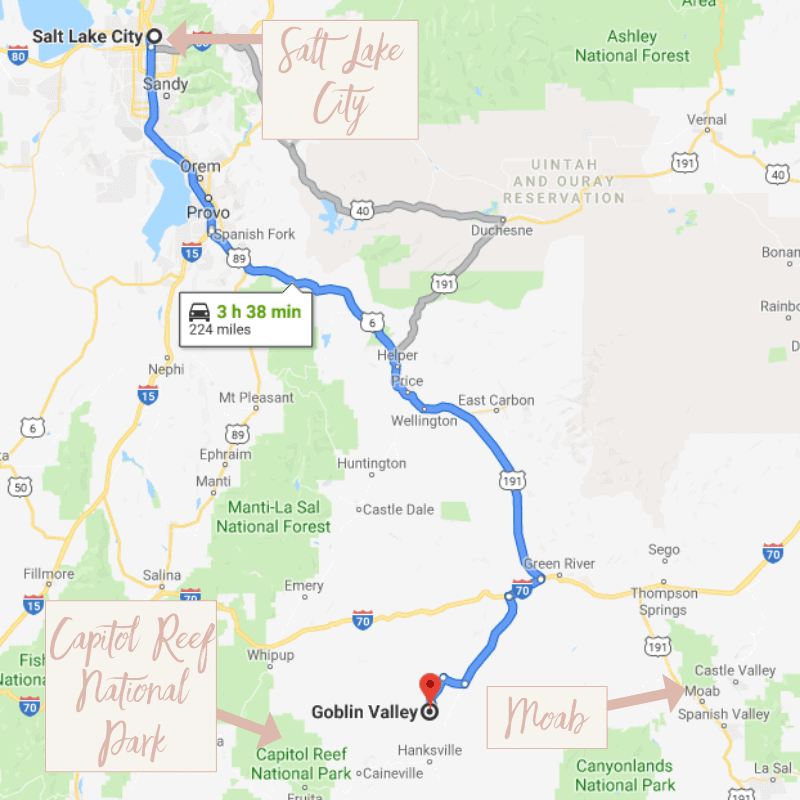
Goblin Valley has two main sections: 1) the hoodoo formations in 3 different yet connecting canyons and 2) the slot canyon area consisting of two separate canyons that connect.
The hoodoo section is a bit more famous. It consists of “hoodoos” which are geological structures consisting of soft rock like sandstone under a harder caprock. Typically, they are only a few feet tall. Millions of years of erosions make these eerie structures that appear alien-like in appearance. Hence, the name “Goblin Valley” is apropos. I guess one could look at these rock structures and assume they look like goblins. There are thousands upon thousands of these hoodoos throughout the park.

Hoodoos, Goblin Valley State Park
The hoodoo section of Goblin Valley has three canyons. Most people just explore Canyon 1 (see the picture below). My spouse and I searched out the other two canyons (2 and 3) which became much more spectacular since no one was there (it was hot and some climbing was required). The quietness of the other two canyons matched the amazing views.
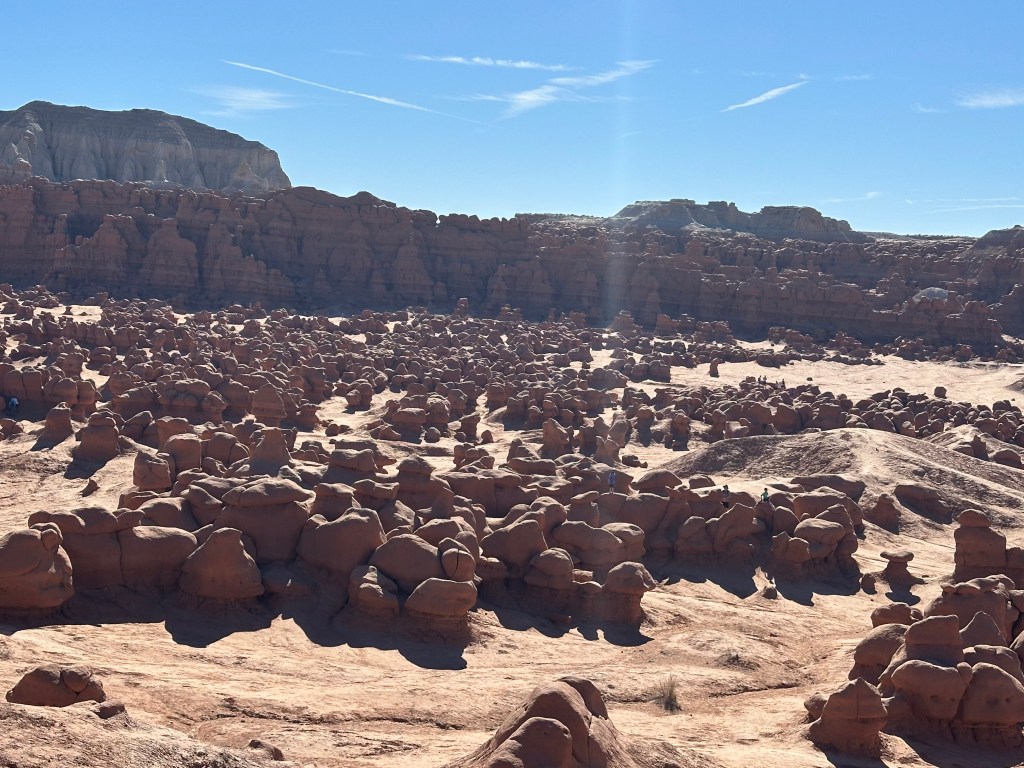
Canyon 1
The next day, we explored the slot canyons of Bell Canyon and Little Wild Horse Canyon. These two canyons connect in an 8-mile loop. It was hot (90 plus degrees Fahrenheit), and we had to pack water and food to make the loop. Most people don’t do the entire loop as the slot canyons require some climbing. The canyons were exquisite.

Slot canyon view. You can see how difficult it would be to climb over the terrain. We managed to do it.
What really impressed me was the immensity of the slot canyons. They would get quite wide in some regions and then get narrow at perhaps 2-3 feet across at other regions. One could see how people have died in the narrow sections when flash floods hit the area. Flash floods are not uncommon here. You should always check the weather before hiking in slot canyons.
I have told people that my hike in the slot canyons felt like walking through a Georgia O’Keeffe painting. The colors were outstanding. My spouse and I found this area of alternating black and red where water had come out of the stone likely for thousands of years (below).
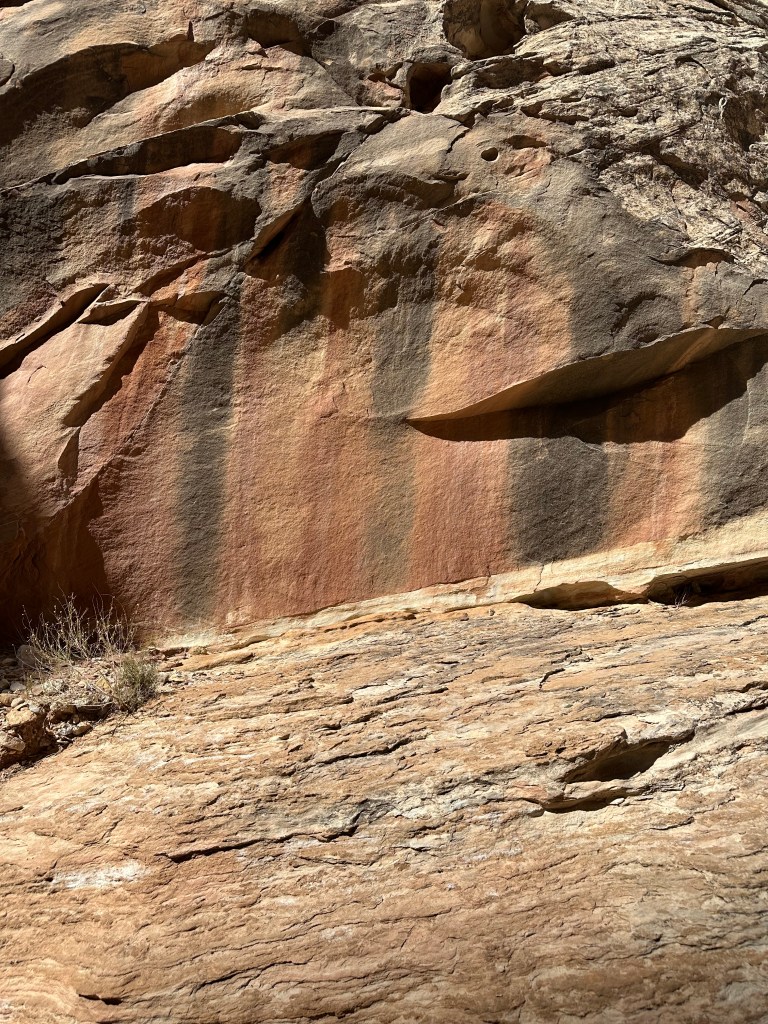
It was just beautiful. The color distribution was so evenly divided that it looked like a light spectrum although it obviously was not.
I found another section near the ground of a slot canyon with blazing red, orange, and brown colors (below). It trailed on for about 80 to 100 feet. It sure seemed to excel in what O’Keeffe was trying to achieve in her paintings.

I like to write about theology. I’m not sure what my camping experience says about God, but let me try.
Perhaps God lures for beauty in this world, even in the desert. Such beauty exists even in the setting of extinction (Goblin Valley was probably a muddy area near the Western Interior Seaway during the Jurassic period around 170 to 145 million years ago).
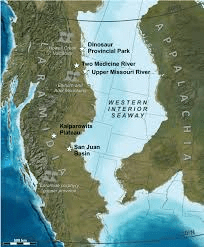
Image from Nature
This seaway was filled with life. As tectonic activity and erosion continued, the sea dried out producing today’s desert ecology and resultant hoodoos / slot canyons. It is hard to look at this area and to understand the past presence of abundant dinosaurs and food chains present in the distant past.
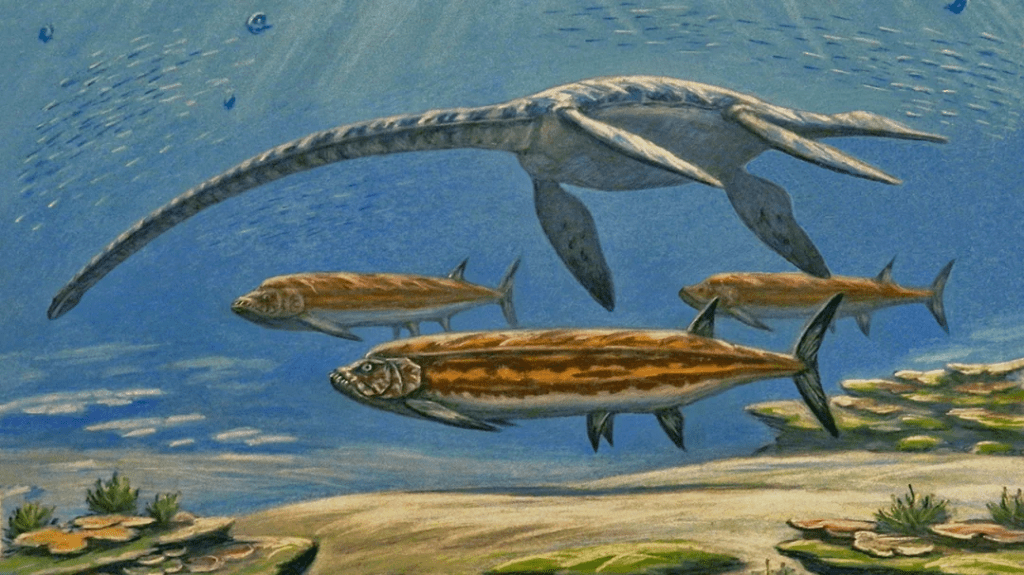
Over the millions of years of land elevation, loss of water, wind, and erosion, this area continues to be beautiful. We, as humans, are provided a gift of this beauty.
What does this say about the human condition in that we find areas like Goblin Valley beautiful? What does it say, perhaps, about God?
From a human perspective, we have both objective and subjective thoughts. Objectivity contains the rational. Perhaps you could put the subjects of mathematics and science as contained in human objective thought. Science has improved the world in so many ways. I’m a big fan of it. Heck, we would know pretty much nothing about the ancient history of Goblin Valley State Park without scientific knowledge.
However, humans also are subjective animals. This part of our brain contains the arts, literature, theater, and our emotional feelings about beauty found in nature. Why are we subjective when it comes to looking at nature? Some people think that we get profound emotions in the setting of nature as an evolutionary way for us to relax. Humans have leftover evolutionary responses to stress. Instead of looking for predators and for food sources, we are dealing with stress at work and with the stress living in urban environments. Getting out into a beautiful natural setting helps us reset from the fatigue of chronic attention and resultant stress. This idea is called “Attention Restoration Theory.”
Some people think that our human reaction to beauty in nature may be transcendental in nature. Yes, it is a natural, chemical reaction to love beauty, but there still may be a transcendental aspect to this feeling. This connection could be to the Divine. Perhaps science will help here. Perhaps emotional connection will help here. Perhaps our combined objective AND subjective mental aspects will help here. In other words, the beauty we see over millions of years of geological change and evolutionary pathways may be a way for us to see God IN nature without the chains of human-centered “woo” of pseudo-science or the non-science aspects of wooden, literal readings of our holy scriptures.
What does this mean about God? I feel strongly that the Imago Dei is divine love perceived by humans both objectively and subjectively. Perhaps a good reference article is here.
Readers of my blog know that I believe strongly that God lures for creativity at all levels of nature. God lures of “the good.” The good, in my opinion, is to have nature proceed with beauty and with spontaneity through time even in the setting of death and destruction. Creativity continues. Love continues. Natural laws may lead to the Second Law of Thermodynamics with all of its benefits and destruction. Natural laws lead to death. Yet, God is always there…breathing potential into our universe and into each of us. This is not a forced potential yet is a lure or a call for something new.
An ancient dried up ocean that was once filled with life is still beautiful millions of years later as a state park with amazing colors, majestic geology, and even life today. Insects, lizards, and birds are there today. And we humans are blessed to have the capability to visit.

Mosasaur from the Western Interior Seaway (U.S. National Park Service)
I’m slowly writing a new book as I have referenced in some of my prior posts. My current thought is that the book will consist of five chapters, and I am about done with the 4th chapter. I don’t want to talk about this book too much as I still have to write the 5th chapter and then I need to do a deep review of the first 4 chapters for accuracy and for deciding if more length is needed. It is quite a bit of work while doing a full-time job in a completely different field.
I have been reading about the aspects of human ethics and morality as part of the work for the 4th chapter. As a religious person, I do have some metaphysical assumptions here. However, the science behind human morality is quite fascinating. It is admittedly an incomplete science, but it is fascinating.
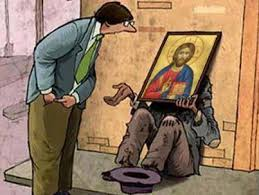
Image from https://anoddworkofgrace.blogspot.com/2016/09/but-love-your-enemies-do-good-and.html
One interesting article that I came across is titled, “The Psychology of Morality: A Review and Analysis of Empirical Studies Published From 1940 Through 2017” written by Ellemers, et al., and was published in Personality and Social Psychology Review in 2019. Basically, this paper is a meta-analysis of morality studies over several decades. Is there universal morality structures throughout worldwide cultures? The answer is “yes if one realizes the research is not great.” In other words, the authors clearly point out the many problems of comparing studies, including how thinking about morality actually affects or doesn’t affect behavior, the vast differences in such research studies, and the disconnect between theoretical research and experimental research when it comes to human morality. These conclusions make sense.
Another interesting article that I came across was titled, “Cultural Group Selection and Human Cooperation: A Conceptual and Empirical Review” published by Daniel Smith in Evolutionary Human Sciences in 2020.
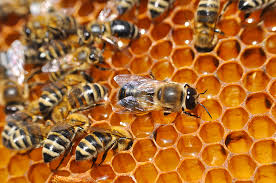
Honey bees
This article is a bit different. This article looks at the validity of “cultural group selection.” If we consider “kin selection” as related individuals putting their reproductive capacity at risk in order to promote the well being of related individuals and “group selection” as unrelated individuals putting their reproductive capacity at risk to promote the well being of the species as a whole, then “cultural group selection” might be considered a type of group selection that promotes a specific culture. Extensions of cultural group selection could include 1) the selection of subjective thought to promote culture (i.e., the arts) and 2) legal systems.
By the way, honey bees are an example of kin selection; tamarins are an example of group selection.

Emperor Tamarin
The problems (as the authors point out) with culture group selection are the following:
-Different definitions of cultural group selection so there is no unified definition.
-Different definitions of altruism which complicates placing evolutionary theory into cultural group selection.
-No mechanism defined for cultural group selection,
-Group behavior changes do not always adapt existing cultural norms.
-Ecology / the environment has a big effect on cultural group selection.
-Cultural group selection does not necessarily correlate with genetic fitness.
-Individuals may benefit more from certain aspects of cultural group selection as opposed to genetic fitness. In other words, cultural group selection may (at times) be just as important and perhaps more important than genetic features.*
*Let’s concentrate on this last idea. First of all, this idea suggests some type of environmental epigenetic features in which the environment itself influences genetic outcomes. The environment in this setting could be one’s religious / non-religious perspectives, how one was raised, where one goes for community activity, etc. A good reference is here. Just to be clear, I have met very moral religious and non-religious people. I also have met very immoral religious and non-religious people. I am not being selective here.
Let’s further suppose what this idea means from a love standpoint. I’m talking about agape-type love or a universal love of the other.
Should we have a universal love for the other? Personally, I think it would help our planet quite a bit to care for each other and for the planet although we seem to perpetually be a violent species. However, at times, I see this agape coming through in history.
I think about various groups hiding Jews from the Nazis during World War II.
I think about the beauty and love demonstrated in hospice care.
I think about people helping slaves in the United States cross into the northern states during the U.S. Civil War.

An example would be Harriet Tubman.
I think about ideas surrounding an expansive view of Muwatanah in Islamic society.
I think about John 15:13, “Greater love has no one than this: to lay down one’s life for one’s friends.” I think “friends” is quite an expansive term here.
I am going to make a metaphysical statement here. I propose that the act of caring for the “other” (for which “other” is an expansive view) is more helpful for our human species than being individualistic, materialistic, or capitalistic.
Further, I am going to make another metaphysical statement. I propose there is something inherently “good” in the setting of nature or the universe when we care for the other.
I personally think this call for the good is God. I think it is God who is in, through, around, and outside of nature as I have described in the past — defined theologically as panentheism.
Notice that I used the term “call.” God isn’t forcing here. I think God calls for nature and perhaps, just perhaps, potentially and especially for us on Earth.
God, I think, call for us at every moment of time to be loving, to be good. God calls for nature to be creative, to be novel. At every moment in time, nature, the universe, you, and me can choose the good / the creative. It is nature’s choice (and thus our choice) to choose the good or not. This choice is freely made. God lures but does not force.
I think nature / the universe is contained in God (panentheism), so a biological aspect of moral choices as in genetics or epigenetics makes sense. God calls for us to consider the choice of morality through our biology and through our world.
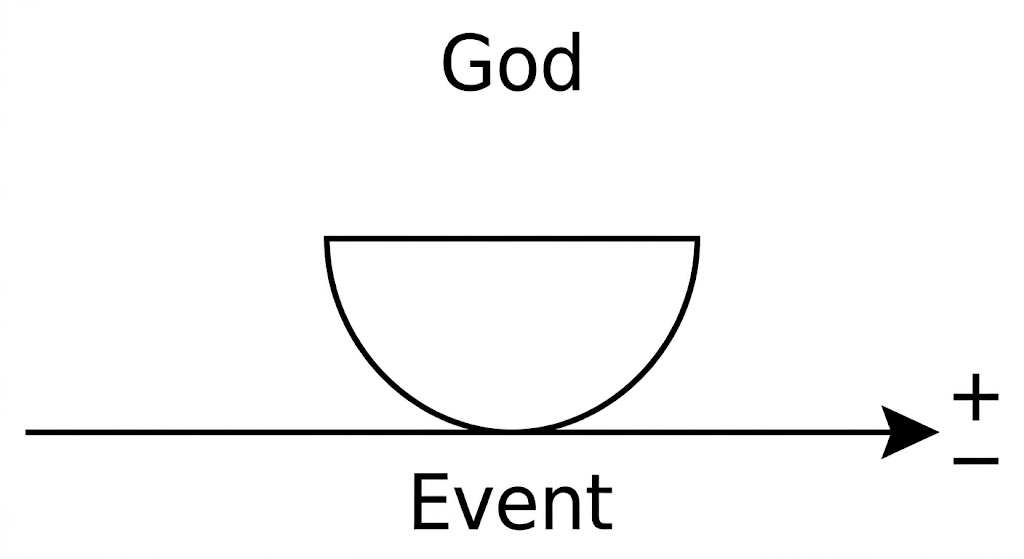
Here is my idea from my post encapsulated as an image. An event emanating from an entity happens in time. God interacts at one point in that event to call or to lure for creativity. The entity in time of the event has the decision to be creative (“+”) or not (“-“).
As one gets older, the second law of thermodynamics seems to kick in a bit more with me, and the body starts the process of slowly breaking down.
Unfortunately, I recently scheduled tons of medical visits over a 5-day period. I was not paying attention to the fact that I had bunched these appointments all together. Such appointments consisted of annual visit with my PCP, my every-2-year colonoscopy, and my annual artificial cardiac valve testing. I may work in healthcare, but I hate being a patient even though I am pretty “type A” following up on my personal health needs.

I get my care at the University of Utah.
As I once again underwent my colonoscopy, I was sedated with propofol. I have had a few diagnostic colonoscopies at this point. I also have had very deep sedation with paralyzing agents given to me twice due to open heart surgery.
I like to think about what I am experiencing while I am slowly being sedated. I think about how my body’s nerves are changing based on medication. I try to think about how long I can continue with conscious thought. I have had so many procedures at this point that sedation doesn’t really bother me psychologically as it does to some people. I have friends who are terrified about sedation.
My scheduled colonoscopic examinations always consist of propofol, which by the way, is the same sedation that I use on my own patients as I am a pediatric gastroenterologist. Propofol is an interesting drug. You go into deep sedation very quickly. It is typically given as an infusion. Once the infusion is stopped, it is amazing how quickly one wakes up with no real sedation effects. Propofol works by causing large amounts of chloride to enter postsynaptic neurons. This extra chloride basically “short circuits” the neurons of the central nervous system leading to deep brain sedation. The drug is eliminated quickly through the liver, kidneys and lungs. The multiple paths of propofol’s elimination is why people wake up quickly once the drug is stopped. Honestly, it is an amazing drug.

Propofol
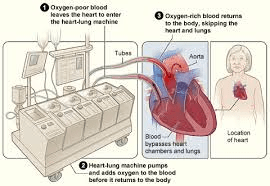
I have had several colonoscopic examinations, one transesophageal echocardiogram (an echocardiogram performed through the esophagus), and two open heart surgeries in which I was exposed to heart-lung bypass. I have always experienced unconsciousness during these procedures.
Weirdly, when I wake up, I do feel that time has passed even though I don’t specifically remember time passing while under sedation. Also, I don’t remember anything during the procedure.
These personal experiences of being potentially close to death (especially with open heart surgery) make me think of the idea of near death experiences (NDEs). Such events have been reported occurring between 6% to 40% of patients who experience cardiac arrest. There is some commonality among those who undergo NDEs…feelings of peace, being surrounded by light, and being outside the human body.
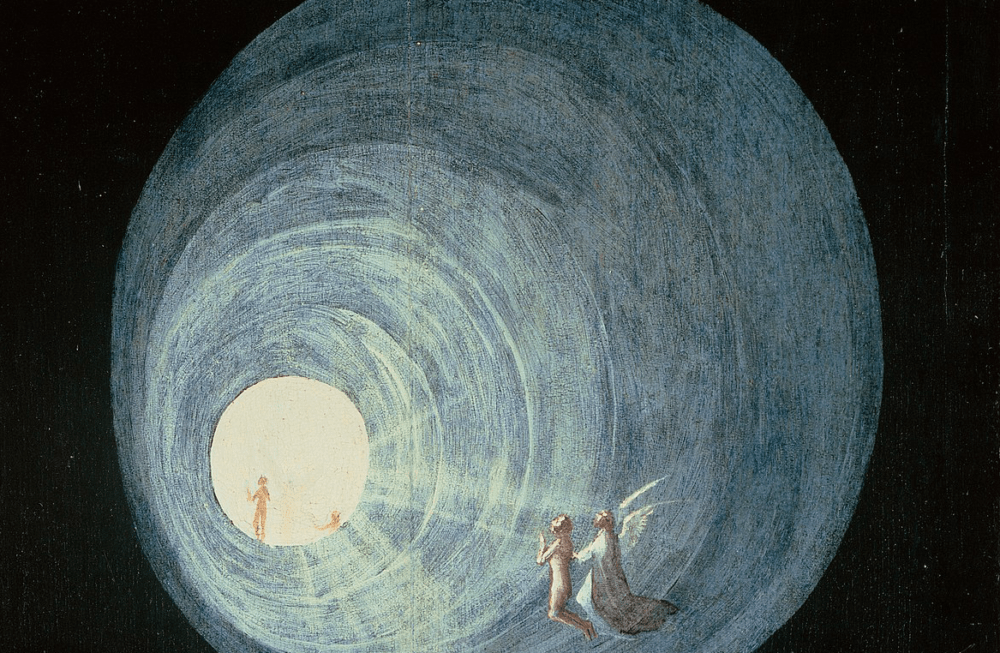
When I underwent open heart surgery for valve replacement in 2012, I did undergo somewhat of a temporary cardiac arrest. It is impossible to replace a heart valve in a beating heart, so potassium is added to the heart to make it stop. My surgery was several hours long. My heart was stopped during some of that time period. Absolutely no NDE happened. I was just unconscious.
My first thought here is that I believe NDEs cannot be studied by the hard sciences. Yes, they can be studied psychologically, historically, and sociologically as part of of human experience or societal experience. I just don’t see how any type of instrument can be used to see if NDEs actually occur. NDEs are not subject to study by mass spectroscopy, Western blot, microscopy, or atomic collider. I think NDEs are filled with subjectivity with little objective illumination. Subjectivity, just like consciousness, often is hard to explain materially.
My second thought is that the older I get and the more I learn, the more I wonder if spiritual dualism can even be a thing. Are we both body and soul? Do body and soul separate at death? Does the soul (or psyche), per Plato, have an eternal existence that was present before and definitely after its associated material body dies? As conceived in much of Western contemporary Christianity, do our souls separate from our body which then are condemned to Hell or blessed in Heaven eternally?
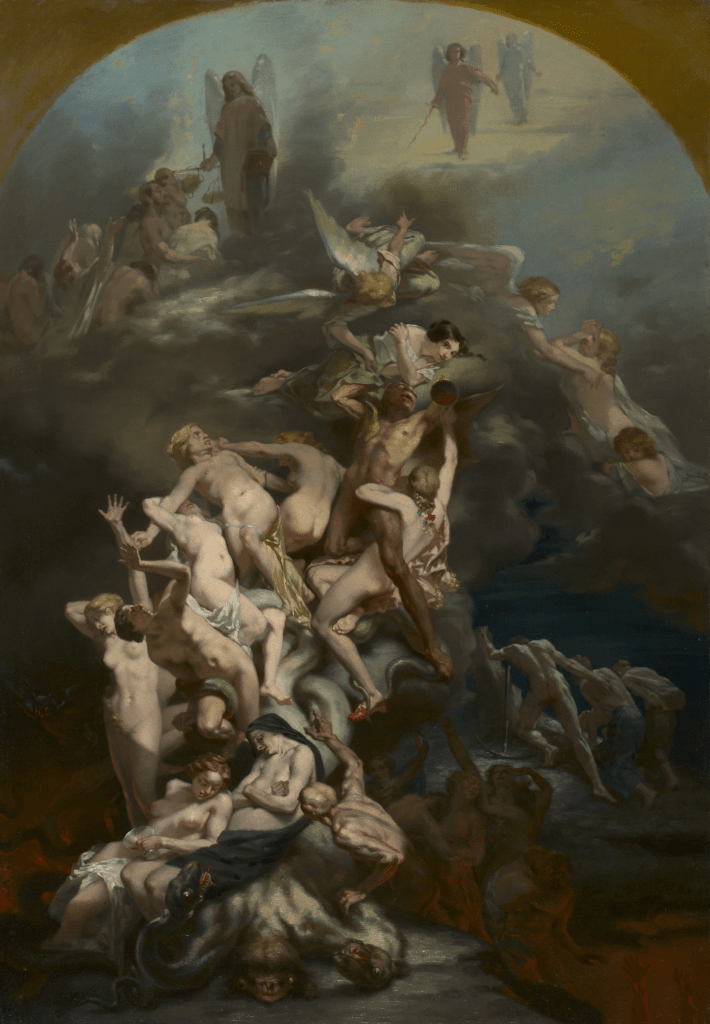
Heaven and Hell, by Octave Tassaert
As we learn about so many aspects of the universe, I wonder if these ideas are even close to possible. As we learn more about the world, does it change our theology? Our philosophy? Our metaphysics? Our thought on what the afterlife means?
The universe appears to be expanding faster and faster. Time is relative and not continuous throughout the universe. Time, in fact, may be structural in the setting of general relativity. A particle and wave co-exist in quantum mechanics. Quantum entanglement exists. Random genetic mutations existing in massive quantities leads to morphological changes in creatures producing innumerable species on our planet. Life began somehow from unalive sources.
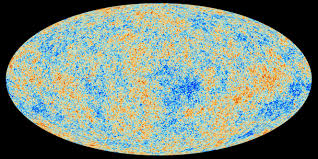
Cosmic microwave background
On the human level, we are living longer and longer. Once deadly diseases are now curable, while at the same time, new diseases are becoming common due to our living longer. We are more urban. We live with electricity. We have many ways of destroying all of human civilization, not just a local village or small kingdom.
For me, the fact that the universe becomes more mysterious despite learning more about it, makes me think we do not have any grasp of what a potential afterlife entails. There may be some objective reality regarding the afterlife that our little human brains will never understand.
In the end, all of our scientific endeavors will still often lead to blind alleys (epistemic limitation) or to alleys that we cannot find (idealism). For me, the fact that a nuclear war or intense global warming could destroy all remnants of H. sapiens, makes me sure that the world is not black and white. The world is not bimodal Heaven or Hell. The effect of our species on the world is simply “gray” in that reality is too complex and too interconnected for us to say, “This person is definitely going to Hell” or “That person is definitely going to Heaven.” We all, to some degree, deserve both credit and blame for what happens locally, geopolitically, and planetarily.

William James in The Varieties of Religious Experience writes the following:
“The difference in natural ‘fact’ which most of us would assign as the first
difference which the existence of a God ought to make would, I imagine,
be personal immortality. Religion, in fact, for the great majority of our own race means immortality, and nothing else. God is the producer of
immortality; and whoever has doubts of immortality is written down as
an atheist without farther trial. I have said nothing in my lectures about
immortality or the belief therein, for to me it seems a secondary point. If
our ideals are only cared for in ‘eternity,’ I do not see why we might not
be willing to resign their care to other hands than ours. Yet I sympathize
with the urgent impulse to be present ourselves, and in the conflict of
impulses, both of them so vague yet both of them noble, I know not how
to decide. It seems to me that it is eminently a case for facts to testify.
Facts, I think, are yet lacking to prove ‘spirit-return’…”
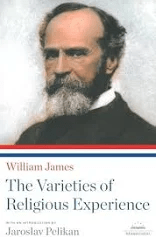
I read his words here as to mean that religious people (such as me) prioritize the existence of God first while everything else becomes secondary to that belief. In other words, if God is the priority or immediate belief, then the afterlife, ideas of Heaven and Hell, and the ideas of the immense number of human religions are simply secondary. As such, these secondary ideas are filled with our subjective beliefs. We cannot prove the miracles of Jesus although we may believe in them. We cannot prove the divine inspirations of Muhammad although we may believe in them. We cannot believe in the eternalities of the Buddha although we may believe in them.
Our individual thesis about the existence or non-existence of God is based on both objective knowledge looking at the world around us which is of equal importance to our subjective feelings, emotions, and beliefs about the existence or non-existence of God. Everything after that (such as ideas of the afterlife) seems to be mainly based on more subjective ideas manifested by all the religions of the world.
How do I think of the afterlife? Well, I think there is an afterlife. Granted, my belief here is more subjective than objective. I do have two thoughts.
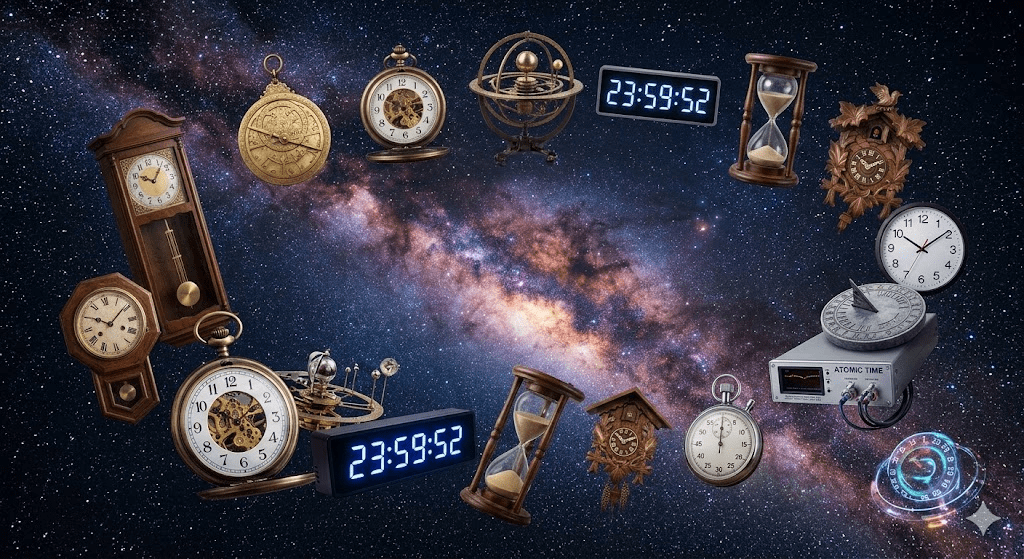
Image generated by Gemini Advanced
“The electron blindly runs either within or without the body; but it runs
within the body in accordance with its character within the body; that
is to say, in accordance with the general plan of the body, and this plan
includes the mental state.”
–Alfred North Whitehead, Science and the Modern World
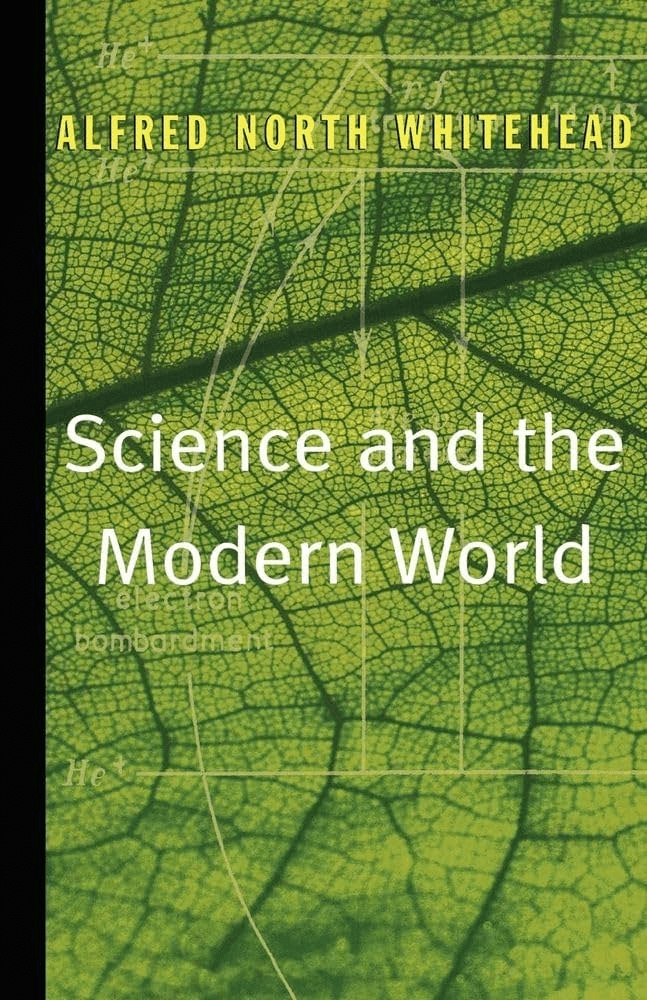
I have always found the above quote fascinating. It comes from one of Whitehead’s many fine books. Whitehead’s work in process philosophy has had a tremendous influence in the setting of process theology and open & relational theology. In fact, there is considerable overlap in these three areas of philosophy and theology.
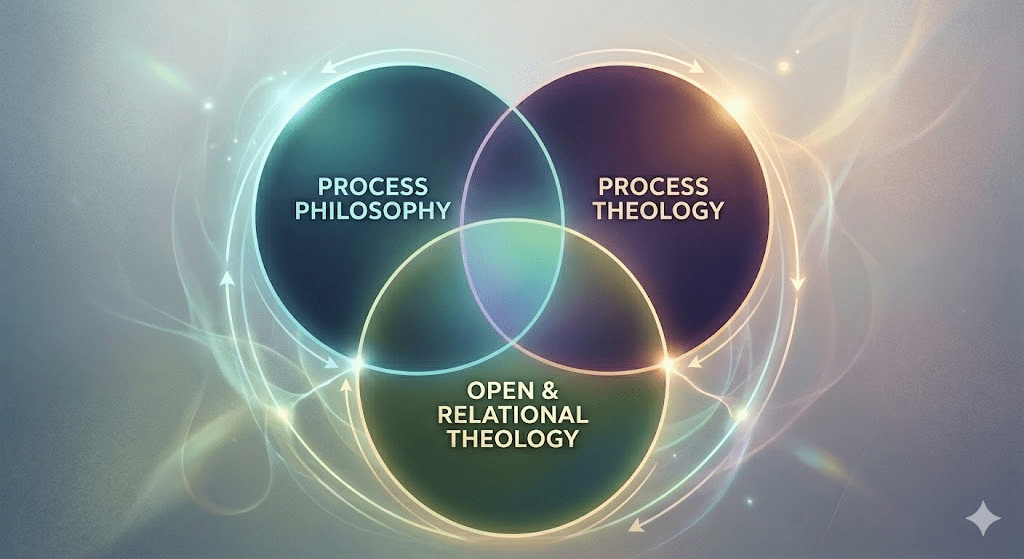
I made this image using Google Gemini.
In this post, I am going to think about the term “panexperientialism” which is contained in these three ideas. Panexperientialism means that all experience. The electron experiences charge, mass, and spin. Humans experience the objective and subjective at every moment. Galaxies experience gravity and rotation.
Consider this aspect. Every large structure also experiences the effects of its smaller components as well…sort of like nesting dolls. For example, a human experiences the effects of all his / her cells (including the non-human microbiome cells). The cells experience the effects of all of the organelles inside it. The organelles experience the effects of their molecular structure. Molecules experience the effects of their atomic structure.

Nesting dolls
One can then consider that the experience also goes the other way…atom to molecule to organelle to cell to human. Each smaller system is experiencing the effect of the larger system that they are contained in.
And the effect could grow even larger as well…human to society to nature to planet to solar system to galaxy as well as in the reverse.
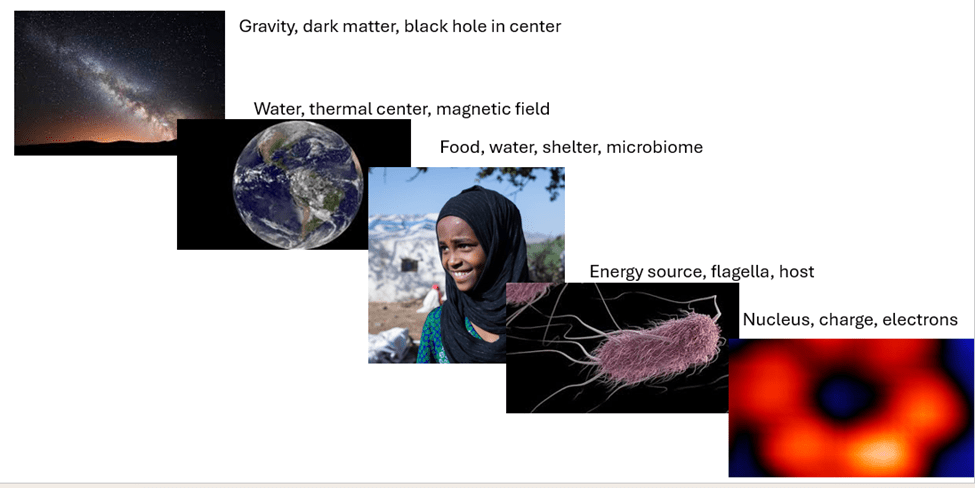
Slide from my IRAS talk (https://www.youtube.com/watch?v=B8Id8-zQCVA)
I want to just consider a thought experiment which is not the least bit scientifically provable. This “experiment” is more of a theological idea in the setting of panexperientialism.
I want to consider the idea of entanglement for which I am not an expert.
The basic ideas of entanglement are as follows: If a system is maximally possibly known (no statistical mathematics involved) and if the system has two particles, such as electron A and electron B, then the two quantum systems of electron A and electron B will combine to form a single quantum state. Electron A no longer has an independent quantum state. It is now “entangled” with electron B.
Thus, although electron A is in a quantum state and has statistical uncertainty, the interaction between electron A and electron B is known. Whatever is measured of electron A will lead to knowledge about electron B since the two quantum states are now a single quantum state.
Here is the weird thing. This entanglement between electron A and electron B is independent of distance. Electron A and electron B could be on other ends of the Milky Way galaxy and still be perfectly entangled. A great explanation is here.
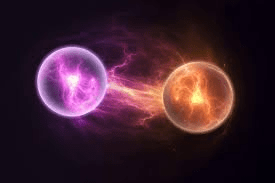
Image from New Scientist Magazine
Okay, on to my theological thought experiment.
Let’s say that Electron A and electron B are entangled. Then let’s say that electron A is in the limbic system (the emotion center) of my brain while I am experiencing something emotional. Then, let’s then say that electron B is hanging out near Proxima Centauri. Since these two electrons are entangled, do they have a panexperiential quality of my experience? I like this idea.
On the other hand: From my understanding, this idea makes little sense scientifically. Entangled particles seem to be disrupted when they interact with any aspect of the environment. Also, there is some difficulty in understanding how entangled particles could carry information (I assume due to the effects of environmental interaction).
However, theologically, if every entity experiences, then how can one NOT say that the subjective experience of the electron in my brain is not affecting the experience of an entangled electron somewhere else right away?
Notice that I am not using the word, “panpsychism”. Panpsychism suggests some consciousness at every level of reality, even at the particle level. I am suggesting panexperientialism, not panpsychism.
Experience is not necessarily consciousness. If I throw a rock in the air, the rock experiences my throwing, the rock’s velocity, the effect of gravity, etc. It is not conscious of my throwing. I realize that some may find my statement different from what Jesus expressed in Luke 19: 39-40, but those verses really have a different connotation.
Experience…perhaps if particles, molecules, and humans have the possibility of entanglement, then perhaps they experience each other. This experience cannot be proven scientifically, but it can be considered theologically.
God in the setting of panentheism (“all in God”), then would experience all of reality in real time. God would experience our joy and our sadness. God would experience our birth, our life, and our death. God would experience us from our singular bodies to our consciousness to our electrons.
I find such an idea comforting as God is not some distant entity. God is there with us in real time. And if God is love (which I believe), then God is loving us through our experiences. Even at the level of our electrons.
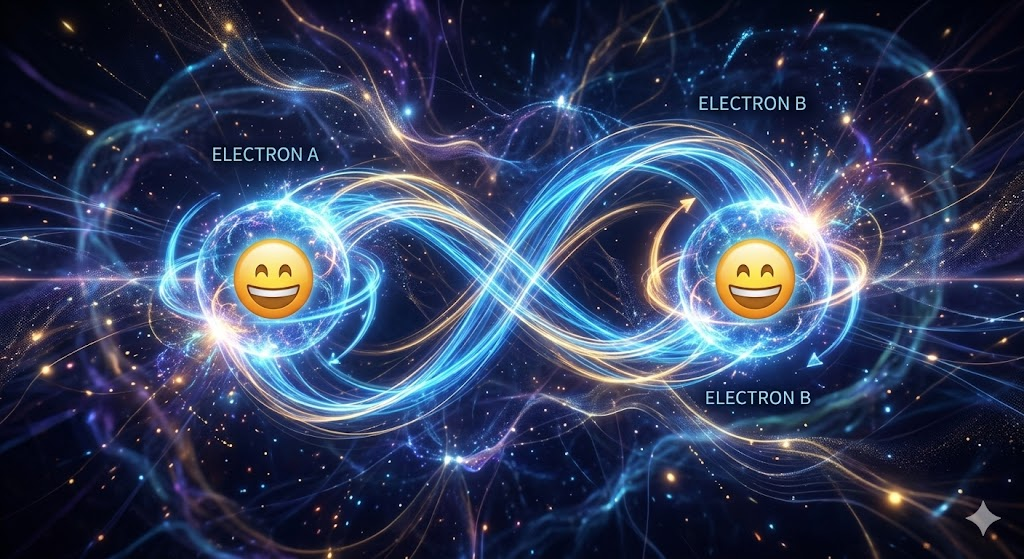
Image generated by Gemini Advanced
I have been reading about the Axial Age which is defined as an approximately 200 year period (500 – 300 BCE) in which the main religious traditions of Eurasian society began. Of note, some people extend the Axial Age a bit farther out on either end of the time spectrum. The term, “Axial Age” was coined by Karl Jaspers (1883-1969). Jaspers was a philosopher who started off as a psychiatrist. He came up with this term although many others had considered similar ideas previously.
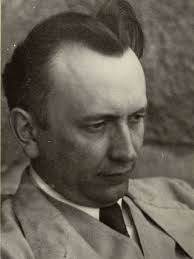
Karl Jaspers
Like any axis providing a turn of the wheel, the idea of the Axial Age is that human thought changed or pivoted around a certain period.
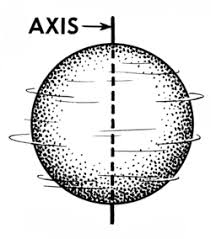
Specific thought leaders during this time period include Socrates, Pythagoras, Buddha, Mahavira, Confucius, Lao Tse, and the various Hebrew prophets. In some ways, this list makes sense when one considers that philosophical and theological paradigms that arose from these individuals.
It is unclear why this time period had the association of the Axial Age. Some have attributed it to a change in Homo sapiens cognitive ability. Some have attributed it to the formation of urban structures allowing population density and the exchange of ideas. Some have attributed it to a change from short-term material needs to long-term spiritual desires. Perhaps the rise of early city states with the association of agriculture for food and city walls to protect populations provided people time to think, to cognitively change, to philosophize.
It is a fascinating idea.
However, there are issues here:
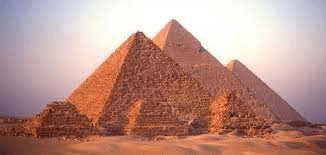
The Egyptian Pyramids
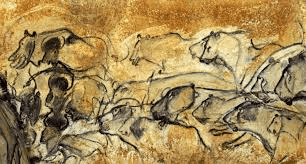
Chauvet Cave, southern France
2. The Axial Age may not be such a compressed time period. Two hundred years (or so) seems long, but in the setting of the first H. sapiens bone fragments going back 300,000 years, 200 years is quite small. This would be 0.07% of the time of the known existence of our species. Newer research suggests that there, in fact, may be no Axial Age as “axial” shifts may have been occurring as early as 3000 B.C.E. in areas such as Cambodia or Japan. Thus, the development of proto-modern human culture may have occurred over millennia, not centuries. As always, more research is needed here.
3. I have a hard time explaining why Jesus (as the founder of Christianity) or Muhammad (as the founder of Islam) would not be considered in the context of the definition of the Axial Age above. Jesus lived approximately 300 years after the Axial Age; Muhammad lived 900 years after the Axial Age. Although one can point to the influences of important Axial figures and cultures on the teachings of Jesus and of Muhammad, it also be remembered that all past cultures influence present cultures, religious or not…Axial or not. I would argue that the rise of both Christianity and Islam have caused profound changes in the world, far more than many of the figures listed as belonging to the Axial Age.
4. Finally, I am going to make an argument from process philosophy as to why the Axial Age idea may be problematic. If one looks at the Axial Age as a directional evidence occurring in history, one might fall into Georg Wilhelm Friedrich Hegel’s camp in stating that “teleology is a structure of reciprocal interaction.” In other words, history is directional. It has a purpose. I don’t know if history is directional.
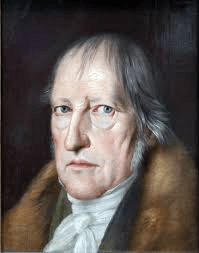
Hegel
I recall my father who was a military historian telling me that war provided evidence that there was no direction in the human experience.. There was to be no final war (outside of a potential nuclear holocaust). Wars would just continue. Kingdoms and countries would rise and fall. I find truth in that.

5. However and in contrast, I like the ideas as expressed by Alfred North Whitehead in his famous book, Process and Reality. In the book, he states, “Neither God, nor the World, reaches static completion. Both are in the grip of the ultimate metaphysical ground, the creative advance into novelty. Either of them, God and the World, is the instrument of novelty for the other.” In other words, things change as time moves on. Things in history may repeat themselves somewhat (as in convergent evolution), but change is in the air. Change is all we have as our ground. The only “purpose” in world history may be change itself without direction.
Now as someone who is a proponent of process theology / open & relational theology, I think it makes sense that God is the “still small voice” to give nature the opportunity to have directionality for the good or for the creative. All of nature (including our species) has free choice here. Original sin or not, we generally seem to demur to the Divine Lure. Thus, the Axial Age doesn’t seem to make sense to me.
6. One final thought…it appears that the world is quickly becoming less religious. How would this not be a new Axial Age in line with Jaspers’s definition? Is this directional? Is this just novelty in time? Is this simply change itself? More philophical and theological work is needed here.

Image generate by Gemini Advanced
This weekend, I was a panelist for a session of ORTLINE 2026. ORTLINE stands for “Online Open & Relational Theology Conference.” This international online theology conference occurs annually over three days and is used to discuss very intriguing books on theology — Christianity as well as world religions. It is a great conference, and I recommend signing up for it even if you are not a theologian or pastor.
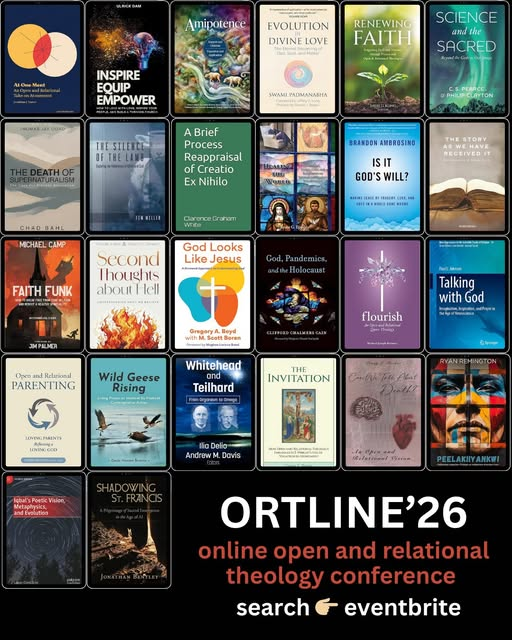
I was asked to review (as part of a panel discussion) , “Science and the Sacred: Beyond the Gods in Our Image” by C.S. Pearce and Philip Clayton. It’s a great book. I’m not sure if should paste my whole review as a panelist as I want to respect the organizers of the conference.
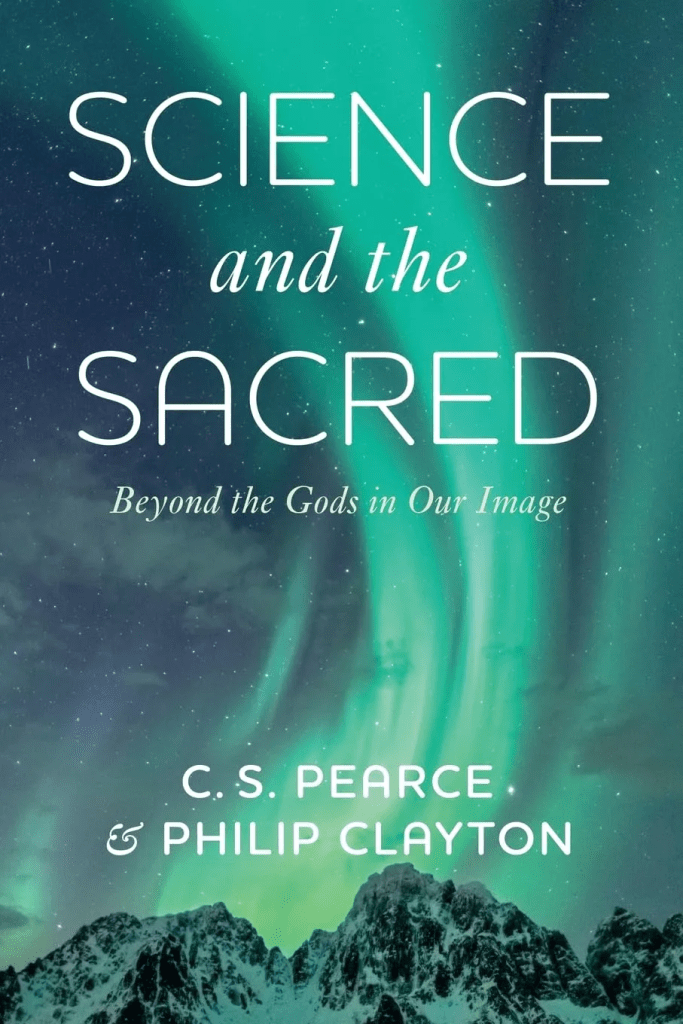
This book is really a great read for lay persons trying to understand how both theists and atheists can look at the world and find common agreement among scientific topics that extend into protecting our species and our planet. The authors go over specific issues including the Big Bang, biological evolution, human consciousness, human sexuality, and many other topics. Clayton is a theist; Pearce (now unfortunately, deceased) is an atheist. Both are well-known individuals in regard to their academics and their writings. They both are pro-science. I found myself absolutely loving this book.
The authors discuss the pros and cons of the theological idea of panentheism. Panentheism basically means “All in God.” This term makes sense to me. All of nature. All of the universe. All of reality. All are in God.
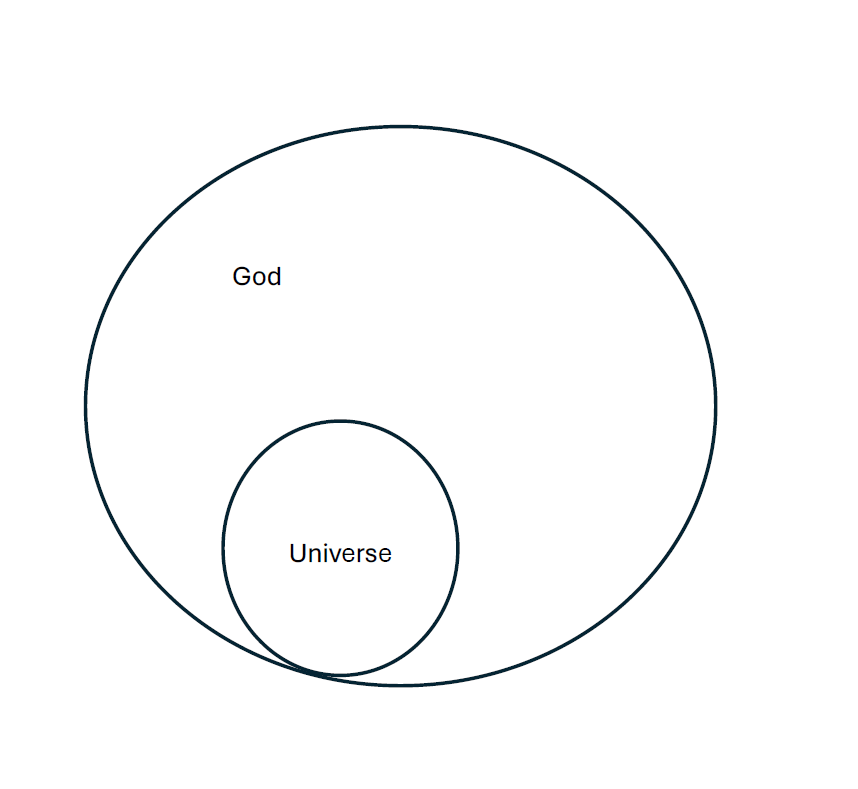
My diagram of panentheism
This term is different from pantheism (no “-en”). I would interpret this term as “nature is God” or “the universe is God.” Famous people who have leaned into pantheism would include Baruch Spinoza and Albert Einstein.
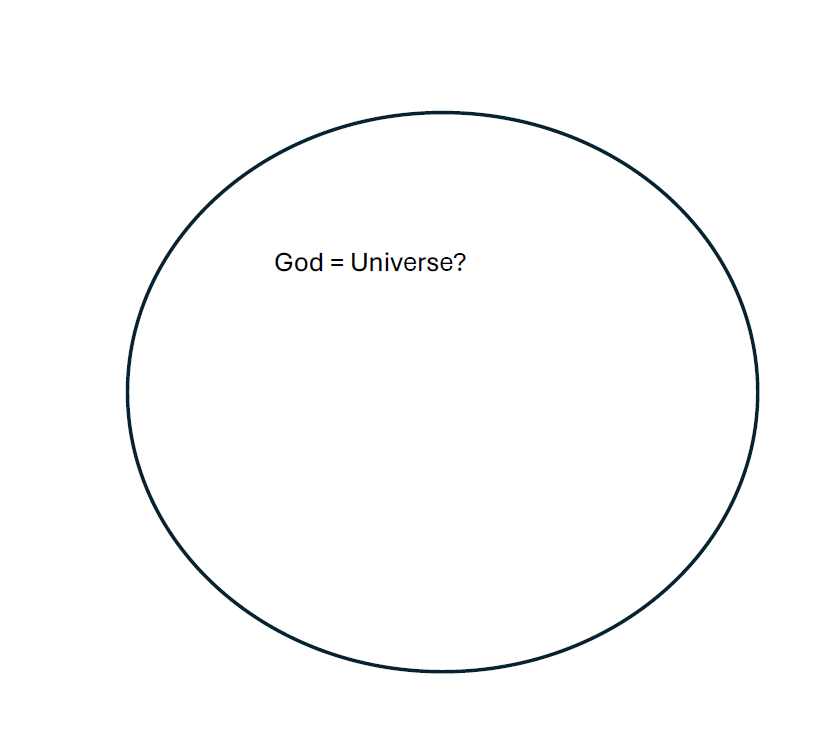
My diagram of pantheism
When I gave my presentation today about the book discussed above, I provided the following critique:
“One small criticism of the book… I am very much in agreement with the idea of panentheism – I believe very much that all of nature is contained in God. However, due to the closeness in pronunciation to ‘pantheism’, I think the authors need to consider how this book differentiates panentheism from pantheism. Complexity over time, the possibility of the universe learning, various religious claims searching for a divine entity…How is this not the universe itself learning and perhaps even luring (for creativity)?”
I guess my concern is relatively minor, but I wonder if we can provoke the issue the following way: Can the possibility of panentheism answered theologically or metaphysically have a “yes/no” response to potentially being true? Or does it have a spectrum answer or spectrum response?
For example, consider the Trinity. I am a Trinitarian. In the Christian world, the Holy Trinity is a pretty big deal. I am not a “Quartinarian.” I think I just made this word up. I don’t believe in the sameness of God, Jesus, the Holy Spirit and whatever “X” factor would make sense as a Quartinarian. It is a yes/no response when considering a Trinitarian concept of God. You either accept it or not.
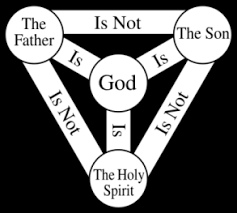
From the Stanford Encyclopedia of Philosophy
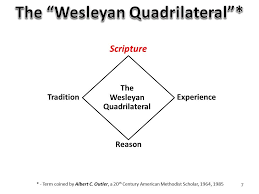
Consider the Wesleyan Quadrilateral. I don’t worship in the Wesleyan Christian tradition although I respect it greatly. I don’t think a “Wesleyan Pentagon” would make sense in that tradition. The importance of scripture, reason, tradition, experience with the addition of whatever “X” factor to the Wesleyan tradition would not seem logical in that tradition. It is a yes/no response to considering the Wesleyan Quadrilateral. You either accept it or not.
I am not Muslim, but one of my closest friends is of that faith. The Five Pillars of Islam is an inherent part of that world religion. The importance of a declaration of faith, obligatory prayer, compulsory giving, fasting during Ramadan, and a Pilgrimage to Mecca with the addition of a whatever “X” factor to make the Six Pillars of Islam would not make sense in this religion. It is a yes/no response in accepting the Five Pillars of Islam. You either accept it or not.

By the way, the examples above are theological arguments. I’m not interested if you answer “yes” or “no.”
Yes/No: Here is the argument that I am working on from a very preliminary perspective when it comes to panentheism. The similarities of the universe responding to us either through the universe itself (pantheism) or through the universe in God (panentheism) seems almost a “spectrum” response. There seems to be more than one possibility. There seems to be the potential for combinations of possibilities.
Consider:
1) Maybe there is just the universe with no God (atheism, materialism). 2) Maybe the universe and God are the same (pantheism). 3) Maybe the universe is running on its own with God having set the initial conditions (deism). 4) Maybe the universe controls nature no matter how much God lures for creativity (extreme open theism, some interpretations of process theology). 5) Maybe God lures all of nature for creativity since the universe is in God (some interpretations of process theology, open & relational theology, panentheism). 6) Maybe there is a universe and God with God controlling everything (theistic determinism). There seems to be a spectrum here with the potential for overlap.
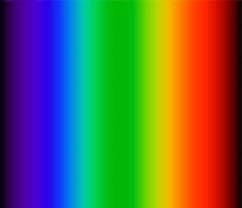
The spectrum of light (from Arizona State University)
As an example, when I look at how the universe works from my simple perspective of doing some small degree of clinical research in the field of medicine, I obviously look at results of my work from a scientific perspective. If I expand my results to a metaphysical perspective (not a scientific perspective), I can see my results fitting all 6 options above. There is overlap.
So, I definitely am a panentheist. I embrace panentheism wholeheartedly. I am fine if a person tells me that my metaphysical belief system is wrong. However, I can’t envision that same person give me a valid binary “no” because they would have all of the other options that I listed above available (and there likely are more options).
Maybe, I should experiment with “theism-en-pan”…Theismenpan…sounds really complicated. My AI (Google Gemini) tells me that the better Latin wording is “Deus in omne” or “God in All.” God is in all 6 options above and even in options that I cannot comprehend. As someone who has done work in process theology / open & relational theology, I imagine this God-In-All lures all creation for the good, for the novel, for the creative even in ways beyond our universe and unto God’s self.
Image from NPR
I have been reflecting on the recent racist social media posting by our U.S. President. The state of my country (the United States) currently has left me in a current state of despair. We seem to have one political party that is leaning on the worst of human behavior to get its way. We have the other political party that seems lost in its ability to confront the worst of human behavior which suggests to me that the opposition party either doesn’t understand or doesn’t care. At the same time, we have seen U.S. Justice Department files released that show the abhorrent behavior of captains of industry, famous academics, and various other leaders.
The various degrading “-phobias” and “-isms” by many (not all) in my country becomes even more depressing when one considers the state of religion in the United States. It seems that there is a movement afoot in many Christian denominations that American power should be mixed with Christian faith as well as with violence. Such a combination seems ridiculous as Jesus was not a power seeker. He searched out the weakest in society when one reads through the Gospels.
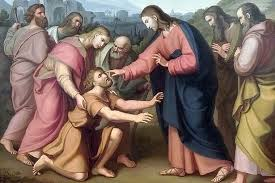
Jesus healing the blind man (Mark 8)
In the realm of open & relational theology (ORT) which is within the tree of process theology, God has two main characteristics. 1) The future is open. In other words, God does not force an entity (including humans) to do things. 2) God is “relational.” God relates to everyone and everything…from quark to quail to quasar as I like to say. This relationality is based on love in which love is defined as creativity or novelty over time. God is relational. God knows us, and God lures for us to be creative. Being awful to others is not creative or novel and is simply destructive. It is every entity’s choice…every human’s choice to go along with the lure in the setting of love or to ignore the lure / to be the prick against the lure.

I did some hunting around and found an interesting article written by Michel Foucault titled “About the Concept of the ‘Dangerous Individual’ in 19th Century Legal Psychiatry.” It was published in 1978 based on a lecture in Toronto at York University. It can be hard to find this lecture, but I did find a link here.
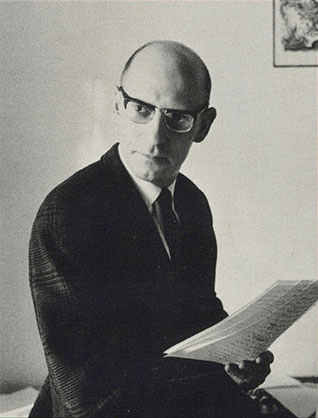
Michel Foucault (1926-1984), image from Wikipedia
The article is not long — just 18 pages. Like much of Foucault’s writing, there is immense detail written in rather long paragraphs. I had to concentrate to get through it.
Say what you want about Foucault, but I think he Continental philosophy often seems to make sense. In this specific article, he discusses “homicidal mania” in the setting of psychiatry, criminal law, and civil law. I would like to parallel his thoughts about homicidal mania with perhaps the Diagnostic and Statistical Manual of Mental Disorders (the DSM) definition of antisocial personality disorder. This disorder has the following criteria:
As someone who works in the medical field, I appreciate the work put into the DSM used by psychiatrists and psychologists. Mental health therapy is very hard work, but perhaps it is getting easier with better understandings of genetics, neuronal activity, and brain pharmacology.
However, when I look at the criteria for antisocial behavior, it seems (theologically) that such behavior goes against being creative or being benevolent or being loving. The behavior is choosing to go against God’s lure for the good.
Foucault then states in the article that “…insanity [I will use antisocial personality disorder] can produce not just behavioral disorders, but absolute crime, the crime which transgresses all the laws of nature and of society…” I think Foucault is on to something here although I know he wasn’t thinking in a religious sense.
Are the laws of nature inherently creative? I would think so when I look at the current state of the universe. The universe seems uniform from the point of view of galaxy distribution, but every galaxy is a bit different as is every star, every planet, and every potential for life or non-life throughout our universe.
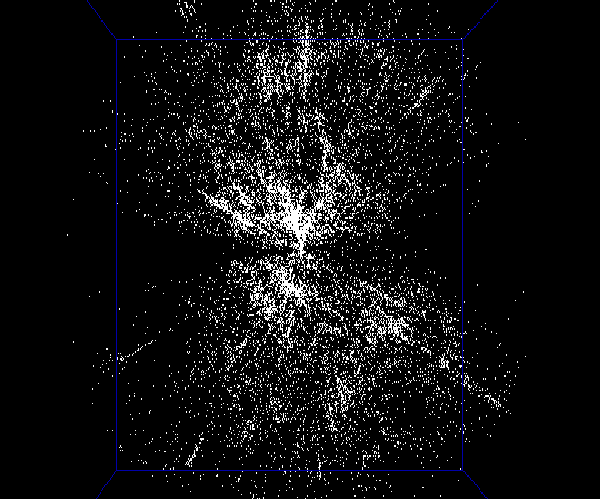
Galaxy distribution, from the University of Chicago
Are the laws of society inherently creative? I would think a creative society would produce a creative populace. I would think a destructive society (for example, the Khmer Rouge) would decrease the creativity of its population.
Time contains events. Past events uniformly affect future events in the setting of time’s arrow. These past events for each individual human action contain innumerable factors. Such factors include star stuff contained in our bodies, our genetics, past genetic mutations occurring in us and in past generations, and the epigenetics of geography, pollution, wealth inequality, society, and culture. Thus, when Foucault states “He [the criminal] is responsible since by his very existence he is a creator of risk, even if he is not at fault, since he has not of his own free will chosen evil rather than good..”, he is considering the setting of people who perform unspeakably evil acts.
I am a believer in free will only in the setting that we have limitations to such free will. I have some degree free will in how I raise my children, but I have some degree of limitation based on how I was raised as a child myself. The past influences my decisions to some degree. I have free will in my work life, but I have some degree of limitation based on my ability to be reflective, to have some degree of memory, and to be placed in an environment of required work hours and management decisions. I have free will in what I do every day, but I am limited by my life span and the risk of disease, injury, and eventual death.
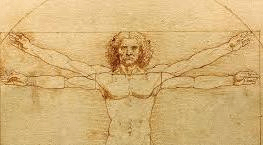
Foucault points to this idea in the setting of a person doing bad things. Genetics likely can increase the benefit or risk of making certain decisions. The environment one has grown up in and is currently exposed to can increase the benefit or risk of making certain decisions. Again, there is some degree of free will present, but life’s circumstances from genetics to one’s personal exposures throughout life can affect the degree of free will from minuscule to massive amounts at every moment in time.
We cannot forget, however, that God’s lure is present in this very moment just as God’s lure was present in all of the past events of the individual. The parents of an abused child could have chosen to not abuse. The thief could have chosen to not steal from their neighbor. The current U.S. President could choose not to say or to do awful things that have been so hurtful to so many people.
Finally, Christian nationalism (seeming to be increasing in our country currently) appears to be a big prick against a relational God in the setting of ORT. Christian nationalists could choose to put their love of God in front of their loving the country.
It seems simple. God loves all people just as God loves all entities The United States is just matter (land, rivers, buildings) and non-corporeal pseudo-objects (borders and laws). God was creative in nature when land and rivers were made. These are objects of God’s love. God’s love also is present when we go along with God’s lure to love others through just, humane laws.
All objects in our society can demonstrate God’s love if they lead to human thriving as well as to thriving of all of nature in a rejoicing never-ending hymn of thanks for a God who wants to work with us to love and to co-create.

Image from Gemini Advanced
Northwind Theological Seminary had its journal club last week, and on line attendees to this event are those who are studying or have graduated from the Open & Relational Theology program at Northwind. Our journal club tends to discuss scientific issues in the setting of theology. This combination makes sense when one considers that any observation, including scientific observations, can have associated metaphysical implications whether one is a theist or atheist.
Our two articles were:
“How ‘green’ can religions be? Tensions about religious environmentalism” written by Jens Koehrsen, Julia Blanc, and Fabian Huber (2022) and published in Zeitschrift für Religion, Gesellschaft und Politik. The English translation is open access.
“The Imago Dei: A Bridge to Faith-Infused Reconciliation Ecology” written by Abigail Tamkin and David Wituszynski (2025) and published in Perspectives on Science and Christian Faith. The article is open access.
The former article is more of a sociological study; the latter article is theological in nature.
I would like to highlight some of the interesting topics from the 2 articles that we discussed.
From the Koehrsen, et al. article:
The authors state that “…tensions are an inherent part of religious environmentalism.” This statement is very true. In my opinion, religions that lean toward the apocalyptic side of thinking about the world, seem to be against environmentalism. A good review article about this issue is here. If one thinks Jesus is coming back very soon, one risks thinking that they do not need to worry about the current state of the environment. If one belongs to a religious group that is anti-science and anti-education, then the purpose of environmentalism is lost. If one puts one’s nation ahead of one’s faith (for example, Christian nationalism which is not Christian), then one puts a priority of one’s nation over others, thus risking environmental degradation.
The authors point out that “indigenous religions and new spiritualities” tend to have a stronger belief in environmentalism. They tend to have a closer relationship with nature and likely consider nature as divine. I think this is quite true in the vast number of circumstances. I would point out that Evan Connell’s book (Son of the Morning Star: Custer and the Little Bighorn) points out some possible exceptions to this idea. In the end, humans are humans, and individual humans can cause environmental waste regardless of culture. The readers of this blog can read that specific book to consider his opinion.

Photo from the Alaska Wildlife Alliance
Genesis 1: 28 is read completely wrong by many Christians. The verse states, “God blessed them and said to them, “Be fruitful and increase in number; fill the earth and subdue it. Rule over the fish in the sea and the birds in the sky and over every living creature that moves on the ground.” Subdue it. I think there are some interpretation issues here made by Christians that our Jewish brothers and sisters find lacking in us. Even if “subdue” was part of the original translation, this verse in Hebrew was written thousands of years before modern technology, modern pollution, modern warfare, and the modern risk of global warming. What if “subdue” initially meant “to farm” and further meant “to farm while protecting the land”? By protecting the land, H. sapiens can be the equivalent of a good king, not a tyrant. Good references for such ideas are here and here.
The authors point out that even when the head of religions want their adherents to be better stewards of the environment, the followers under the religious leaders typically ignore such messages. I think this idea is quite true, and I don’t know how to fix the issue. As a physician in an academic medical center, we often do quality improvement studies to improve patient outcomes by changing small things in patient flow or patient care structure. Often the changes occur in small group settings (such as one clinic) first before being implemented throughout the hospital system. Medicine is not religion, but one wonders if a quality improvement-adjacent system could be used in the religious setting in promoting environmentalism.
From the Tamkin and Wituszynski article:
The authors state that Christians should reconcile ourselves to the environment using the FIRE mnemonic. FIRE would be “Faith-Infused Reconciliation Ecology.” I do not always like mnemonics as I think they tend to lose their importance over time in the setting of repetitive use. However, if FIRE helps one to remember that humans need to restore their relationship with non-humans / the environment / nature, then I am all for it.

I took this picture from Alta where I skied today.
The 5 steps mentioned by the authors to reconcile humans with the environment include:
“Recognizing the wrong that was done
(Awareness).
Lamenting personal complicity
(Repentance).
Minimizing further harm and working to fix
the wrong that was done (Restoration).
Accepting forgiveness extended by the
agent that was wronged (Acceptance).
Moving forward in a new relationship
marked by mutual flourishing (Renewal).”
Honestly, I love these 5 steps. I think they are easy to remember personally and in the church setting. I think the steps can be followed in other religious traditions as well as the 5 steps could be considered ideal for interfaith dialogue.
The authors state that we should treat the environment just as Jesus treats us in the setting of the munus triplex. In the Christian setting, we consider Jesus the ultimate 1) king, 2) priest, and 3) prophet (a triplex). What does this mean in the setting of how we should treat the environment? As “king”, we should be the good king of the environment who is a steward, not a tyrant. As “priest”, we should provide loving care for the flock which should be expanded to our planet and to all of nature. As “prophet”, we should speak truth about nature and about how we should protect it. I like this idea.
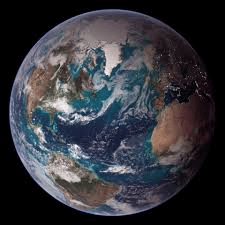
Earth (image from NASA)
My one issue as an American is that I have a difficulty with the “king” concept as our country has never had a king (even though we have had United States presidents who have wanted to be or tried to be kings). I have a hard time relating to the word. Perhaps, our species should be “regents” and not “kings.” As regents we are assisting God who is the ultimate divine authority. This ultimate divine authority is simply love. We are not God, but as creatures who should love nature and all that it entails, we are there to protect, love, and speak truth to the importance of protecting our wonderful little planet.


 Phi-The-Sci: Equilateral Musings