This past week, some of the graduates of Northwind Theological Seminary got together to do our newest journal club. The members of our book club are mainly graduates of Tom Oord’s Open & Relational Theology center.
The latest article chosen to review was “Another Day at the Office? Near-Death Experiences in Their Procrustean Bed of Nothing-Buttery.” Here is the open access link.
What do I personally think about near-death experiences (NDE)? I don’t believe in them. I have heard second-hand NDE stories from friends. I have read about them. I just think the evidence for them is so poor that I can ascribe no credence to them.
Here are some of my personal thoughts about the article:
A. The author points out that almost no negative-experience NDEs are described. Why is this? We exist in a world filled with religions that have hell or hell-like entities associated with the afterlife. Personally, I grapple with the true existence of hell due to the Greek and Persian influences on Christianity regarding this subject. The Old Testament is filled with references to Sheol which doesn’t sound like a great place to hang out when one is dead, but it isn’t hell. One of the contributors in our journal club told me that about 20% of people do have a negative NDE experience per the literature. I don’t have that link, unfortunately. However, if there is a major brain neurotransmitter dump during an NDE, this percentage would come close to the percentage of people who have a “bad trip” while taking hallucinogens. Perhaps the NDE experience is strictly gross neurotransmitter changes while dying, no different than taking psilocybin.
B. Psychological experiences: I very much agree with the author of the article here.
Karo rightly states, “Let me now highlight how this stalemate figures in Greyson and colleagues’ list of NDE theories. Starting from the psychological explanations, these authors divide the theories into four groups: (a) those based upon expectations (the idea that NDEs reflect culturally acquired expectations about death and are essentially a psychological defense mechanism against the threat of death); (b) those based upon depersonalization (the idea that alienation from one’s body helps alleviate the stress of death); (c) ones relating NDEs to birth experiences, and (d) ones based upon specific personality traits (the idea that people with NDEs have personality traits that favor vivid fantasies).”
Of note the author provides the bolded words. Yes, I very much agree that if NDEs are neurological in nature, then they will be associated with one’s psychological profile. There is a large amount of literature on childhood trauma and long-term psychological outcomes in later life. A good review is here. In fact, even the trauma of being a premature infant may cause some long-term behavioral issues in terms of feeding. A good review is here. My point is that human brains and inherent psychological backgrounds may be influencing the ability to produce an NDE.
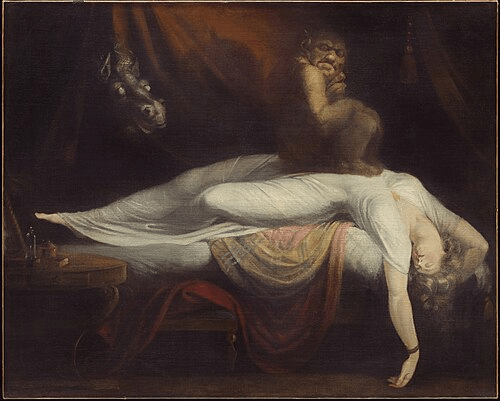
“The Nightmare” by Henry Fuseli
C. Dualism: Let’s consider the proposed separating from one’s own body during an NDE. Seeing a tunnel of light… No longer being contained in the mortal flesh… All of these experiences suggest dualism. The problem here is that dualism is highly debated as a truly helpful philosophical, and therefore theological, entity. I could provide tons of references about this issue, but I did find two helpful ones here and here.

Rene Descartes
My biggest complaint about substance dualism is that Rene Descartes thought the soul was located in the pineal gland. The soul…”captured”…in a small part of the brain.
The fact that the pineal gland (called “gland H” by Descartes) has absolutely nothing to do with the soul makes the premise already faulty.
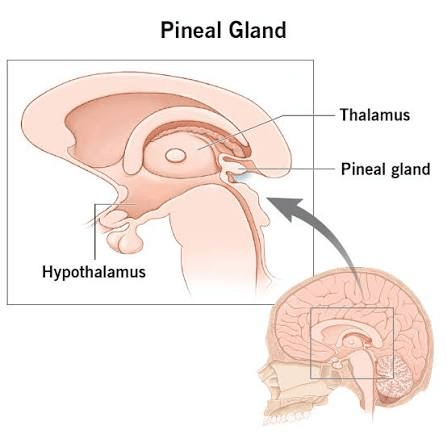
Pineal Gland, from the Cleveland Clinic.
A good review about the function of the pineal gland is here.
Also, as one who is attracted to the ideas contained in process theology and open & relational theology, it would make more sense to consider our bodies as a complete connection with God and not as separate human and divine entities. I lean towards panentheism. In other words, humans, bacteria, galaxies, the universe…all are in God. God is present in, around, and throughout my body and my experiences. God incorporates all of these aspects as I live and when I die.
What does this mean about the afterlife? Well, I certainly believe in the afterlife. I just think some things are not provable, NDEs and the afterlife included. I also think H. sapiens will never be able to understand all aspects of reality which also included the possibility of NDEs and the afterlife. By the way, here is an interesting conversation by Brian Greene and Sean Carroll in which they talk about humans having limits to understanding all of reality.
D. Here is a big one for me… If NDEs are real, then why are they not emphasized in my Christian tradition via the Bible? You think it would be a very big deal in Holy Scripture. So, is God trying to mislead us? Are NDEs not important in God’s existence? My interpretation in this setting is that NDEs have a big psychological and societal aspect associated with them.
Think about the Witch of Endor in First Samuel. Samuel is dead. He comes out of Sheol, He does not come out of a happy heaven which are associated with so many NDEs. Think about Matthew 27. Jesus dies on the cross. The dead came out of their tombs for a while — no NDEs. I think this scriptural aspect should be considered from a theological perspective.
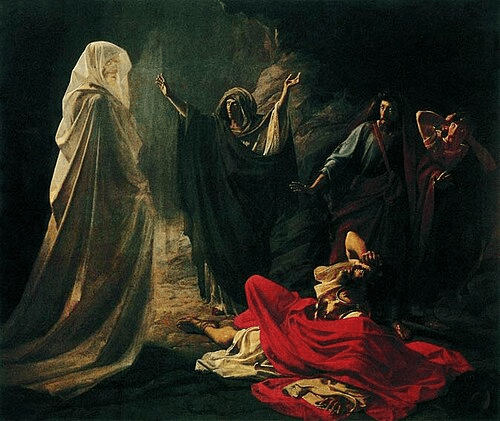
The Witch of Endor Summons the Shade of Samuel by Nikolai Ge (1857)
E. NDE research is poor. Very, very poor. There is this scale called the Oxford Levels of Evidence. The scale is helpful as it differentiates low quality from high quality research. Look at the scale below.
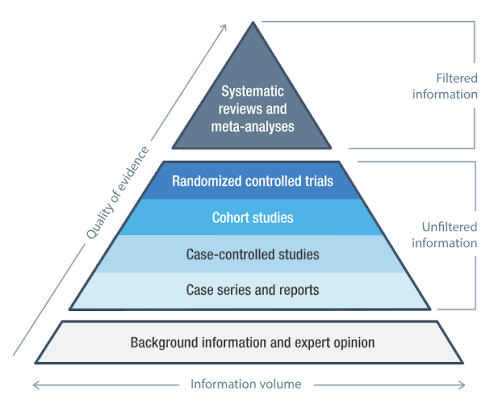
The work in NDEs is quite poor when it comes to the evidence. One may ask the question, “Well, what would you want as evidence?”
My response. Look for actual objective evidence of NDEs. See if a separated spiritual body can be seen floating above a dying person by infrared imaging, ultraviolet imaging, radio waves, or hyperspectral imaging. One might argue that such imaging is expensive. However, you just need ONE CASE of NDE to be verified scientifically, and immense amount of funding would come in via the NSF, NIH, and lots of wealthy private donors. This lack of any firm evidence reminds me of people who have seen UFOs (now UAPs) and ghosts. We just need one actual image that proves aliens or ghosts exist. Just one. We never seem to get there. I don’t think there are government conspiracies out there preventing the discovery of ghosts, UAPs, and the afterlife.
What do I believe? Well, I do believe in an afterlife. My belief is admittedly subjective. I just think some ideas are so difficult to comprehend that scientific experience of humans will never prove it. I do like Whitehead’s idea of God and the non-perishing of all experiences. Perhaps this is a good metaphor of the afterlife:
“The revolts of destructive evil, purely self-regarding, are dismissed into
their triviality of merely individual facts; and yet the good they did achieve
in individual joy, in individual sorrow, in the introduction of needed contrast,
is yet saved by its relation to the completed whole. The image-and
it is but an image-the image under which this operative growth of God’s
nature is best conceived, is that of a tender care that nothing be lost.”
I have no idea if his ideas are true, but they sure seem helpful, yet poetic.
I also think that if we are connected to the universe in the setting of panentheism and panexperientialism, then perhaps our consciousness extends on eternally in the universe even after we die. The experience of the atoms in our brains being in communion with our failures and triumphs, loves and sorrows, and all of our experiences would live on even in the setting of the proposed heat death of the universe. I have no idea if this idea is true, and it probably makes no sense in the setting of physical laws. But perhaps…just perhaps…we communicate with God eternally in such a way.
Finally, when I look at images such as the Hubble Deep Field, I find it quite possible that our species will never know everything about everything. This unknowing includes NDEs and the afterlife. We will never be able to know it until we die (and we still may not know it). I am fine with that mystery.
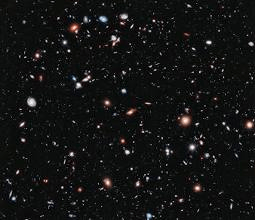
Hubble Deep Field photo

