I know my posts are a bit infrequent right now. I am extremely busy at work and my new theology book seems to be coming along very quickly. I am in a big editing stage which absorbs so much of my time.
One of the reasons that I have enjoyed learning about process theology and its close relative, open & relational theology is that it helps me deal with theodicy or the problem with evil. When a child dies or a when a family member dies or when humans try to exterminate a minority human population or when a natural disaster kills thousands, I have never found determinism to be a helpful answer.
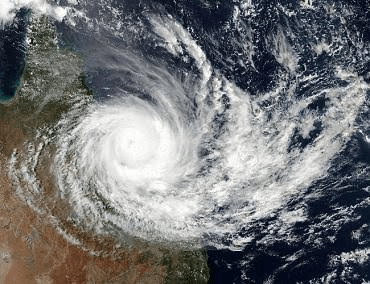
Image of cyclone near Indonesia
For example, if a child dies from cancer, an explanation of the death being caused by the initial particle and forces at the beginning of the universe or being caused by God’s Will smack of determinism and seem problematic.
Have you ever seen a child die? I work in a tertiary children’s hospital so I have seen such an event many times. In the setting of a little body who has lost their body temperature and all metabolic function surrounded by crying parents and family, it is hard to see that this event was “determined” by the universe, by God, or whatever. If the child’s death was determined, then was the emotional output by the parents additionally determined? Would you walk into the room of the dead child and say to the parents, “Don’t worry. This was going to happen anyway. Also, quit crying unless the particles in your body are deterministically making you feel sad.” That would be ridiculous. The statement, “God needed an angel back in heaven”, also is obscene.
In this setting, I have found process theology / open & relational theology helpful, especially since I do believe in God. Process theology would suggest that God lures or calls for creativity or novelty. Open & relational theology would agree, but such creativity and novelty is based on love. I do believe God essentially is love, but the child has still died in the scenario described above.
Well, process theology / open & relational theology can respond here. God calls for the creative to occur in real time. Thus, God can lure for the child to be healed. For example, the cancer potentially can be healed by medication. The cancer cells potentially can respond and die from medication. The medical staff potentially can work at the best of their ability. Society potentially can eliminate pollution that causes cancer.
God lures or calls here for the good or the creative so that there is a chance for healing. There is a chance.
However, again emphasizing the components of process theology / open & relational theology, every level of nature can ignore or go along with the lure. This is pure openness allowed by God. There is some degree of free will throughout all of nature. Previously, I have published work on obvious limits to libertarianism in nature (at least limits to me).
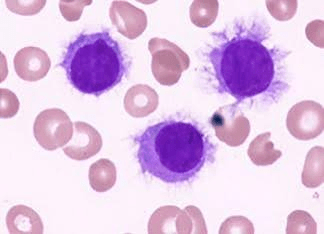
Hairy cell leukemia microscopic image (from the National Cancer Institute)
Here is my question: What percentage of outcomes in which God calls for the creative or for the good has a true, creative result?
I have no idea.
I guess if one thinks there is a lure for the creative / good as seen in the observed lack of proton decay in nature, then perhaps the percentage is pretty high.
Stars begetting new stars also would suggest the percentage is pretty high.
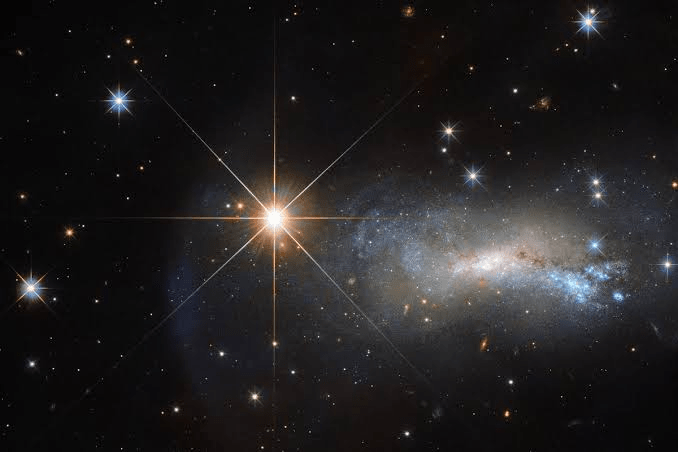
Stars (image from Scientific American)
Biological evolution produces new life forms to fill changing niche space in the environment. Evolution suggests novelty and also suggests the percentage is pretty high.
From the human perspective, I worry that the percentage of hearing God’s call is horribly low. We seem to be a very violent species, possibly similar to our close relatives, the chimpanzees. We probably have been violent for thousands and thousands of years. I worry about how much all of us (yes, including me) ignore the environment, other humans, and other animals and plants around us in the setting of violence. In other words, we can be uneccessarily cruel to our planet at times. In the setting of our species, the percentage seems awfully low.
What about death? Death is part of entropy, and entropy is natural. So, is entropy a refusal to listen to God’s call for novelty / creativity / love? Does entropy make the percentage exceedingly low and perhaps zero? Is nature, in the end, always refusing God’s lure for creativity?
That is a good question. I have no clue. However, in the setting of infinite time moving forward and a universe forever expanding, I have wondered if the randomness of particles in a cold universe in the far, far, far future will lead to new structures? The philosophical idea of a Boltzmann brain in the setting of extreme entropy would be an example.
If a “brain” theoretically could form in the setting of ultimate entropy, could particles come together to eventually form a new universe? Think about this aspect. We are talking about infinite time and infinite space. Perhaps, in the end, creativity still wins. In the “end” (although there may be no “end”), the metaphysical percentage for ongoing creativity seems rather high. Perhaps 100%? Again, I have no clue. I am just theorizing from a theological perspective.
The question is if our species want to play a small part of in Divine creativity for the short time our species will exist in the universe. I would argue that for the total universe, there may be a great percentage of events that are potentially creative.
Human nature, which is just a blip in the history of the universe, so often seems to be mostly failing despite God’s call for us to love. I always assume that we have the potential to be better creatures. We just have to hear this call, if the call indeed exists.
Image made from Gemini Advanced

