This post is a quick dip into process philosophy and process theology.
The Bible has many verses talking about the purpose of God placing the moon in the heavens.
Psalm 89:37: “It shall be established forever as the moon, and as a faithful witness in heaven”.
Psalm 8:3: “When I consider your heavens, the work of your fingers, the moon and the stars, which you have set in place…”
The Quran has similar verses. For example, in 21:33 — “And He is the One Who created the day and the night, the sun and the moon—each travelling in an orbit.”
In ancient civilizations, the moon was considered a great light (lesser than the sun) that marked the nights and helped humans differentiate the seasons.
However, wording such as “established forever” and “set in place”, suggest a world that does not change. In particular, the heavens (considered the abode of God in many religious) does not change since the moon is established in place eternally.
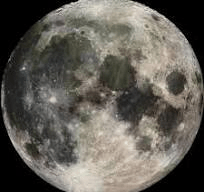
NASA image
The 3 Abrahamic religious often state that God is not changing. Aspects of Vendantic Hinduism also propose that reality is unchanging (such as the cosmos).
Even Albert Einstein provocatively wrote to the family after the death of his dear friend. “Now he has again preceded me a little in parting from this strange world. This has no importance. For people like us who believe in physics, the separation between past, present and future has only the importance of an admittedly tenacious illusion.”

Image from NobelPrize.org
It is difficult to determine what he was writing here as general relativity suggests time exists but is relative to gravity. I have wondered if he was describing some personal belief in the afterlife. His belief system is certainly fine. We all have unproven ideas about the afterlife.
Recently, the New York Times reported that astronomers have discovered that the Earth may have a mini-moon called 2024 PT5. It was likely created by some sort of lunar collision. It has a “horseshoe” orbit which is unstable. It can, at times, be near the Earth. Other times, it is very far away.
Here is my philosophical and theological argument about such a finding:
- My argument is metaphorical only. This metaphor is based on human observation of nature just like the vast entities of metaphors that humans use.
- The moon is slowly expanding its rotation away from the Earth at 3.78 centimeters per year. Billions of years from now, it will quit rotating around the Earth due to its distance and weakened gravitational attraction. By that time, the sun will have expanded anyway and will absorb the moon and Earth. The moon is orbiting the Earth. It is orbiting away. It has lost parts of itself due to asteroid collisions. It is changing. It is not “established forever” or “set in place.” Human observation has determined this aspect via science.
- The Earth’s moon was created or “set in place” during Earth’s early formation. Other planets in our solar system have more than one moon. Earth, at a minimum, has at least one mini-moon. No mini-moon is described in holy texts. This lack of description is certainly fine as we are reading scriptures from a pre-scientific era that can be loaded with great wisdom but lack the science. The scientific method (which has many meanings) had not been invented yet. You can consider an object such as 2024 PT5 and still marvel at the universe and at God.
- Reality is change. Change requires time. Process is change in time. Such ideas the basis of process philosophy, in many ways. If one considers that God is in this change, then process theology comes about. If one considers that God is in the change and God is personal, then open & relational theology comes about.
- Charles Hartshorne has described such an understanding of God as “dipolar”. One pole is abstract, consisting of all transcendent potential akin to a manner of holding all potential Platonic forms. The other pole is concrete. This concrete pole is God being in and experiencing nature while nature is in action, in change, in time, and in finitude. Oord has described this idea as a “binate” deity.
My book, “A Theology of the Microbiome” contains a figure that can help explain this concept:
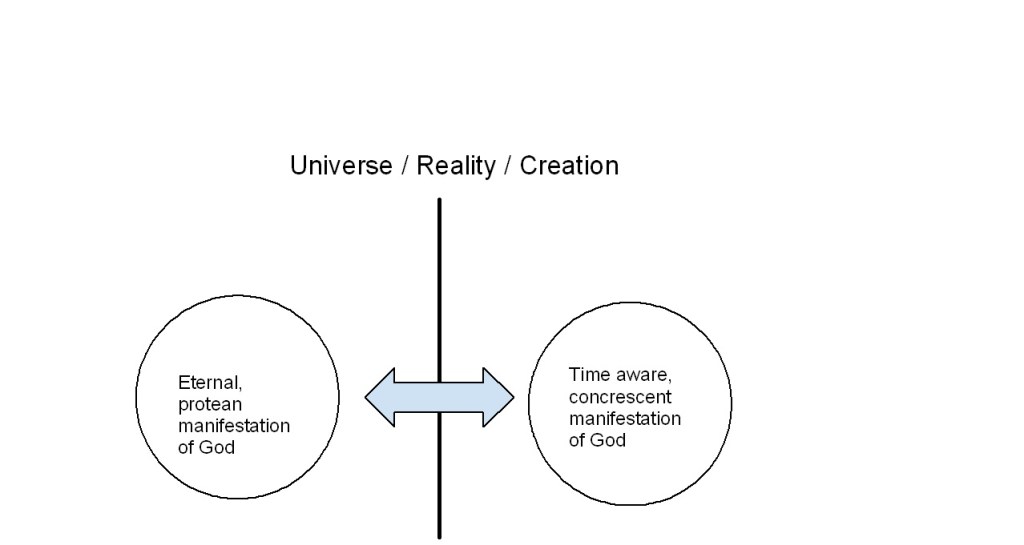
Here is what I suggest…. God is full of possiblity. I think all theists would agree on that point. Our religious texts often suggest (not always) that God is unchanging as seen in an unchanging cosmos. This idea about the cosmos is pre-scientific. When one looks at the changes in Earth’s moon (and now mini-moons), one must contend that 1) human observation will change how we view God, 2) God is in the change of nature, 3) nature changes, thus God is changeable, 4) and if God contains love (which I strongly believe), then God desires for us to learn more and more about nature through time.
Learning about nature objectively (sciences) and subjectively (the liberal arts and fine arts) can give us a deeper appreciation of the eternal yet changing presence of God.
Image made by Meta AI
 Phi-The-Sci: Equilateral Musings
Great post! It popped up in my feed after I also recently posted a reflection about the moon as an analogy for the revealed and hidden faces of God described in the Trinity.
LikeLiked by 1 person
Thank you!
LikeLike