I very much enjoy the journal, Theology and Science, published by Taylor & Francis. The latest issue has the following article: “St. Hildegard of Bingen’s Integral Ecology: Insights from Her Trinitarian Theology” written by Bruno Mello. Here is the link…behind a paywall (sorry). I subscribe to the journal, and it is not super expensive. I would recommend checking it out if you are able to financially.
St. Hildegard lived from around 1098 to 1179 ACE. She was a prolific Christian writer and mystic. I’ve always had an affection for the Christian mystics (and for some Islamic mystics as well). As a Christian myself, I appreciate the idea of loving God, believing in the deity of Christ, but not always going along with policies or doctrines of various church bodies even though I attend and am a member of a mainline Christian denomination. Here is an open access article on Christian mysticism.

St. Hildegard
In the article from Theology and Science, the author discusses St. Hildegard’s book, Causae et Curae, which is a medical treatise. In her writing, she uses the term, “Viriditas.” I like what Mello states in the article. He states that although viriditas means “greenness”, it also means, “greening power” of God. Mello beautifully writes, “Viriditas is the golden thread that runs through all of Hildegard’s theological writings…”
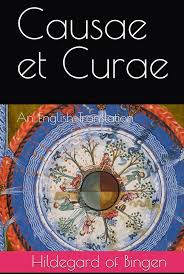
Veriditas can be inferred as the creative energy of God, and Mello states there are 4 ways to look at this term through St. Hildegard.
Literal sense: “Nature’s greenness” in all creation.
Allegorical sense: The soul of each human. Humans grow as the soul experiences.
Moral sense: Spirituality and holiness as seen through Christ.
Anagogical sense (i.e., spiritual or mystical): Communion with God as the ultimate “greenness in celestial and divine life”. The Trinity and the Eucharist are examples.
Have you ever removed yourself from the daily grind of traveling to work, sitting through boring meetings, doing the mundane tasks at work? Have you felt trapped by the absolute chaos that is social media? Research suggests that getting into nature makes a huge difference in improving one’s mental health. Going to the beach, hiking in the woods, going into the mountains — all of these places have the benefit of clearing one’s mind while creating peace. In a way, these are mystical experiences and perhaps have the possibility of being spiritual mystical experiences for those who lean towards religion.
For me, getting into nature is a way of communing with the Divine.

I took this picture of pine trees while skiing in the mountains in Feburary.
Humans are odd. You would think religious people would be more accepting of the world’s bounty and beauty (“greenness”) from a mystical approach. However, that is not necessarily the case as it depends on the religious movement (including drilling down into separate Christian denominations) as well the politics of the moment. That aspect is sad.
I have a daughter who lives very close to Manhattan, New York. When I visit her and walk through Central Park, I still can get this relaxed feeling even with other people walking or running close by.

Central Park, image from National Geographic
The idea of the Trinity in Christianity is old and not necessarily based on the books of the New Testament. Early Christian thought leaders, such as Tertullian came up with the concept. It is a beautiful idea, and I find it strange, satisfying, and yes, mystical.
Besides being a theological idea of Christianity, I think it also can be used as a metaphor. What do I mean by this? I have two thoughts.
One: Father-Son-Holy Ghost are all in a divine perichoresis or a divine dance of love with each other throughout eternity. They experience each other. They love each other. Readers of my blog will know that I write frequently about “panexperientialism” which is a common term used in process theology as well as in open & relational theology. It means that all have experience…from the smallest bits of matter to the entire universe. God, through God experiencing time and surrounding all of nature (“panentheism”), experiences all of what we experience. And I mean all — from quarks making particles to humans experiencing daily life to galaxies moving about with gravity. This is God in creation. This is God loving creation. This is viriditas.

Divine Perichoresis
Two: As metaphor but not as a theological concept, how would we think about viriditas here as we experience the world around us? I imagine a metaphor of the Trinity…the individual person (although one also can substitute an individual entity) interacting with all of nature (the universe) as well as interacting with God. If done well, this could be a perception or expression of the Divine Dance. We experience the universe and see its beauty. We love and appreciate God. The universe with all of its beauty and terror recognizes us while reflecting the eternal fire of lure of creativity from God. God loves us and God loves all of nature / the universe.
St. Hildegard was on to something special here even 1000 years later.
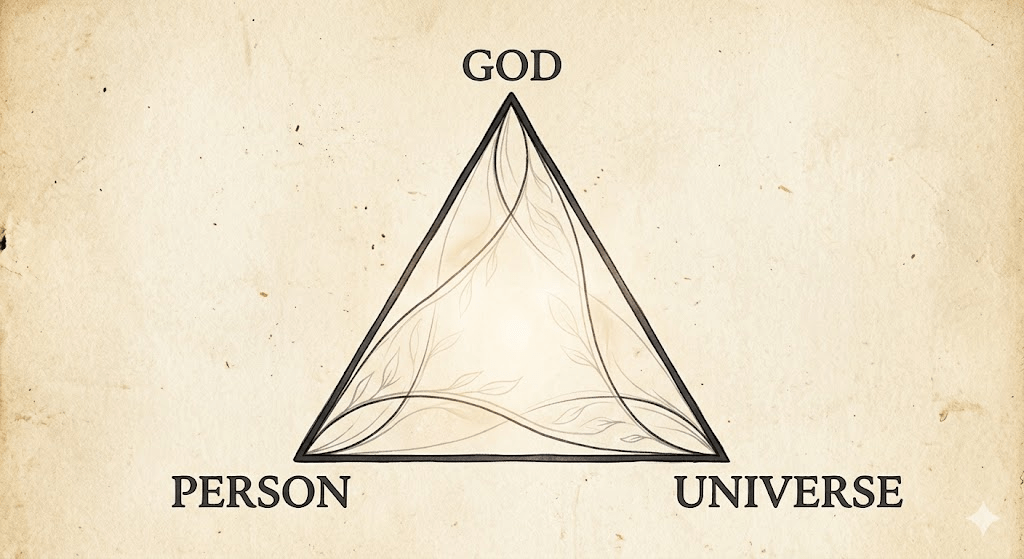
Image made by Gemini Advanced
 Phi-The-Sci: Equilateral Musings