I’m slowly writing a new book as I have referenced in some of my prior posts. My current thought is that the book will consist of five chapters, and I am about done with the 4th chapter. I don’t want to talk about this book too much as I still have to write the 5th chapter and then I need to do a deep review of the first 4 chapters for accuracy and for deciding if more length is needed. It is quite a bit of work while doing a full-time job in a completely different field.
I have been reading about the aspects of human ethics and morality as part of the work for the 4th chapter. As a religious person, I do have some metaphysical assumptions here. However, the science behind human morality is quite fascinating. It is admittedly an incomplete science, but it is fascinating.
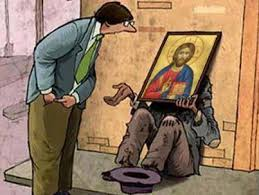
Image from https://anoddworkofgrace.blogspot.com/2016/09/but-love-your-enemies-do-good-and.html
One interesting article that I came across is titled, “The Psychology of Morality: A Review and Analysis of Empirical Studies Published From 1940 Through 2017” written by Ellemers, et al., and was published in Personality and Social Psychology Review in 2019. Basically, this paper is a meta-analysis of morality studies over several decades. Is there universal morality structures throughout worldwide cultures? The answer is “yes if one realizes the research is not great.” In other words, the authors clearly point out the many problems of comparing studies, including how thinking about morality actually affects or doesn’t affect behavior, the vast differences in such research studies, and the disconnect between theoretical research and experimental research when it comes to human morality. These conclusions make sense.
Another interesting article that I came across was titled, “Cultural Group Selection and Human Cooperation: A Conceptual and Empirical Review” published by Daniel Smith in Evolutionary Human Sciences in 2020.
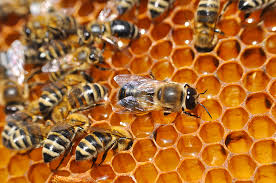
Honey bees
This article is a bit different. This article looks at the validity of “cultural group selection.” If we consider “kin selection” as related individuals putting their reproductive capacity at risk in order to promote the well being of related individuals and “group selection” as unrelated individuals putting their reproductive capacity at risk to promote the well being of the species as a whole, then “cultural group selection” might be considered a type of group selection that promotes a specific culture. Extensions of cultural group selection could include 1) the selection of subjective thought to promote culture (i.e., the arts) and 2) legal systems.
By the way, honey bees are an example of kin selection; tamarins are an example of group selection.
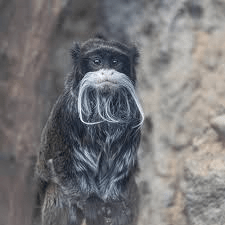
Emperor Tamarin
The problems (as the authors point out) with culture group selection are the following:
-Different definitions of cultural group selection so there is no unified definition.
-Different definitions of altruism which complicates placing evolutionary theory into cultural group selection.
-No mechanism defined for cultural group selection,
-Group behavior changes do not always adapt existing cultural norms.
-Ecology / the environment has a big effect on cultural group selection.
-Cultural group selection does not necessarily correlate with genetic fitness.
-Individuals may benefit more from certain aspects of cultural group selection as opposed to genetic fitness. In other words, cultural group selection may (at times) be just as important and perhaps more important than genetic features.*
*Let’s concentrate on this last idea. First of all, this idea suggests some type of environmental epigenetic features in which the environment itself influences genetic outcomes. The environment in this setting could be one’s religious / non-religious perspectives, how one was raised, where one goes for community activity, etc. A good reference is here. Just to be clear, I have met very moral religious and non-religious people. I also have met very immoral religious and non-religious people. I am not being selective here.
Let’s further suppose what this idea means from a love standpoint. I’m talking about agape-type love or a universal love of the other.
Should we have a universal love for the other? Personally, I think it would help our planet quite a bit to care for each other and for the planet although we seem to perpetually be a violent species. However, at times, I see this agape coming through in history.
I think about various groups hiding Jews from the Nazis during World War II.
I think about the beauty and love demonstrated in hospice care.
I think about people helping slaves in the United States cross into the northern states during the U.S. Civil War.
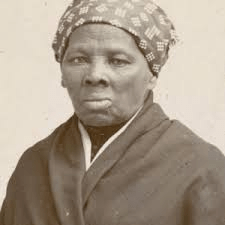
An example would be Harriet Tubman.
I think about ideas surrounding an expansive view of Muwatanah in Islamic society.
I think about John 15:13, “Greater love has no one than this: to lay down one’s life for one’s friends.” I think “friends” is quite an expansive term here.
I am going to make a metaphysical statement here. I propose that the act of caring for the “other” (for which “other” is an expansive view) is more helpful for our human species than being individualistic, materialistic, or capitalistic.
Further, I am going to make another metaphysical statement. I propose there is something inherently “good” in the setting of nature or the universe when we care for the other.
I personally think this call for the good is God. I think it is God who is in, through, around, and outside of nature as I have described in the past — defined theologically as panentheism.
Notice that I used the term “call.” God isn’t forcing here. I think God calls for nature and perhaps, just perhaps, potentially and especially for us on Earth.
God, I think, call for us at every moment of time to be loving, to be good. God calls for nature to be creative, to be novel. At every moment in time, nature, the universe, you, and me can choose the good / the creative. It is nature’s choice (and thus our choice) to choose the good or not. This choice is freely made. God lures but does not force.
I think nature / the universe is contained in God (panentheism), so a biological aspect of moral choices as in genetics or epigenetics makes sense. God calls for us to consider the choice of morality through our biology and through our world.
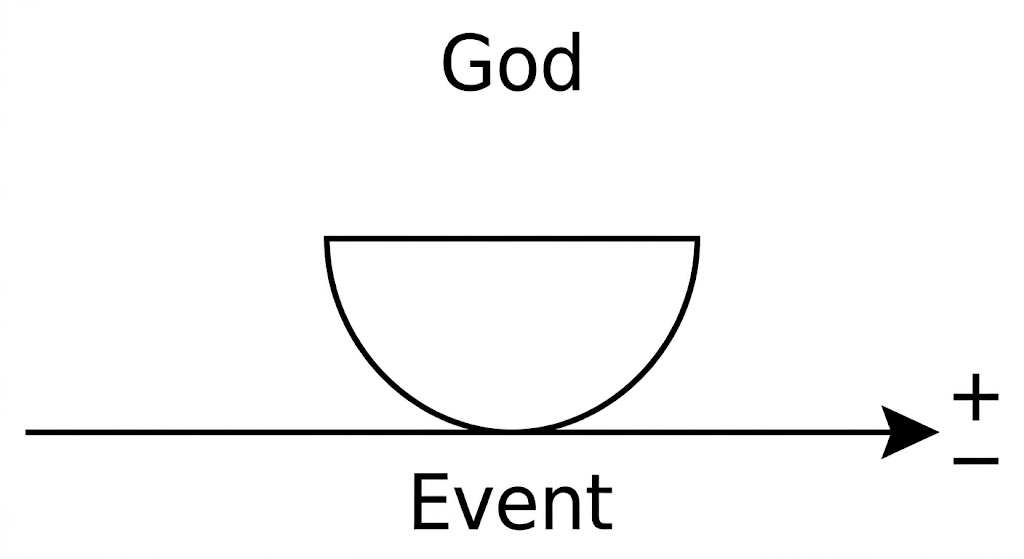
Here is my idea from my post encapsulated as an image. An event emanating from an entity happens in time. God interacts at one point in that event to call or to lure for creativity. The entity in time of the event has the decision to be creative (“+”) or not (“-“).
 Phi-The-Sci: Equilateral Musings