“The electron blindly runs either within or without the body; but it runs
within the body in accordance with its character within the body; that
is to say, in accordance with the general plan of the body, and this plan
includes the mental state.”
–Alfred North Whitehead, Science and the Modern World
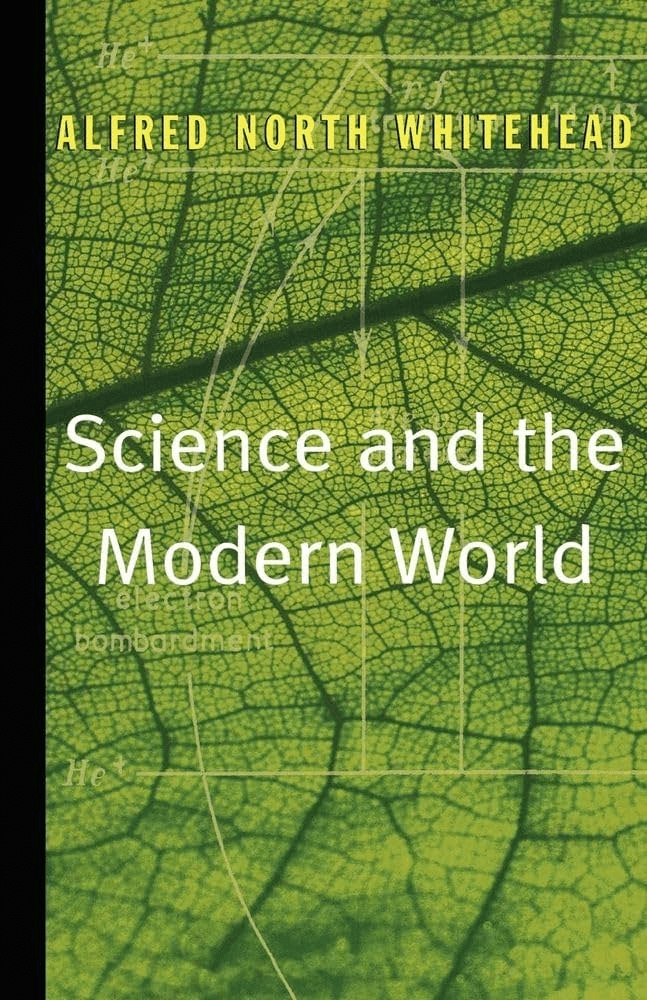
I have always found the above quote fascinating. It comes from one of Whitehead’s many fine books. Whitehead’s work in process philosophy has had a tremendous influence in the setting of process theology and open & relational theology. In fact, there is considerable overlap in these three areas of philosophy and theology.
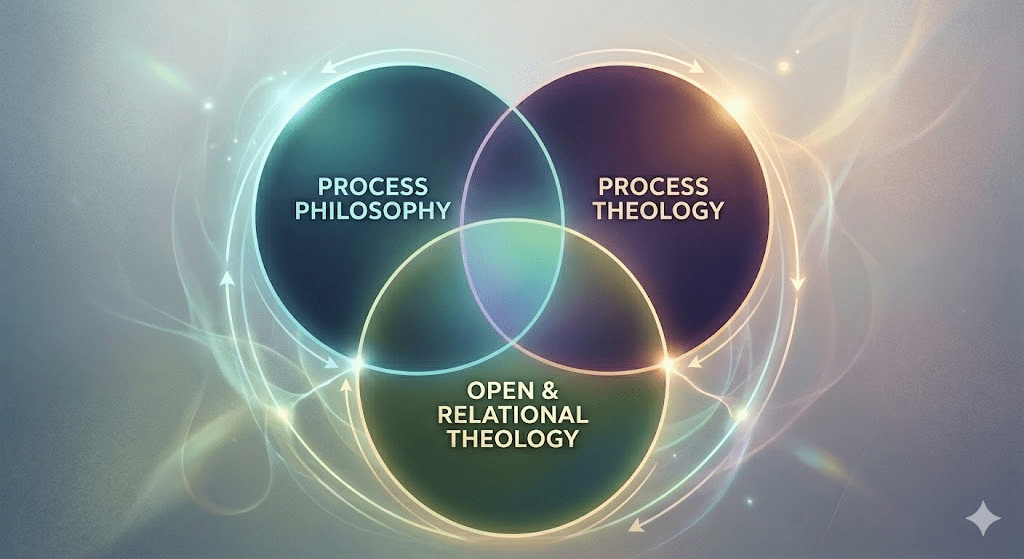
I made this image using Google Gemini.
In this post, I am going to think about the term “panexperientialism” which is contained in these three ideas. Panexperientialism means that all experience. The electron experiences charge, mass, and spin. Humans experience the objective and subjective at every moment. Galaxies experience gravity and rotation.
Consider this aspect. Every large structure also experiences the effects of its smaller components as well…sort of like nesting dolls. For example, a human experiences the effects of all his / her cells (including the non-human microbiome cells). The cells experience the effects of all of the organelles inside it. The organelles experience the effects of their molecular structure. Molecules experience the effects of their atomic structure.

Nesting dolls
One can then consider that the experience also goes the other way…atom to molecule to organelle to cell to human. Each smaller system is experiencing the effect of the larger system that they are contained in.
And the effect could grow even larger as well…human to society to nature to planet to solar system to galaxy as well as in the reverse.
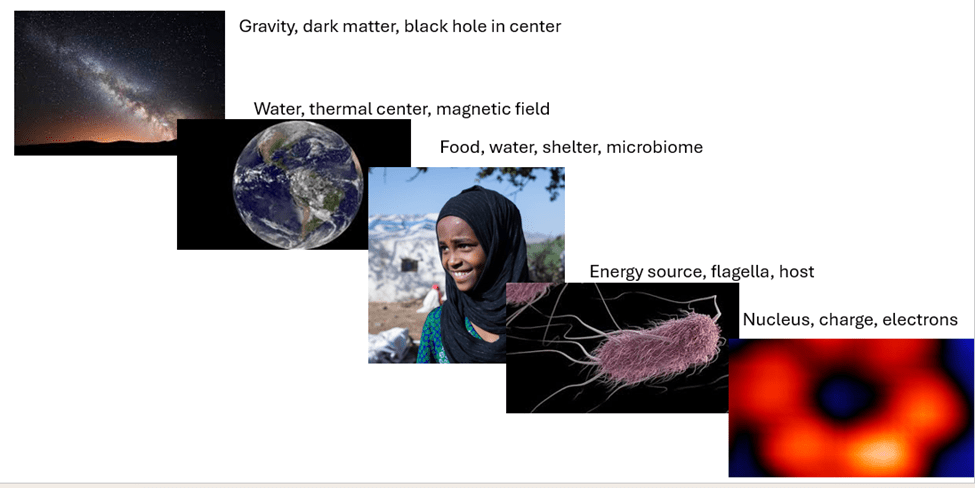
Slide from my IRAS talk (https://www.youtube.com/watch?v=B8Id8-zQCVA)
I want to just consider a thought experiment which is not the least bit scientifically provable. This “experiment” is more of a theological idea in the setting of panexperientialism.
I want to consider the idea of entanglement for which I am not an expert.
The basic ideas of entanglement are as follows: If a system is maximally possibly known (no statistical mathematics involved) and if the system has two particles, such as electron A and electron B, then the two quantum systems of electron A and electron B will combine to form a single quantum state. Electron A no longer has an independent quantum state. It is now “entangled” with electron B.
Thus, although electron A is in a quantum state and has statistical uncertainty, the interaction between electron A and electron B is known. Whatever is measured of electron A will lead to knowledge about electron B since the two quantum states are now a single quantum state.
Here is the weird thing. This entanglement between electron A and electron B is independent of distance. Electron A and electron B could be on other ends of the Milky Way galaxy and still be perfectly entangled. A great explanation is here.

Image from New Scientist Magazine
Okay, on to my theological thought experiment.
Let’s say that Electron A and electron B are entangled. Then let’s say that electron A is in the limbic system (the emotion center) of my brain while I am experiencing something emotional. Then, let’s then say that electron B is hanging out near Proxima Centauri. Since these two electrons are entangled, do they have a panexperiential quality of my experience? I like this idea.
On the other hand: From my understanding, this idea makes little sense scientifically. Entangled particles seem to be disrupted when they interact with any aspect of the environment. Also, there is some difficulty in understanding how entangled particles could carry information (I assume due to the effects of environmental interaction).
However, theologically, if every entity experiences, then how can one NOT say that the subjective experience of the electron in my brain is not affecting the experience of an entangled electron somewhere else right away?
Notice that I am not using the word, “panpsychism”. Panpsychism suggests some consciousness at every level of reality, even at the particle level. I am suggesting panexperientialism, not panpsychism.
Experience is not necessarily consciousness. If I throw a rock in the air, the rock experiences my throwing, the rock’s velocity, the effect of gravity, etc. It is not conscious of my throwing. I realize that some may find my statement different from what Jesus expressed in Luke 19: 39-40, but those verses really have a different connotation.
Experience…perhaps if particles, molecules, and humans have the possibility of entanglement, then perhaps they experience each other. This experience cannot be proven scientifically, but it can be considered theologically.
God in the setting of panentheism (“all in God”), then would experience all of reality in real time. God would experience our joy and our sadness. God would experience our birth, our life, and our death. God would experience us from our singular bodies to our consciousness to our electrons.
I find such an idea comforting as God is not some distant entity. God is there with us in real time. And if God is love (which I believe), then God is loving us through our experiences. Even at the level of our electrons.
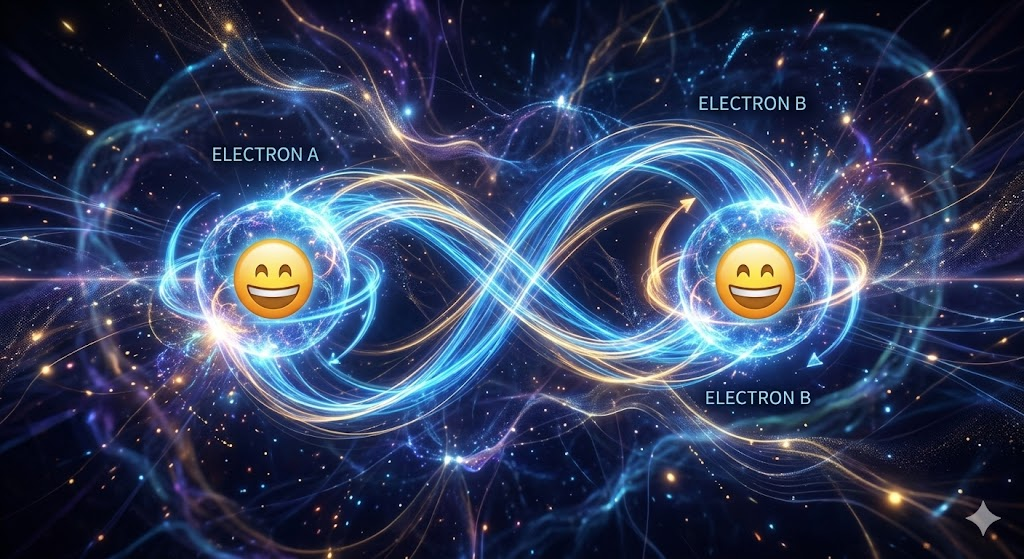
Image generated by Gemini Advanced
 Phi-The-Sci: Equilateral Musings