This weekend, I was a panelist for a session of ORTLINE 2026. ORTLINE stands for “Online Open & Relational Theology Conference.” This international online theology conference occurs annually over three days and is used to discuss very intriguing books on theology — Christianity as well as world religions. It is a great conference, and I recommend signing up for it even if you are not a theologian or pastor.
I was asked to review (as part of a panel discussion) , “Science and the Sacred: Beyond the Gods in Our Image” by C.S. Pearce and Philip Clayton. It’s a great book. I’m not sure if should paste my whole review as a panelist as I want to respect the organizers of the conference.
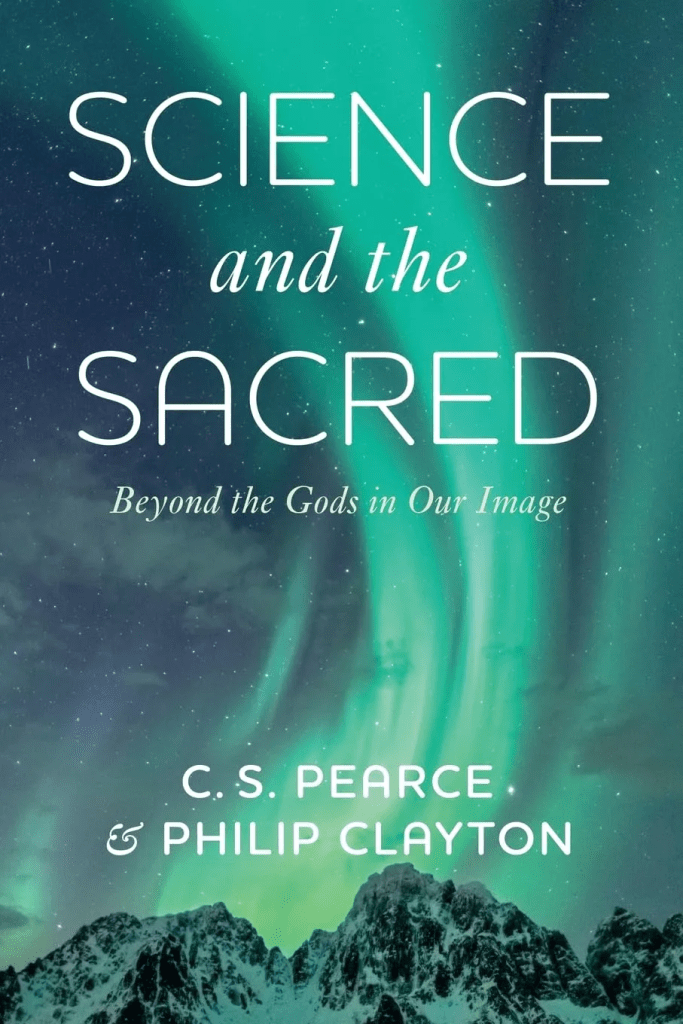
This book is really a great read for lay persons trying to understand how both theists and atheists can look at the world and find common agreement among scientific topics that extend into protecting our species and our planet. The authors go over specific issues including the Big Bang, biological evolution, human consciousness, human sexuality, and many other topics. Clayton is a theist; Pearce (now unfortunately, deceased) is an atheist. Both are well-known individuals in regard to their academics and their writings. They both are pro-science. I found myself absolutely loving this book.
The authors discuss the pros and cons of the theological idea of panentheism. Panentheism basically means “All in God.” This term makes sense to me. All of nature. All of the universe. All of reality. All are in God.
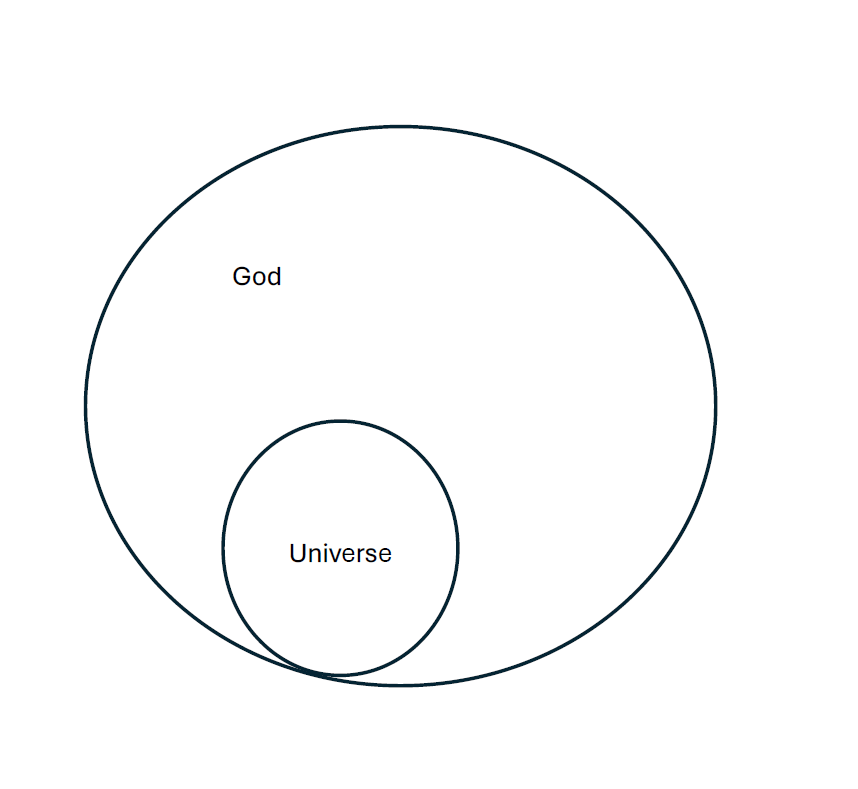
My diagram of panentheism
This term is different from pantheism (no “-en”). I would interpret this term as “nature is God” or “the universe is God.” Famous people who have leaned into pantheism would include Baruch Spinoza and Albert Einstein.
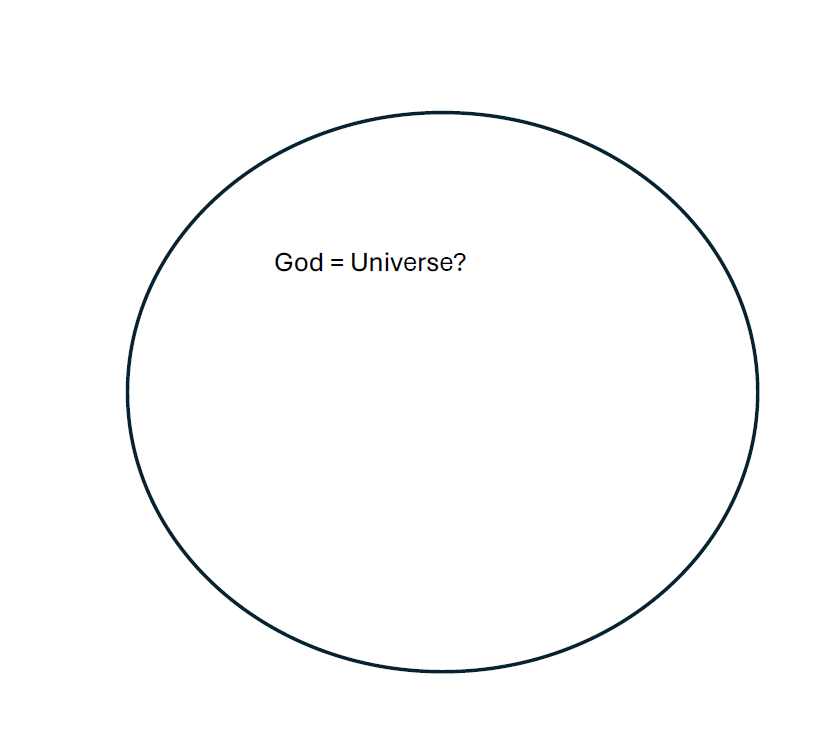
My diagram of pantheism
When I gave my presentation today about the book discussed above, I provided the following critique:
“One small criticism of the book… I am very much in agreement with the idea of panentheism – I believe very much that all of nature is contained in God. However, due to the closeness in pronunciation to ‘pantheism’, I think the authors need to consider how this book differentiates panentheism from pantheism. Complexity over time, the possibility of the universe learning, various religious claims searching for a divine entity…How is this not the universe itself learning and perhaps even luring (for creativity)?”
I guess my concern is relatively minor, but I wonder if we can provoke the issue the following way: Can the possibility of panentheism answered theologically or metaphysically have a “yes/no” response to potentially being true? Or does it have a spectrum answer or spectrum response?
For example, consider the Trinity. I am a Trinitarian. In the Christian world, the Holy Trinity is a pretty big deal. I am not a “Quartinarian.” I think I just made this word up. I don’t believe in the sameness of God, Jesus, the Holy Spirit and whatever “X” factor would make sense as a Quartinarian. It is a yes/no response when considering a Trinitarian concept of God. You either accept it or not.
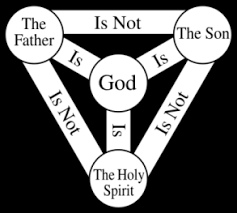
From the Stanford Encyclopedia of Philosophy
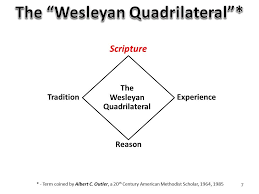
Consider the Wesleyan Quadrilateral. I don’t worship in the Wesleyan Christian tradition although I respect it greatly. I don’t think a “Wesleyan Pentagon” would make sense in that tradition. The importance of scripture, reason, tradition, experience with the addition of whatever “X” factor to the Wesleyan tradition would not seem logical in that tradition. It is a yes/no response to considering the Wesleyan Quadrilateral. You either accept it or not.
I am not Muslim, but one of my closest friends is of that faith. The Five Pillars of Islam is an inherent part of that world religion. The importance of a declaration of faith, obligatory prayer, compulsory giving, fasting during Ramadan, and a Pilgrimage to Mecca with the addition of a whatever “X” factor to make the Six Pillars of Islam would not make sense in this religion. It is a yes/no response in accepting the Five Pillars of Islam. You either accept it or not.

By the way, the examples above are theological arguments. I’m not interested if you answer “yes” or “no.”
Yes/No: Here is the argument that I am working on from a very preliminary perspective when it comes to panentheism. The similarities of the universe responding to us either through the universe itself (pantheism) or through the universe in God (panentheism) seems almost a “spectrum” response. There seems to be more than one possibility. There seems to be the potential for combinations of possibilities.
Consider:
1) Maybe there is just the universe with no God (atheism, materialism). 2) Maybe the universe and God are the same (pantheism). 3) Maybe the universe is running on its own with God having set the initial conditions (deism). 4) Maybe the universe controls nature no matter how much God lures for creativity (extreme open theism, some interpretations of process theology). 5) Maybe God lures all of nature for creativity since the universe is in God (some interpretations of process theology, open & relational theology, panentheism). 6) Maybe there is a universe and God with God controlling everything (theistic determinism). There seems to be a spectrum here with the potential for overlap.
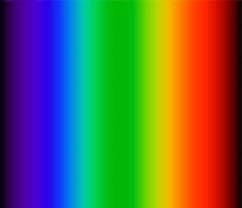
The spectrum of light (from Arizona State University)
As an example, when I look at how the universe works from my simple perspective of doing some small degree of clinical research in the field of medicine, I obviously look at results of my work from a scientific perspective. If I expand my results to a metaphysical perspective (not a scientific perspective), I can see my results fitting all 6 options above. There is overlap.
So, I definitely am a panentheist. I embrace panentheism wholeheartedly. I am fine if a person tells me that my metaphysical belief system is wrong. However, I can’t envision that same person give me a valid binary “no” because they would have all of the other options that I listed above available (and there likely are more options).
Maybe, I should experiment with “theism-en-pan”…Theismenpan…sounds really complicated. My AI (Google Gemini) tells me that the better Latin wording is “Deus in omne” or “God in All.” God is in all 6 options above and even in options that I cannot comprehend. As someone who has done work in process theology / open & relational theology, I imagine this God-In-All lures all creation for the good, for the novel, for the creative even in ways beyond our universe and unto God’s self.
Image from NPR
 Phi-The-Sci: Equilateral Musings