I have been reflecting on the recent racist social media posting by our U.S. President. The state of my country (the United States) currently has left me in a current state of despair. We seem to have one political party that is leaning on the worst of human behavior to get its way. We have the other political party that seems lost in its ability to confront the worst of human behavior which suggests to me that the opposition party either doesn’t understand or doesn’t care. At the same time, we have seen U.S. Justice Department files released that show the abhorrent behavior of captains of industry, famous academics, and various other leaders.
The various degrading “-phobias” and “-isms” by many (not all) in my country becomes even more depressing when one considers the state of religion in the United States. It seems that there is a movement afoot in many Christian denominations that American power should be mixed with Christian faith as well as with violence. Such a combination seems ridiculous as Jesus was not a power seeker. He searched out the weakest in society when one reads through the Gospels.
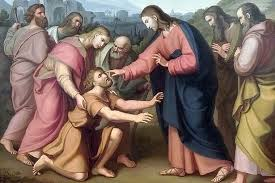
Jesus healing the blind man (Mark 8)
In the realm of open & relational theology (ORT) which is within the tree of process theology, God has two main characteristics. 1) The future is open. In other words, God does not force an entity (including humans) to do things. 2) God is “relational.” God relates to everyone and everything…from quark to quail to quasar as I like to say. This relationality is based on love in which love is defined as creativity or novelty over time. God is relational. God knows us, and God lures for us to be creative. Being awful to others is not creative or novel and is simply destructive. It is every entity’s choice…every human’s choice to go along with the lure in the setting of love or to ignore the lure / to be the prick against the lure.

I did some hunting around and found an interesting article written by Michel Foucault titled “About the Concept of the ‘Dangerous Individual’ in 19th Century Legal Psychiatry.” It was published in 1978 based on a lecture in Toronto at York University. It can be hard to find this lecture, but I did find a link here.
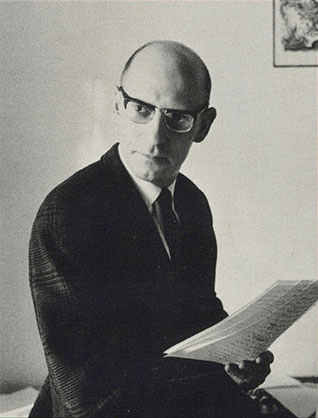
Michel Foucault (1926-1984), image from Wikipedia
The article is not long — just 18 pages. Like much of Foucault’s writing, there is immense detail written in rather long paragraphs. I had to concentrate to get through it.
Say what you want about Foucault, but I think he Continental philosophy often seems to make sense. In this specific article, he discusses “homicidal mania” in the setting of psychiatry, criminal law, and civil law. I would like to parallel his thoughts about homicidal mania with perhaps the Diagnostic and Statistical Manual of Mental Disorders (the DSM) definition of antisocial personality disorder. This disorder has the following criteria:
- Nonconformity: Repeatedly performing acts that are grounds for arrest, failing to conform to social norms and laws.
- Deceitfulness: Lying, using aliases, or conning others for personal profit or pleasure.
- Impulsivity: Acting without forethought or failing to plan ahead.
- Aggressiveness/Irritability: Frequent physical fights, assaults, or hostility.
- Reckless Disregard: Disregarding the safety of oneself or others.
- Irresponsibility: Consistent failure to maintain work, education, or financial obligations.
- Lack of Remorse: Indifference to or rationalizing the harm, mistreatment, or theft of others.
As someone who works in the medical field, I appreciate the work put into the DSM used by psychiatrists and psychologists. Mental health therapy is very hard work, but perhaps it is getting easier with better understandings of genetics, neuronal activity, and brain pharmacology.
However, when I look at the criteria for antisocial behavior, it seems (theologically) that such behavior goes against being creative or being benevolent or being loving. The behavior is choosing to go against God’s lure for the good.
Foucault then states in the article that “…insanity [I will use antisocial personality disorder] can produce not just behavioral disorders, but absolute crime, the crime which transgresses all the laws of nature and of society…” I think Foucault is on to something here although I know he wasn’t thinking in a religious sense.
Are the laws of nature inherently creative? I would think so when I look at the current state of the universe. The universe seems uniform from the point of view of galaxy distribution, but every galaxy is a bit different as is every star, every planet, and every potential for life or non-life throughout our universe.
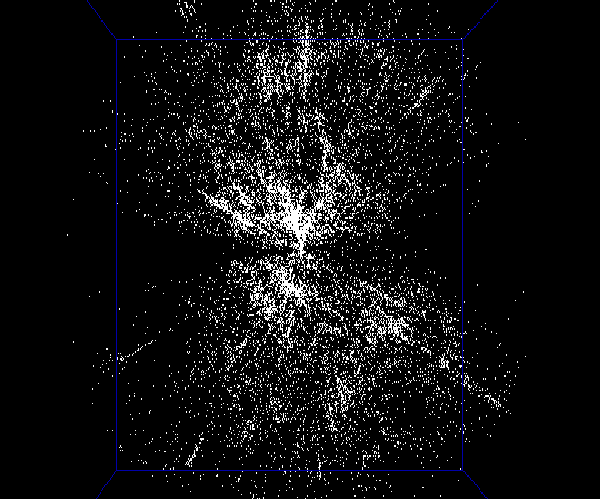
Galaxy distribution, from the University of Chicago
Are the laws of society inherently creative? I would think a creative society would produce a creative populace. I would think a destructive society (for example, the Khmer Rouge) would decrease the creativity of its population.
Time contains events. Past events uniformly affect future events in the setting of time’s arrow. These past events for each individual human action contain innumerable factors. Such factors include star stuff contained in our bodies, our genetics, past genetic mutations occurring in us and in past generations, and the epigenetics of geography, pollution, wealth inequality, society, and culture. Thus, when Foucault states “He [the criminal] is responsible since by his very existence he is a creator of risk, even if he is not at fault, since he has not of his own free will chosen evil rather than good..”, he is considering the setting of people who perform unspeakably evil acts.
I am a believer in free will only in the setting that we have limitations to such free will. I have some degree free will in how I raise my children, but I have some degree of limitation based on how I was raised as a child myself. The past influences my decisions to some degree. I have free will in my work life, but I have some degree of limitation based on my ability to be reflective, to have some degree of memory, and to be placed in an environment of required work hours and management decisions. I have free will in what I do every day, but I am limited by my life span and the risk of disease, injury, and eventual death.
Foucault points to this idea in the setting of a person doing bad things. Genetics likely can increase the benefit or risk of making certain decisions. The environment one has grown up in and is currently exposed to can increase the benefit or risk of making certain decisions. Again, there is some degree of free will present, but life’s circumstances from genetics to one’s personal exposures throughout life can affect the degree of free will from minuscule to massive amounts at every moment in time.
We cannot forget, however, that God’s lure is present in this very moment just as God’s lure was present in all of the past events of the individual. The parents of an abused child could have chosen to not abuse. The thief could have chosen to not steal from their neighbor. The current U.S. President could choose not to say or to do awful things that have been so hurtful to so many people.
Finally, Christian nationalism (seeming to be increasing in our country currently) appears to be a big prick against a relational God in the setting of ORT. Christian nationalists could choose to put their love of God in front of their loving the country.
It seems simple. God loves all people just as God loves all entities The United States is just matter (land, rivers, buildings) and non-corporeal pseudo-objects (borders and laws). God was creative in nature when land and rivers were made. These are objects of God’s love. God’s love also is present when we go along with God’s lure to love others through just, humane laws.
All objects in our society can demonstrate God’s love if they lead to human thriving as well as to thriving of all of nature in a rejoicing never-ending hymn of thanks for a God who wants to work with us to love and to co-create.

Image from Gemini Advanced
 Phi-The-Sci: Equilateral Musings