Recently, the Ark Encounter in Kentucky had a measles exposure due to an unvaccinated visitor visiting the park. You may wonder what the Ark Encounter is… It is simply an extension of the Creation Museum in Kentucky which is run by the group, Answers in Genesis. I’m not going to provide a link to either of these facilities or AiG because, simply put, they are 1) anti-science and 2) anti-religious. They are anti-science as they essentially support no real science. They state they support “creation science” which is a misnomer and is a fruitless endeavor in confirmation bias. They are anti-religious in that they only support a narrow view of religion and, honestly, a narrow view of Christianity. Being anti-science can kill people; being anti-religious (especially from a Christian perspective) can cause bigotry especially if it is associated with politics and nationalism.
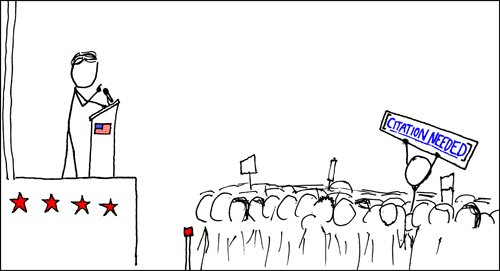
XKCD comics
Both the Ark Encounter and Creation Museum get about 1 million visitors per year from tourism estimates. It is unclear if this 1 million number is correct, but if one divides the amount by 365 (not counting seasonal variation), an unvaccinated person with measles may have exposed approximately 2740 people to a very bad and potentially deadly infection.
Measles is one of the most infectious viruses in the world. The virus kills approximately 1-3 of every 1000 children who are infected and not vaccinated. Measles has been shown to cause life-altering permanent neurologic disease in 1 in 1,000 children who are infected and not vaccinated. It is terrifying to consider that 25% of children who are malnourished and are infected with measles will die. Considering the food insecurity rate in Kentucky where the Creation Museum and Ark Encounter are located, the potential mortality rate for Measles is concerning. For example, one can consider this graph from Feeding America.(https://map.feedingamerica.org/county/2023/overall/kentucky).

I have so many thoughts here:
One: Bad science typically begets bad science. This statement is quite true. Of course, one could point out that good science can be ignored while bad science continues. An example, to some degree, would be what happened to Galileo Galilei in the setting of his proving the heliocentric model. In the situation of Galileo, further studies proved his point and the idea of Earth rotating around the sun was eventually accepted notwithstanding that further research over time showed that our sun is one of billions of suns in the Milky Way galaxy and our galaxy is one of billions of galaxies in the observable universe. Social and religious pressure initially prevented but could not stop scientific observation. What I am stating here is different. I am stating the following: bad science such as that promoted by the anti-vaccine movement self selects for more anti-vaccine nonsense. Bad science such as that promoted by the anti-evolutionary movement self selects for more anti-evolutionary belief nonsense. These nonscientific belief systems have their own insular journals, have their own insular “experts”, and have their own insular “scientific” meetings. The results lead to promotion of dangerous anti-science belief systems in federal funding systems (especially in the United States) and a decline in life-saving medical therapies such as childhood vaccinations.
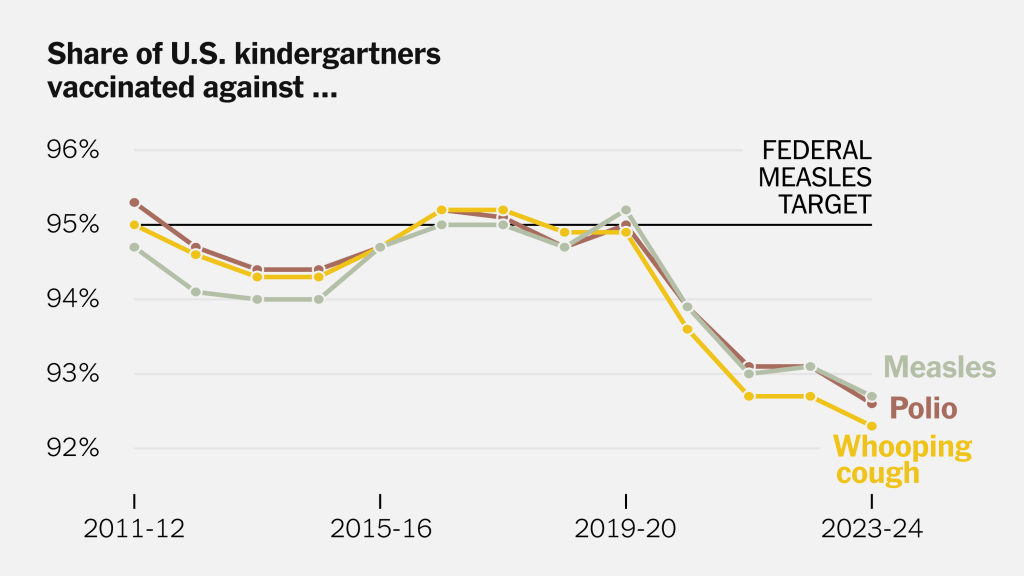
Graph from the New York Times
Two: Bad theology helps bad science. Bad theology such as wooden and weak literal interpretation of the Bible leads to a poor subjective understanding of how science works. If you think that praying for God to prevent measles in your child is how to treat this infection instead of vaccinating your child, then you have poor theology and very poor understanding of science. Have you considered that God was behind the miracle of childhood vaccinations? This poor understanding may not be your fault. You may have had poor education in public or private school. You may have been taught horrendously terrible theology growing up. I have posted about the following example in the past. When my children were young, we sent them to a Bible camp in northern Utah very close to the Idaho border. It all seemed to go well until some random pastor gave a sermon about evolution being wrong since pterodactyls have been seen flying around Idaho. I will limit my cussing here, but the response from my wife and from me was, “This is 100% excrement.” Our children were removed from the Bible camp because once a religious community is anti-science about one well-known concept, the community tends to become anti-science about other concepts. Experts have defined the increasing number of anti-science beliefs in some religious communities as the “spillover effect.” Good references are here and here.

Pterodactyl from 150 million years ago. It is NOT flying over Boise, Idaho. Image from the National Dinosaur Museum.
Three: We need better science communication. Here is a constant complaint of mine. At least in academic institutions (i.e, universities), there is minimal ability to get academic promotion and/or tenure by participating in public outreach. Sure, I personally have reached “full professor” level at my university, but my promotion was simply due to publications (lots of journal articles, a few grants, one edited textbook, one editorial board membership with associated writing). Patient care was emphasized to a degree as I was bringing in revenue to the institution. Medical education for medical students, residents, and fellows also was considered, but medical education is never considered a big component of “RPT” (“retention-promotion-tenure”). Outward facing speaking to the public has pretty much a nil component in any of my promotion packets. The problem does not just occur with my university. It is a nationwide problem in the United States. Perhaps in countries like Switzerland, public outreach is valued in academic culture. However, in many universities, the importance of scientific outreach is not considered valuable. In the world of trying to promote scientific understanding in the realm of Christianity, there are limiting cases of success here. Perhaps Francis Collins would be a well known exception.
Random university photo
Four: Strive to be a better Christian / be a better religious person when understanding science. I can speak for Christianity. Jesus is very clear. When one is caring for the poor, the ill, the needy, one’s mind so go back to specific verses in the Bible such as Matthew 25:40 or Luke 6:31. Not providing correct scientific education regarding how the world works would go against what Jesus has commanded us to do. Not vaccinating your child so that they get sick and potentially die from an easily preventable disease would go against what Jesus has commanded us to do. Not vaccinating your child so that they get sick and potentially cause others to die (infants, people undergoing chemotherapy, people with autoimmune disease, people with organ transplants, etc.) would go against what Jesus has commanded us to do. Interestingly, Quran 4:36 has parallel type statements (“To parents is owed kindness, as also to relatives, to orphans, to the needy, to a neighbour who is a relative, to a neighbour who is a stranger, to a companion by your side, to a traveller and to your slaves, God loves not the swaggering and the conceited…” Quran 4:36, Tarif Khalidi translation).
Loving others as Christ loves us…Kindness to the “other”… It seems that God wants us to promote good science not only in the setting of academics but also in general society and in our religious settings.
By the way, the Dr. Joel Duff’s Youtube channel has expressed my thoughts much more clearly. I would recommend the video, “Ken Ham’s Ark Encounter: More Effective Than Billy Graham? (Really?)” as an example. Link: https://www.youtube.com/watch?v=kt2ldTMStz8

Image generated by Gemini Advanced
 Phi-The-Sci: Equilateral Musings