I love the expression “turtles all the way down.” I have heard many stories about how this metaphor came about. I have read that perhaps William James or Bertrand Russell used the phrase first, but this likely is just a legend. I also read that Joseph Berg (1854) first used the phrase in a lecture on religion.

Artwork by Susan Culver
Basically, the argument is about “infinite regress” or an argument or theory in which there is no final answer. I am personally fine with no final answer to many of the metaphysical questions of the world. Our human brain typically weighs around 3 pounds (approximately 1.4 kg). I am under no illusion that this little mass of tissue, despite its nerve complexity, can solve all of the natural issues of the world. The presence of a multiverse is an example of something we cannot solve. I am not an expert, but I do not see how we could possibly perceive universes beyond our own.
The same goes with religion. I am a religious person, very much so in fact. However, I know I can never prove the existence of God. No human can. Alternatively, no human can prove that there is no God. Our brain and sense organs have no ability here. The answer to the existence / nonexistence of God is an infinite regress.
I want to address a potential problem with process theology and open & relational theology. I have written about these two cousins of theological thought multiple times. I very much believe that God works in a manner consistent with process theology, and I am extremely confident that if God exists, God works in a manner consistent with open and relational theology. That is, 1) the future is “open” (i.e., not deterministic) and 2) God relates to all entities. What does “relate” mean? My interpretation is that God loves all entities and does not force. God is not a spiteful emperor. God is simply a force available for the potential of good, for love. By “force”, I mean that God lures or desires or wants us (and all entities in nature) to be creative or to be novel. The ultimate in creativity or novelty, in my view, is love.
Every quark, every molecule, every bacterium, every human, every star, every galaxy is exposed to the lure to be ever more creative. This lure is not forceful but is metaphorically the “still small voice” (1 Kings 18:12) desiring creativity (i.e., love) in nature. Every entity, regardless of size, can accept the calling of the lure, ignore the lure, or do the opposite of the lure. This lure exists in real time and is not separate from time. I do realize that there are obvious theological limitations to this idea which I have discussed in prior posts.
Turtles. They keep going down. What does this mean about God?

If God lures all creation for the good, 1) has God eternally lured for creativity / novelty / love or 2) was there a point in God’s nature that God “chose” to lure for the good. In other words, did God actually choose or desire to become non-deterministic or did God always have non-determinism or freewill as part of God’s essence?
God chooses? God changes God’s mind? Is such a thing possible? From a Christian perspective, there is theological evidence such as can be seen in Jeremiah 18: 7-10, Jonah 3, Gospel of John 2: 1-11, Gospel of Matthew 15: 21-28. Part of the issue that arises when people think that God is immutable and cannot change has much to do with the Greek philosophical influence on Christian thinking. I strongly recommend this open access article by John C. Peckham at Andrews University to more fully understand this sway.
I am not knocking down Greek philosophy. It has influenced culture worldwide in many ways. However, it is easy to see that the ancient Greek philosophers such as Plato described God as unchanging.
From Plato’s Republic: “Do you think that God is a wizard and capable of manifesting himself by design, now in one aspect, now in another, at one time himself changing and altering his shape in many transformations and at another deceiving us and causing us to believe such things about him; or that he is simple and less likely than anything else to depart from his own form?”
Plato’s God is simple in form and does not change despite the complexities of the natural world around us. This unchanging God meets the changing universe in a bridging manner that is not the least bit clear. From a naturalist perspective, this Platonic description of God reminds me of a black hole. Black holes are fairly simple consisting of mass, spin, and charge (a neutral charge). They make a big difference to the space-time around them but are fairly simple in appearance.

Black hole illustration from the University of Chicago
Charles Hartshorne, the process philosopher, may give us a more satisfying answer here. Per Hartshorne, what if God is “dipolar”? In other words, what if God exists in two realities united as one in God. What if there is an infinite God who is full of the possible but also the same God experiencing what is actually happening in nature.
Hartshorne has put his idea this way:
“I nevertheless admit a symmetry of logical interdependence between God’s knowing that we, for example, exist, and our actually existing. God cannot know this unless we exist, but (because of his infallibility) he cannot fail to know if we exist…Or, as I like to put it, God and the creatures must ‘interact.’ (The abstract divine existence of course is independent, but not the divine knowledge in its concreteness).”
In my book, “A Theology of the Microbiome“, I provide the following figure to illustrate Hartshorne’s idea:
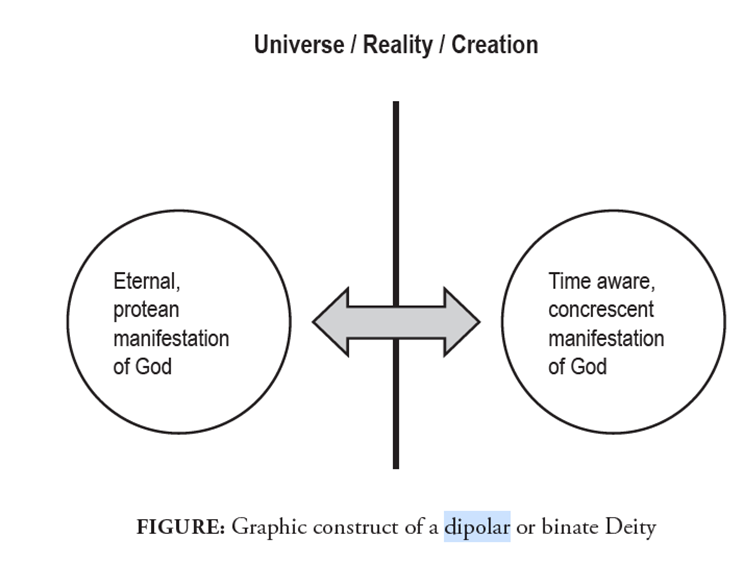
Another way of looking at this better view of God, would be to consider Thomas J. Oord’s description of God as having an “essence-experience” binate.
Instead of God being unchanging with all the omnis (omnipowerful, omniscient, omnipresent) and with the addition of the dreaded “D” of determinism, process theology / open & relational theology proposes that God is the God of possibility but also the God that reacts to our independent natures. And by “our”, I mean all aspects of nature.
My thoughts lead me to consider intriguing questions that I propose process theology / open & relational theology need to consider:

In an eternal sense, has God changed God’s “mind” (whatever that means) to become non-deterministic and luring for creativity and love?
By becoming non-deterministic, did that give God the ability to lure for change or novelty or creativity or love?
By having the subsequent ability to lure for change or novelty or creativity or love, did our natural world then have the ability to form?
Alternatively, if God has eternally been luring and never deterministic, then is God simply THE “divine lure”?
If God has never been deterministic, can God be described as follows: “The ultimate Platonic / pseudo-Platonic form or the ultimate base of reality is perhaps simply and beautifully change through time…”*
*quote from my book : )
If God always changes, then is God immutable in a paradoxical way? God must necessarily change. God cannot “not change”. An unchangeable aspect of God is change itself.
I realize I am probably talking about how many angels dance on the head of a pin.
However, I do think this discussion leads one to think about “turtles all the way down.” There is an infinite regress of a dichotomy of possibilities. God is immutable or God is open to change.
I think the turtle analogy works well when one considers the old idea of turtles being “hopeful monsters” from an evolutionary standpoint.

image from Gemini Advanced
 Phi-The-Sci: Equilateral Musings