Our seminary (Northwind Theological Seminary) had its recent book club for its graduates interested in process theology / open & relational theology. We discussed Dr. Andrew Davis’s recent article in Zygon, titled “Extraterrestrial Metaphysics in Process Perspective: Implications of Our Anthropocosmic Nature.” The article is open access, and the link is here.
The article is quite long (26 pages!). However, it is filled with superb writing about how to consider our human theology in the setting of the potential for life on other planets.
Personally, I do not believe that extraterrestrial life ever has or ever will visit our little planet. It is too small and insignificant, and distances in space are beyond extreme.

Hole in Cloud 9 Comics
Consider the following: If the universe is 93 billion light years across* (at least in the observable universe) and if the universe contains up to 200 billion galaxies, one would think that life is statistically possible throughout space.
*one light second = 186,282 miles = 299,792 kilometers
I would like to point out some of the salient parts from Davis’s article.
Quote: “My philosophical launching point will be the robust, albeit neglected, tradition of process metaphysics, which has largely been ignored in recent philosophical and theological discourse concerning other worlds and extraterrestrial life. As I aim to demonstrate, this neglect is unfortunate and unwarranted. Process philosophy and theology are robust traditions of cosmic reflection that have always been implicitly open to all manner of extraterrestrial life and intelligence.”
Yes, this idea is true. Process theology finds God existing in change, in real time, and in the idea that God desires creativity. Our massive universe is full of change. It also changes in real time (with the possible exception of what might occur in special relativity). If one believes that God is love and this God, thus, desires creativity, then it makes sense that in an immense universe with innumerable particles, life has had eruptions throughout the history of our universe even if we will never observe it. Open & relational theology (a branch of process theology which emphasizes God’s love) would state that this Divine love presents as a lure for creativity. It is not a deterministic theological mechanism.

Galaxies, from the American Astronomical Society
Quote: “…human existence and experience is an exemplification rather than an exception to the nature and character of the universe and what it is ultimately doing.”
It took me a while to work through this statement. By “exemplification”, Davis means “a typical example.” The human experience is filled with times of creativity, times of loss, times of love, times of birth, and times of death. In the end, humanity is changing. We are an example of the universe of persistent change and just perhaps a search for novelty in real time. I think exemplification can be extended towards the very small (bacteria, viruses, molecules) and the very large (planets, suns, galaxies) which all provide perspective about the universe’s nature. This aspect of the universe seems beautiful.
Quote: “Extraterrestrial metaphysics pushes still deeper, however. Beneath the multitude of real conditions that make life possible on any particular planetary habitat, is the pure possibility of life itself which belongs inexorably to the nature of things.”
Davis’s statements seem to describe the creativity of nature as beautiful, especially when considering life’s emergence. If one proposes that the unfolding of life from non-life is the sole or perhaps one of many goals of the universe (as desired by God’s lure for creativity), then life will and must happen throughout our universe. This idea can be extended to life having occurred many times in the universe’s past as well as life occurring many times in its future. Just like a flower blooming from a seed, this potential for creativity is a metaphor for a field of seeds planted in early spring. The potential for life has been set. The goal can be reached with the essential aspect of time.

Quote: “Where Whitehead developed a ‘philosophy of organism’ as a ‘atomic theory of actuality’, Teilhard developed a ‘hyper-Physics’ or ‘hyper-Biology’ that is ‘both organic and atomic’ in nature. Both men rejected clear divides between living and nonliving entities, with Whitehead stressing that there is “no absolute gap between ‘living’ and ‘non-living’” organic systems and Teilhard admitting that at atomic depths ‘all differences seem to become tenuous’ so that ‘we can no more fix an absolute zero in time (as was once supposed) for the advent of life’. For both men, it can be said that prior to the emergence of what we recognize as highly evolved ‘living’ organism, there are still-more-fundamental organisms that exhibit active evolution, dynamic response, and purposive internal relations to their environment.”
Indeed, how can we define life? My cat sitting next to me while I type as well as the coffee cup on my desk both contain protons, neutrons, and electrons. When does this array of tiny particles become life? I don’t believe in an Élan vital. I do, however, think that creativity in nature leads to an emergence of life from non-life without a dualist aspect being needed.
If one thinks about it, the emergence of new life from the decomposition of dead matter can be a type of life emergence. Death is a nidus for life to occur.

Image from the book, Soil Fungi Associated with Graves and Latrines: Toward a Forensic Mycology
An interesting thought to consider is that life appears to have limits in its appearance and perhaps abundance. In my book, A Theology of the Microbiome, I discuss the work of Lee Cronin’s lab. He has come up with “Assembly Theory.” Assembly theory proposes that the complex molecules for life necessarily require large structures (or a larger assigned “assembly number”). This complexity is not a guided formation of large structures but rather a random formation. Good resources exploring this idea are here and here.
Subjectively, perhaps randomness of reality in itself is a base structure for the potential for the novel, for the creative, for life’s emergence. Such an idea sounds provocative, but it may not be correct. However, when considering the concept of “lim Δ” which is a theological construct describing a limit (lim) to change (Δ) in God’s creative potential, one can state that creativity abounds even if randomness is limited. The theory of lim Δ proposes that God loves nature so much that God allows nature to freely put limits on creativity. God never forces.
Quote: “For both Whitehead and Teilhard, therefore, it can be said that Life signifies an ultimate principle that is always embodied in a processual ontology. It is this living ontology that constitutes the antecedent conditions of all higher life achieved throughout cosmogenesis. For both men, moreover, this is not insignificant when considering what evolution is ultimately about. We might put it in the following way: where life in a primitive processual form belongs inexorably to the universe as such, there is no meaning to evolution beyond the higher achievement, complexification, and intensification of life. “
Davis proposes that whether evolution is entirely random, limited by natural events outside of its biological control (volcanoes, asteroids, oxygen levels, availability of water, etc.) or has built-in plasticity to repeat itself (as in convergent evolution), life is the ultimate goal of evolution. Life and even more life and even more variety in the forms of life may be the goal of evolution. Such an evolutionary goal would be incredibly hard to prove scientifically, but the idea can be discussed theologically. The idea that randomness of events occurring in real time and in the immenseness of the universe always leading to life is intriguing. From a theistic perspective, perhaps the potential of the random is what God desires.
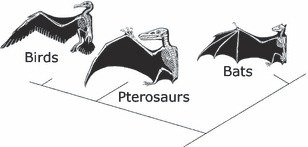
Example of convergent evolution (wings) from the journal, Ethology
My final thought is that if the universe is infinitely huge beyond the observable limit, yet the number of potential molecular formations are limited, then life would have to occur without exception.
Somewhere far away, deep in the past or deep in the future or even now, another John Pohl would be writing this exact same blog post. Somewhere far away, deep in the past or deep in the future or even now, another “you” is reading what another John Pohl is writing in this exact same blog post.
I think life is out there beyond Earth. We just may never have the opportunity to interact with it due to the immensity of space and time. Perhaps life’s emergence is a goal of the universe and, thus, a goal of God.
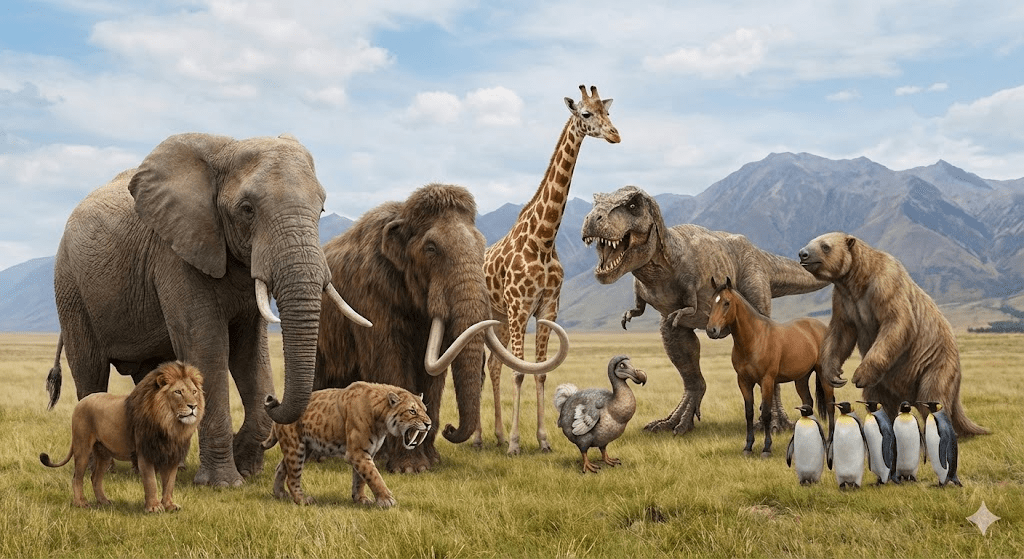
I made this image using Gemini Advanced. It is supposed to show the diversity of some of the animal life that has existed on our planet through time.
 Phi-The-Sci: Equilateral Musings