I have started a Sunday school series at my church based on my work on the intersection of the microbiome and theology that led to the writing of my book, “A Theology of the Microbiome.” I have been asked to do this series for a while, but I have been hesitant as I believe discussing potentially controversial theological issues in Sunday school is an inherent way to make people upset. Questioning God’s omniscience can make people anxious. Stating that one cannot prove God’s existence, or conversely, stating that one cannot prove the non-existence of God make people irritable. Stating that God loves but does not control definitely can make people angry.
In fact, I have often wondered if non-standard theology discussions should occur in the “academy” first before being filtered out to laity. That being said, I don’t even know what the academy is in such a setting. I have often wondered if new concepts in theology are like new concepts in philosophy. They really don’t make much change, but like numerous water molecules hitting a pollen grain, the multitude of converging new ideas in theology makes the system shift a bit. Metaphorically, I would compare such a possibility of change to Brownian motion.
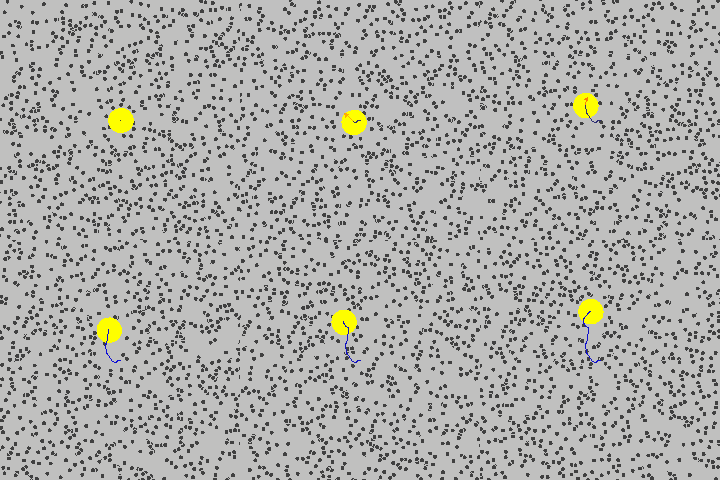
Example of Brownian motion
There are 2 aspects that I noticed that made people uncomfortable while I talked:
First, some people in Sunday school were uncomfortable that Greek philosophy had any influence on Christianity. There were individuals who do not accept this well known fact. Fortunately (or unfortunately), the influence is very much there. Ideas surrounding Aristotle’s unmoved mover (or the idea of God who started all motion) has been seen in Christianity as well as in other religions.

This unmoved mover could be essentially good. Thomas Aquinas describes God as follows: “Aristotle argues in many ways—still, it is absolutely true that there is first something which is essentially being and essentially good, which we call God, as appears from what is shown above , and Aristotle agrees with this. Hence from the first being, essentially such, and good, everything can be called good and a being, inasmuch as it participates in it by way of a certain assimilation which is far removed and defective; as appears from the above.”
God is all good yet separate from our daily reality? Since God is separate yet knows all things, then God has the capacity of “knowing all things made by Him, not only in the universal, but also in the singular” per Aquinas. This is omniscience. This is a description of God who is separate from the world, is good, and knows all things.
Jesus as described in the Gospels is good, but he is in the muck of the world. He also is not strictly omniscient. Think about Jesus in Luke 7 (“When Jesus heard this, he was amazed at him, and turning to the crowd following him, he said, ‘I tell you, I have not found such great faith even in Israel.'”
Thus, is God necessarily omniscient? Genesis 3 also would point to an alternative hypothesis with God saying, “Where are you?” to Adam and saying, “Who told you that you were naked?” to Eve. These are not omniscient statement.
My supplication here is that humans necessarily bring in all sorts of philosophical and theological ideas when thinking about the Divine. We bring in individual, familial, societal, historical, and cultural influences unknowingly. We can say that Western Christianity has no Greek philosophical influence (or better yet — no “pagan” influence — whatever that means), but it is most definitely there. I have previously discussed the idea of statistical modeling and God. As such, perhaps God is the the ultimate in making predictions (the “Uber-statistician“), yet God cannot precisely know the future. God is without equal in predictive capacity but is not omniscient. Such an idea helps in the concept of entities having free will. In a way, it is a helpful way to view theodicy. God cannot necessarily predict what will happen — good, neutral, or evil.
Second, some people in Sunday school did not like my idea that while God is all loving, God also desires nature to have freedom. God softly lures for creativity; nature can freely put limits on this call for creativity. Nature can freely put limits on creativity because God desires nature to have freedom…even if that means that nature puts limits on its capacity for freedom. Gravity is an example. The Second Law of Thermodynamics is an example. Evolution is an example. Death is an example.

The pushback that I received is that my idea seems to suggest that God cannot prevent the horrible things that happen in the world.
That is correct. I hypothesize that God cannot prevent the horrible things that happen in our lives and in the world.
God loves all nature and all reality and lures for creativity, for novelty, and for the love of others. Nature (including every human) can accept this lure at every moment in time especially since God is in time in a prehensive capacity. God is not in some far away place, all knowing, all powerful, and all deciding. It is our choice and nature’s choice to follow the lure for creativity. I can describe human choice. I cannot make a great definition about nature’s choice for creativity, but it is there based on nature’s constraints in chemistry, biology, physics, etc. Regardless, God who lures for love / creativity (but who can be unfortunately ignored), seems to make a bit more sense when considering the concept of evil and sadness in the world.
I think humans want God is be totally in control of their lives. From a theodicy perspective, such an idea seems difficult. God is in control of a child’s death? God is in control of a tsunami that kills thousands of people? Such tragedies do not sound to me like a God of love or creativity.
In other words, people want certainty when it comes to God’s existence when examining meaning in their life. We can have faith of God being with us (I certainly do), but we cannot prove any statements about God. God is not amenable to a science experiment.
I have the same issue.
I am certain in my belief of God’s uncertainness.
Image created by Gemini Advanced
 Phi-The-Sci: Equilateral Musings