I’ve returned from a 9-day vacation in Europe and am back to blogging.
I have been slowing reading Magisteria: The Entangled History of Science and Religion by Nicholas Spencer. I say “slowly” because it is often hard for me to find time to read for pleasure. This book is surely a pleasure.
Currently, I am in the middle of Chapter 11 (“The Balance”) which begins to explore how the introduction of Darwinian evolution in the 19th century affected Christianity in both negative and positive ways. As readers of my blog may know, I think the whole idea of a war between religion and science is basically nonsense.
We can choose to make war here. We also can choose to use religion and science to support each other — no differently than how human subjectivity and human objectivity support each other.
In Spencer’s chapter, he points out to “Scientific threats became indistinguishable from political or religious ones” in places such as England in the 19th century. It is so odd that we have such problems persisting today. Biblical literalism, the desire (wrongly) to teach creationism in public schools, the anti-vaccine movement — all occur because many people want to put God in a well-defined box. The box of human wants and needs is finite; God is infinite. Dividing the infinity of God with the finitude of humans is objectively (as in mathematics) infinity. It is subjectively showing us that God cannot be contained. The uncontained God works in theological models as diverse as Aristotelianism or in process theology.

image produced by Gemini Advanced
Certainly, such ideas of Divinity should be explored and criticized both philosophically and theologically, but the well of exploration is infinite. Honestly, I think it is fun to explore the infinite whether one is considering the existence of God or no God.
The beginnings of ideas surrounding evolution brought up significant issues regarding the human experience. Is morality an evolutionary by-product? Why is there such much death and biological waste in the world (in contrast to what William Paley believed was nature’s grand design).
But wait… What if 1) God is in / around / throughout nature and what if 2) God desires creation to freely choose good / love / creativity / beauty?
Here is where the objective and subjective meet. Evolution (which includes genetics) is objectively obvious. We should try to determine what evolution subjectively encompasses whether we believe in God or not.
I am a religious person, and I see death fairly regularly as part of my career. I could certainly say that I don’t believe in God, and honestly, it is a valid argument when one sees suffering on our planet.
However, my perception of the objective (the actuality of evolution) combined with my subjectivity (my belief that God is present) leads to many ideas that I have discussed in prior blog posts. Three major concepts here could include:
First concept: God loves us. God loves all of us (quark to quail to quasar) so much that each entity in nature has the ability to create in real time. The quark keeps its charge and mass to maintain creativity. The quasar (really the massive black hole in a galaxy’s center) promotes the evolution of a galaxy to maintain creativity. Humans have this capacity as well. We can be creative in how we treat other humans as well as how we treat the rest of nature. Unfortunately, we also can be destructive. Destruction by our species is definitely not love in both a divine or human sense. Destruction is not creativity.
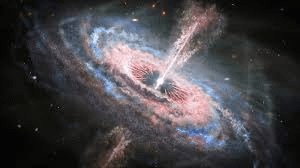
Quasar illustration (from NASA)
Second concept: God freely gives the entirety of nature the ability to “choose” for creativity or not. Thus, evolution and biological death can make subjective sense if one considers that nature has a “choice” (whatever that means metaphysically) to do otherwise.
Third concept: If God is infinite and we are not, then the sting of death is a consequence of living in a finite, time-dependent state. We cannot do otherwise as we are not infinite entities. We cannot contain God. I am a religious optimist, however. I think God containing infinite love and infinite creativity still provides potential for further creativity for every entity even after death. I don’t know what that creativity would entail. The infinitude of God fully containing love provides me with hope after death.
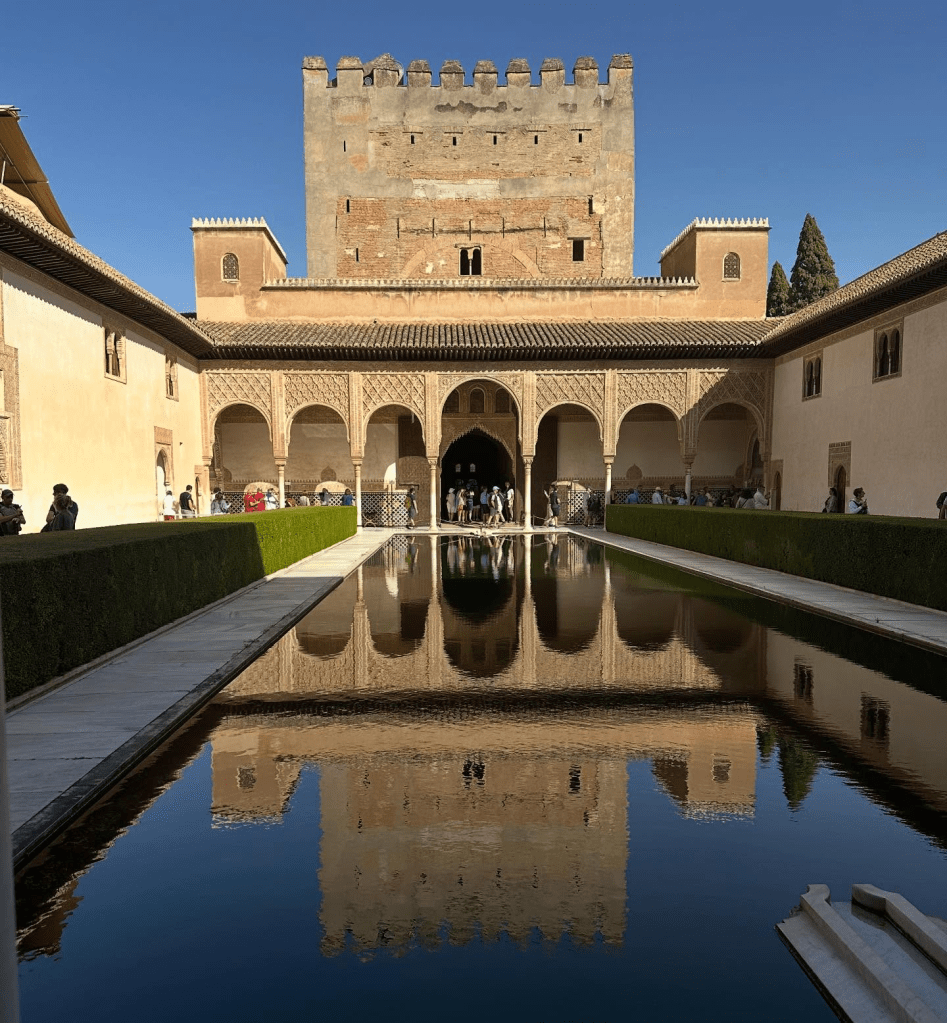
Image from the Alhambra from my recent trip to Europe (Granada, Spain)
 Phi-The-Sci: Equilateral Musings