I am going to be out of town for a couple of weeks, so it has been somewhat difficult to put a post together.
However, I did provide the sermon today for Wasatch Presbyterian Church. I am a member there. My sermon was titled “Faith and Love. Faith and Science.”
I have included the sermon below. Here is the link to the church service if an audio version is better for you. https://www.wpcslc.org/worship-from-wasatch?month=10-2025. Just choose “October 2025” worship services, and my sermon has been recorded for October 5, 2025.
I’ll get back to posting on a fairly regular basis when I am back in town.
____________________________________
Lectionary: Gospel of Luke 17:5-10 (The Gospel Reading for Today’s Sermon)
5The apostles said to the Lord, “Increase our faith!” 6The Lord replied, “If you had faith the size of a mustard seed, you could say to this mulberry tree, ‘Be uprooted and planted in the sea,’ and it would obey you.
7“Who among you would say to your slave who has just come in from plowing or tending sheep in the field, ‘Come here at once and take your place at the table’? 8Would you not rather say to him, ‘Prepare supper for me, put on your apron and serve me while I eat and drink; later you may eat and drink’? 9Do you thank the slave for doing what was commanded? 10So you also, when you have done all that you were ordered to do, say, ‘We are worthless slaves; we have done only what we ought to have done!'”
Me: This is the Word of God for the people of God
Everyone: Thanks be to God.
___________________________________________________________
Sermon: Faith and Science. Faith and Love
This is a difficult Gospel message to preach. Verses 5 and 6 in our bulletin seem to make sense both materially and spiritually. Verses 7 through 10 in our bulletin are confusing in many ways. Just so you know, Pastor Irene kindly offered to have me give a sermon on some part of the Gospels outside of the lectionary. I refused (hence we are reading the Gospel reading in the bulletin) which was probably not my smartest move. So, all complaints should go to her!
Let’s begin. Many have looked at Verses 7 through 10 to suggest that God owes us nothing. These verses have been interpreted (by some) to suggest that 1) we should not be prideful (I agree), 2) we should serve others without hesitation and without expectation of benefit (I also agree), and 3) God owes us nothing (hmmm…this is difficult). By saying, “God owes us nothing”, such wording can be interpreted that God is the great King for which we are mere peasants who are sowing the field and providing our harvest to the king with no expectation of any thanks. We give our material needs to this king while also awaiting for some type of benefit if things go awry. Unfortunately, this benefit is never secured. For example, if a local kingdom invades your farm, you HOPE that the king will be there to protect you from your enemies, your illnesses, your tragedies, and even your potential death. I don’t accept that interpretation of God, and I don’t think Jesus necessarily meant this common interpretation either.

Tintagel Castle, England
Brothers and sisters in Christ at Wasatch Presbyterian Church, let’s consider how to think about today’s Gospel in the setting of modernity, especially in the setting of modern science. Many of you know that I am an academic pediatric gastroenterologist working at the University of Utah. My primary location of practice is at Primary Children’s Hospital. By “academic”, I mean that my job involves 1) patient care at a high-tech children’s hospital, 2) teaching of medical students and residents, and 3) research.
Research – what does that mean? By “research”, I mean “medical research” and by “medical research”, I mean using “science.” And what is science? Science, in my opinion, requires just looking at the world to learn and to improve the human experience. One can do this by watching nature (paleontology, astronomy) or setting up experiments (biology, chemistry) or both (meteorology, medicine). Alfred North Whitehead (one of my favorite philosophers) in his book, “Process and Reality” has described science as follows: “Science has shown a curious mixture of rationalism and irrationalism. Its prevalent tone of thought has been ardently rationalistic within its own borders, and dogmatically irrational beyond those borders.”
Science can be rational. Think of the thousands of science journals produced monthly that produce research containing a huge amount of information. Biology, chemistry, physics, geology, mathematics, medicine (I could go on and on) all coming out with information about our species and about the world we exist in. This is rational – the best rationality humans can acquire.

Image from AAMC
But what is irrational and “beyond the borders” (per Whitehead)? This is where verses 5 and 6 come in. Look at those verses again in our bulletin. As a Christian, do we really believe a literal reading of this passage as saying, “Look! I have so much faith that I can make a mulberry tree leap out of the earth and go running into the sea!” But we don’t see that happening, do we? We don’t see trees running into the ocean. We don’t see mountains being thrown into the sea (as Jesus states in Matthew 21).
We do see clearly what King David reportedly states in Psalm 8:
When I consider your heavens,
the work of your fingers,
the moon and the stars,
which you have set in place,
what is mankind that you are mindful of them,
human beings that you care for them?
What is David “considering”? I think David is amazed that he is present in a world that is large, mysterious, and glorious. I think he also is pointing to the potential of today’s science. We are “considering” the world around us (which is science) and are understanding that God wants us to do good science (which is God is “mindful” of us and “cares” for us).
I realize many of you are not working in science-related fields, but I strongly believe that you can participate in the glory of God’s creation even here today.
David looked at the world and was amazed. He was observing all that was wonderful and still is wonderful. He is looking at the world in a manner similar to science. As an example, if you ever hear the word “induction” in science, for example, it means studying or learning or being amazed by the world just by looking around.
You can look at the world and be amazed at what God has given us. Since you should be amazed by what God has given us, it is good to 1) share your amazement and 2) share the tools of amazement.
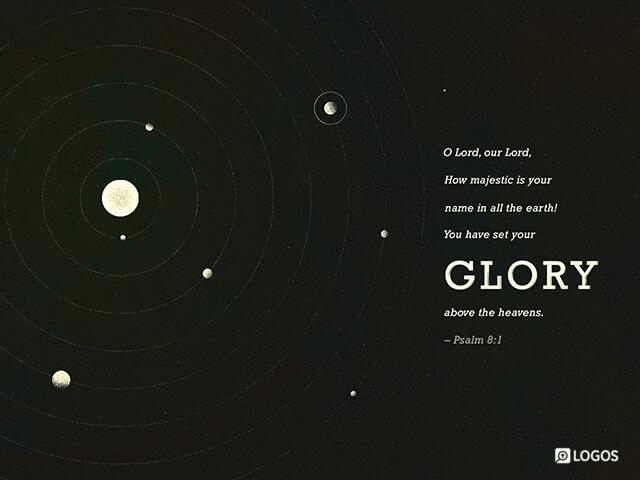
Image from Logos Biblia
As a physician caring for very ill children at Primary Children’s Hospital, I see real world consequences here.
For example, you see God’s glory in childhood vaccinations. Children are living longer than ever mainly due to vaccinations and clean water. You can vaccinate your child or educate people who do not understand vaccinations. As a result, you can see God’s glory and love while living on a wonderfully unique planet that is constantly rediscovered by science. You can help keep our little planet beautiful for now and for always by recycling, preserving water within reason (especially in Utah), and understanding the dangers of global warming or global pandemics. You can help educate people who do not understand the uniqueness of life on our planet.
In other words, as Christians, we should combat misinformation. This combat should be done gently and with love. We should be like the Good Samaritan here. We should bind the wounds of misinformation with love to prevent confusion in the setting of misinformation about science.
For example, measles kills 1-3 of every 1000 children who are infected and not vaccinated. Measles causes life-altering permanent neurologic disease in 1 in 1,000 children who are infected and not vaccinated (I have seen this). 25% of children who are malnourished and are infected with measles will die.
Just think of the miracle God has given us with science. God gave us brains. Brains gave us science. Science gave us the miracle of vaccinations for children. Vaccinations are truly a gift from God. And science, done well, is a gift from God or par in my opinion with the parting of the Red Sea or Jesus’s sharing of the loaves and fishes. And we know God loves children for as Christ said in Matthew, “Let the little children come to me, and do not hinder them, for the kingdom of heaven belongs to such as these.”

Now to the rest of the reading. Look at Verses 7-10 in our bulletin. They seem difficult, don’t they? I don’t necessarily like how Jesus is talking here which means that I was theologically perplexed at first reading. I spent some time looking at commentaries regarding these verses. Let’s talk about 4 interpretations.
First idea: Perhaps this reading is an example of the hypostatic union. That is a weird term, but basically “hypostatic union” means that Jesus is 100% God and 100% man which is a math equation that would very much irritate my 7th grade math teacher, Mr. Aiken, who was quite precise. I’m sorry Mr. Aiken. I am sure I am still driving you crazy 45 years later.
Here, just perhaps, Jesus is showing his human side just like when he became irritated and cursed the fig tree. If you look at the verses just before in Chapter 17 from our reading today, Jesus is being bugged by his disciples about how to increase their faith. He is perhaps simply irritated and would like them to think more deeply about God’s love.
Second idea: Perhaps these verses are an allusion to faith. Verse 10 states that the slaves say, “we are unworthy servants; we have only done our duty.” In other words, we can do only what we can do. This is perhaps a metaphor of God’s grace? The slaves have done everything they know how to do. They do not, cannot, have no clue how to…do more. But God doesn’t need to thank them. For “God to thank us” suggests that God wants the slaves (really, we humans) to do more and more and more and more forever and ever. We hear this theology in many places in our state. Honestly, we often hear such poor theology in our country. You and I cannot do enough to match the workings of God who made our universe and perhaps even made a multiverse. God loves us anyway. God forgives us regardless. God love us always. This is grace.
Third idea: In the parable, the slave still gets food and drink. It is hard to imagine this story being told by Jesus in the setting of the United States at the present time. When Jesus walked the Earth, imperial Rome was ever present in Judaea. There were no courts as in the United States today. There were no well-trained objective judges. There typically was no justice.
In the Palgrave Handbook of Global Slavery Throughout History by Damian Pargas and Juliane Schiel, Roman slavery was described as follows:
“This problem was omnipresent, for even if some of the enslaved persons…were at times able to escape their fetters and sometimes to benefit from the training or status imparted to them while enslaved, there was never a slave in the Roman Empire who did not experience slavery as a relationship of violent domination, natal alienation, and general dishonor.”
Hard stuff to hear. I think Jesus is chiding his disciples as to how they would act if they were slave owners themselves! Humans are always corrupted by power. The French philosopher, Michel Foucault comments in his book, The Order of Things, “The analysis of wealth is to political economy what general grammar is to philosophy and what natural history is to biology.”
In other words, wealth is the most important aspect of economics. Wealth is power. Power is what drives our human world. Jesus is telling his disciples something to the effect of “If you had power, you would abuse it. You are of this world.” And honestly, Jesus shows them how God’s power is used best by simply healing 10 men with leprosy (some of the lowest in society) in the following verses of this chapter.

Villa Romana del Casale mosaic, Sicily (University of Kent)
This is Christ’s power. Not buying big houses or fast cars to impress others. Not running for president with millions in donor money. Not messing around in conspiracy theories. Not killing others who disagree with you. Christ’s healing is available for all of us even when we feel the constant desire to obtain power. This is Christ’s grace. This is Christ’s love.
I would like to add a fourth idea here. I got my Doctorate of Theology and Ministry degree to expand my learning after Susan and I became empty nesters. I got this degree in order to not bug my wife all day. I also got this degree to help in a bigger mission already occurring with many others to get rid of the term “war between religion and science.” This term is not true.
My specific training was in the theological field of process theology and its more Christian oriented theology called “open and relational theology” which has 4 foundational ideas.
- God is in real time.
- All reality, all nature, all the universe is in God.
- Everything experiences from quark to quail to galactic quasar (and yes, humans). We all experience and, thus, God experiences what we experience.
- God is love.

Image from the book, “Panentheism and Panpsychism“
In the setting of these verses from Luke, I would like to theorize that Jesus is challenging his followers by using the slavery term to expand on the word “ought.” Again, Jesus is using slavery as an idea in the setting of first-century Judaea. It is hard to relate to this type of society today.
But what if “ought” means aligning with God’s love? If we align with God’s love, we automatically create love or creativity or beauty in the setting of real time, in all reality, and in all reality in God. Can you imagine how wonderful our societies, our civilization, our planet, and all of nature would be if we tried so very hard to align with God’s love? It is our choice – given freely.
Fellow Christians at Wasatch Presbyterian Church, I ask you to look at your daily Chrisitian walk. Are you peddling in pseudoscience or extreme politics or hostility of the other (and I mean every “other”) which removes you from not aligning with God’s love and creativity as exemplified by Christ Jesus? By the way, my using the word “you” also implies “me, John Pohl.” Our goal to have Christ in our life is the love of truth, love of others, and love of God. Our goal to have Christ in our life is to bring forth ever more love and creativity as we walk on this planet.
We should yearn daily to place our faith in producing love and creativity as both individual Christians and as a church in Christ Jesus. Amen.

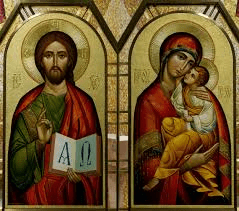
Image created by Gemini Advanced
 Phi-The-Sci: Equilateral Musings