Lately, I have been reading through the book, Magisteria, by Nicholas Spencer. It is quite long (467 pages with the index), but it is easy to read and loaded with excellent information. The book is about the history of the interaction between science and religion through human history. It literally covers almost every aspect of this entanglement — the good, the bad, the neutral. I highly recommend reading it.
I could say so many things about this book, but I am going to concentrate on a major theme in the first half of the book…”physico-theology.”
What does this term mean? Per Spencer, it means an extension or modification of “natural theology.” Natural theology, per the author means “…to understand and define the divine through observing, and reasoning about, nature.” Spencer points out that one does not have to be Christian to have participated in natural theology.
One can look at Plato’s Timaeus to see such an example:
“In the first place, then, as is evident to all, fire and earth and water and air are bodies. And every sort of body possesses solidity, and every solid must necessarily be contained in planes; and every plane rectilinear figure is composed of triangles; and all triangles are originally of two kinds, both of which are made up of one right and two acute angles; one of them has at either end of the base the half of a divided right angle, having equal sides, while in the other the right angle is divided into unequal parts, having unequal sides. These, then, proceeding by a combination of probability with demonstration, we assume to be the original elements of fire and the other bodies; but the principles which are prior to these God only knows, and he of men who is the friend of God. And next we have to determine what are the four most beautiful bodies which are unlike one another, and of which some are capable of resolution into one another; for having discovered thus much, we shall know the true origin of earth and fire and of the proportionate and intermediate elements.”
Plato’s extended quotation above shows elements of observation and reasoning. It is an example of “induction.” Is it science? Not really. It might be considered “proto-science” as science likely evolved from such thinking.

statue of Plato
Spencer then states that natural theology evolved into “physico-theology.” Physico-theology basically can be defined as 1) learning about the world in order to 2) glorify or worship God even more. He states that Galileo’s use of telescopes to see the stars and planets would be an example. Marcello Malpighi who worked on blood circulation and discovered capillaries would be another example. Antonie van Leeuwenhoek who used the microscope to discover microscopic life would be another example.
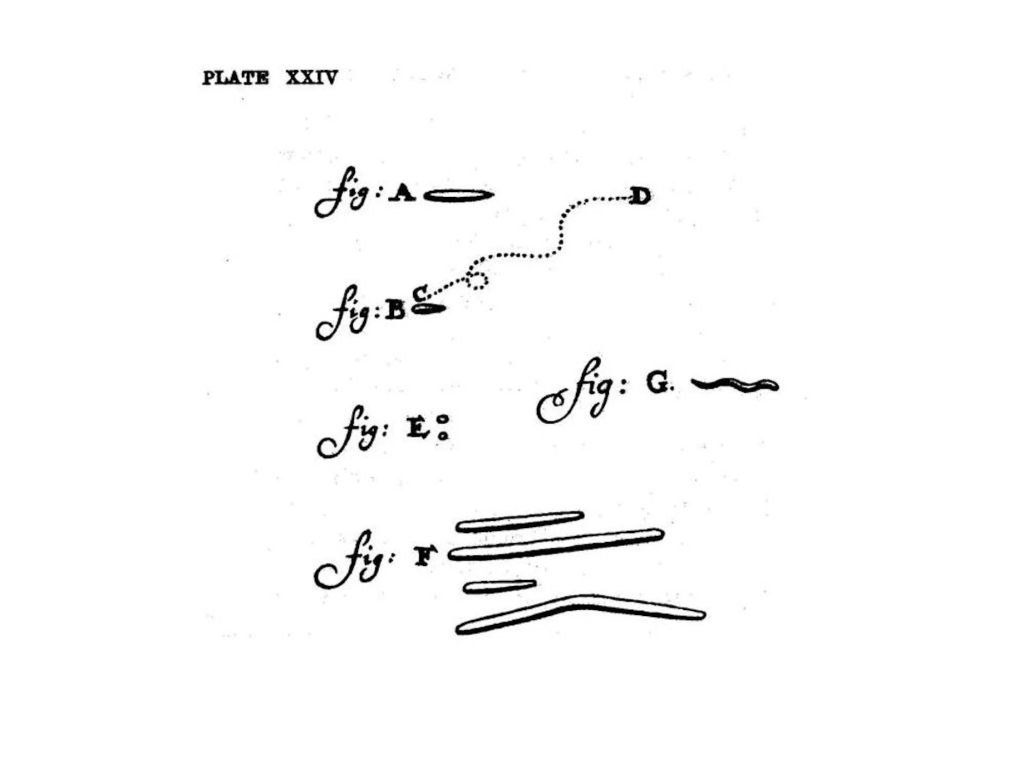
Antonie van Leeuwenhoek’s drawings of mouth bacteria (1684)
Spencer states, “And they did give glory to God, scientists and divines alike, volubly and frequently, in innumerable sermons and books published over the next century…“
His above statement is a wonderful outcome of physico-theology.
Wow. Such ideas sound so differently from how many aspects of religion (and not just Christianity) look at current science through a religious lens.
In my faith stream, it seems that some of the loudest voices who claim to be Christian are also anti-science. Such people often believe in problematic ideas such as young Earth creationism, anti-vaccine conspiracy theories, or refusal of medical care on fundamentalist religious grounds. There has always been an element of human society that has been scared of science or technological advancements, but I think social media is making scared feelings become conspiratorial beliefs that are getting embedded in modern society.
I feel quite sad when I see people pushing for specific religious texts to be taught in U.S. public schools or removing the teaching of evolution in public schools or expanding vaccine exemptions for unscientific (and in my mind, immoral) reasons. I say this as a Christian.
As an example, we have had recent measles outbreaks in Utah, where I live. I think that people forget that measles kills 1-3 of every 1000 children who are infected and not vaccinated. Measles causes life-altering permanent neurologic disease in 1 in 1,000 children who are infected and not vaccinated. The neurologic consequences can be horrific. 25% of children who are malnourished and are infected with measles will die.

Brain imaging of subacute sclerosing panencephalitis which is an awful consequence of measles infection.
It seems to me that refusal to accept the reality of the success of vaccinations through two centuries as well as other successes is science is anti-Christian if one believes the teachings of Jesus. As Jesus teaches in the Gospel of Mark: “‘Love the Lord your God with all your heart and with all your soul and with all your mind and with all your strength.’ The second is this: ‘Love your neighbor as yourself.’ There is no commandment greater than these.”
What to do?
I have no real solutions, but I will provide some potential pathways.
First, scientists, engineers, physicians, etc. need to do a better job of reaching out to the public about how science, done well, is associated with human benefit. By “done well”, I mean that science needs to be done ethically. Humans often fail at this endeavor (for example, the invention of nuclear weapons), but we always have the opportunity to fix the mistakes we make (the development of nuclear energy) or to push scientific fields such as physics into more helpful directions (the discovery of the standard model). We should continually try to keep science ethical as we try very much to do in medicine (see the Helsinki Declaration). If science experts don’t speak out, then non-science experts who could be conspiracy minded will take the experts’ place in the public forum. We are seeing this issue quite a bit in the United States currently.
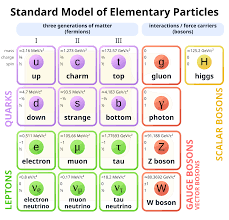
the Standard Model
Second, religious leaders and theologians need to do a better job about reaching out to the public about how science done ethically (and yes morally) will typically benefit the public. I want to emphasize the word “ethically” because our churches, temples, mosques, and synagogues should always emphasize ethics in the setting of our understanding of the Divine. The God that I worship is a God of love who desires for us to make good decisions to help other humans as well as the rest of our planet. There should be no anti-science conspiracy settings in our religious lives. One of the best articles that I have ever read about this issue is here.
Third and as I have discussed before in my blog, we need to appreciate the objectivity and subjectivity of the human experience. Both human objectivity and subjectivity influence each other. The influence can be terrible, but the influence (done well) can be magnificent. Bad science (fraud, plagiarism, faking results) is not good ethics. Bad ethics (making scientific “results” fit one’s personal conspiracy theory, ignoring valid scientific results) is not good science.
Good science with good ethics should be the goal. God, who loves us very much, wants us to achieve this goal. It is our choice to do better.

Image made by Gemini Advanced
 Phi-The-Sci: Equilateral Musings