This post may seem more philosophical than theological, but I find it interesting just the same.
If I consider how I emotionally react to a color, I can extend this type of emotional reaction to other individuals. I may react calmly when I see the color “blue.” In fact, I love blue and prefer my workspace to be blue, if possible. However, do other people feel the same way about blue? If “no”, are they seeing blue the same way that I do?
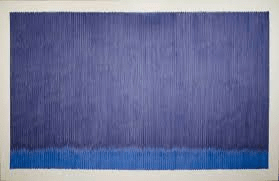
Painting by Gene Davis
In many ways, such thinking perhaps involves the idea of “qualia”. A good review of qualia is here as the philosophical idea can become quite complex. I like to think of qualia as a subjective representation of something we experience objectively.
For example, I love coffee. I love the taste. I love the smell. When I say “love”, I mean that I tend to want to drink it as soon as I smell it. I have some type of subjective desire associated with coffee. I went to a restaurant last night with my spouse. At the end of dinner, the server asked if I wanted coffee. Just hearing the word “coffee” made me have a subjective reaction or perhaps emotional response, which inclined me to say “yes.”
A famous thought experiment regarding the potential of qualia existing is the idea of “Mary’s Room.” I won’t go into the thought experiment in this post, but the original idea by Frank Jackson in 1986 has generated much discussion and many subsequent philosophical papers.
Recently, the Journal of Neuroscience may have cleared up the idea of qualia, at least in the setting of color. A recent article in this journal is titled, “Human V4 Activity Patterns Predict Behavioral Performance in Imagery of Object Color.” The article is open access and available to read freely.
In this study, 19 volunteers underwent functional MRI testing of the brain (fMRI looks at real-time changes of blood flow in organs) to evaluate brain activity in the setting of color. By the way, a good review of the article is in Nature.
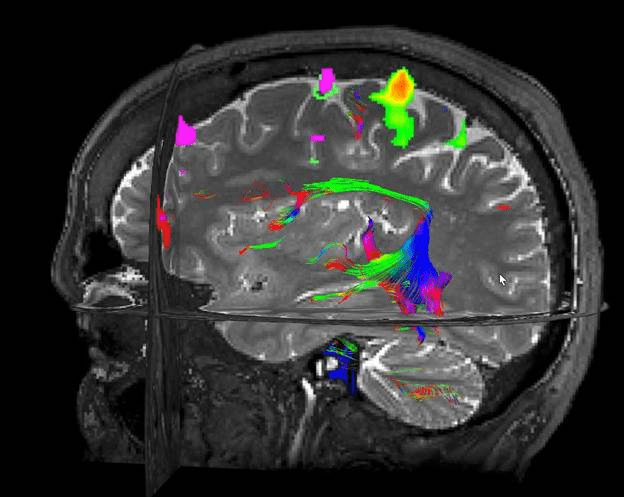
An image of fMRI from the University of Florida
In this study, male and female human subjects had fMRI readings of their brains performed while they looked at red, green, and yellow colors. Next, fMRI readings of their brains were repeated while they were asked to come up with mental images of these same colors.
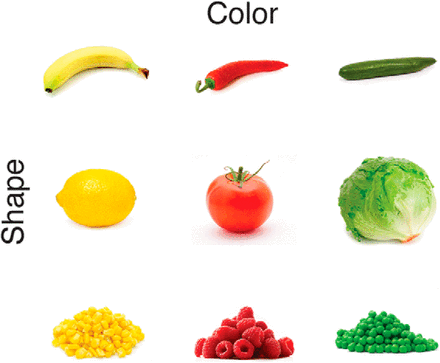
The image patterns use in the experiment
Here is the fascinating part… The study authors performed mapping of retinotopically matched visual areas in association with these colors. This mapping determines the part of the brain being signaled when a part of the retina is observing colors. They found that the specific area of the brain known as human visual area 4 (or hv4) had an extremely high correlation in brain activity as seen in fMRI when patients were shown colors or when they thought about colors. This hv4 area signalled the same whether study subjects 1) saw specific colors or 2) thought about the same specific colors.

Graph from the study showing high correlation of hv4 activity when observing and when thinking about colors.
The locus of hV4 correlates to the ventral surface of the occipital lobe of the brain. Here is an example of mapping of the human visual cortex to the brain:

Image from Cell (open access)
So, this important paper pretty much sums up a long-standing question. Do we all perceive colors the same way? I think the answer is “yes.” Absolutely yes.
When I look at red or green, my brain is neurologically and anatomically acting the same way as every other individual human. This fact seems to be objectively true.
I guess my only concern is how we then emotionally or psychologically react to colors. As a very small example, the black-colored license plate in my home state of Utah has become very popular. Why? Is it cool to look at ? Why is it so cool? Is there something about the color “black” that makes a human think it would look good on their automobile?

I still think there is still a remaining qualia aspect to color. Perhaps the connection of color to emotional reactions can simply be explained neurologically. I accept this idea very much. I think that there is also a philosophical concept that should be explored.
In the setting of process philosophy, nature is described as having a panexperiential aspect inherent to its existence. I’m not talking about emotional or psychological expressions at the atomic level. I am talking about experience in and of itself. An electron experiences charge, spin, and mass. Perhaps, as biological structures grow from the atomic to the molecular to the organelle to the organ to the whole organism, this accumulation in experience leads to consciousness. At the level of consciousness, emotional reactions can occur to stimuli such as color.
Perhaps qualia could be defined as “qualia +“. The “+” would be defined as organic neurologic changes as demonstrated in the study above. The “+” could be the accumulation of experience of all matter to produce a subjective reaction in a human. We objectively see red through the accumulation of experience of all entities in a human. We also subjectively see redthrough the accumulation of experience of all entities in a human. This is philosophy and not science. I am just speculating.
However, there is a theological link here. If we all see a specific color the same way objectively but have potential differences in how we experience color, then perhaps we have a spectrum of emotional or subjective beliefs in how we see God how we don’t see God. We have emotional or subjective ideas that combine with objective reality when we look through a telescope at our galaxy or when we experience the birth of a child.
God.
I think our perception of how we think about God (or the nonexistence of God) is reliant on real sensory objective data plus our subjective psychology. This combination of the subjective and the objective produces a plethora of beliefs about the definition of the Divine.
Objective + Subjective = how we define God = how we define no God.

Image of the Andromeda galaxy
 Phi-The-Sci: Equilateral Musings