I apologize about the delay in posting. I went on a salmon fishing trip in northern British Columbia. I then returned back to Utah to spend 3 days with my spouse at Dinosaur National Monument on the Utah/Colorado border.

Dinosaur National Monument is a beautiful place. It is a relatively small monument (about 320 square miles) with only 350,000 visitors coming through annually. The vast majority of tourists only go to the Utah side to see the famous quarry exhibit hall (the “wall of bones”). Most people just look at the quarry exhibit and leave. Susan and I visited the quarry exhibit but also spent time hiking on the Colorado side at an elevation of 7000 feet which had amazing views of the Green River.
Dinosaur National Park is known for the Morrison Formation which dates to the late Jurassic period (about 140-150 million years ago). Part of that formation contains the quarry exhibit hall. The side of the mountain with the exhibit hall has been exposed here by paleontologists through the years to reveal over 1000 bones of Jurassic dinosaurs include Allosaurus, Apatosaurus, Camarasaurus, and Diplodocus.
A good video of the site is here.

The Morrison Formation and Dinosaur National Monument will continue to change over millions of years into the future. Erosion will happen. Mountains will form and tectonic activity will move the geological layers around. The Green and Yampa rivers will make the canyons deeper while perhaps drying out or making new rivers.
We exist within this geological change in a blink of an eye. The Jurassic dinosaurs also lived within past geological time in a blink of an eye. As I hiked on a trail at 7000 feet above sea level on the Colorado side, I probably caused the canyon to lose just a few atoms of its layers. The dirt on my shoes and my shedded skin cells during the the hike possibly added just a nanometer of geological layering.
Erosion. Tectonics. Water flowing. Dinosaurs walking. My walking. All such events are associated with change. Importantly, change in the setting of process theology as well as in open & relational theology is associated with creative potential.
I believe that God desires or lures for novelty or for creativity in the setting of constant change. The canyons formed by the Green and Yampa rivers were changing and creative in the past. They are currently changing and creative now. They will be changing and creative in the future. There will still be change if the rivers quit flowing. There will still be change as the sun expands and eventually absorbs our planet. There is always change with the potential for creativity in the setting of God who loves such creativity but does not force.
The wall of fossil bones at Dinosaur National Monument point to such creativity. In a way, the accumulation of these bones seem artistic. The dinosaurs lived. They also died and were buried in the soil to fossilize. That is an objective fact. Thousands of humans now come to see these fossilized bones every year because, in fact, the encasement of a period of time from the deep past is subjectively fascinating and perhaps beautiful. This encasement or random bones is definitely an example of potential.

The quarry exhibit hall, Dinosaur National Monument (image from U.S. National Park Service)
One of the areas of the hall demonstrates the protruding head and neck of a sauropod (I think Camarasaurus). It is beautiful in may ways. I took picture of it (below).
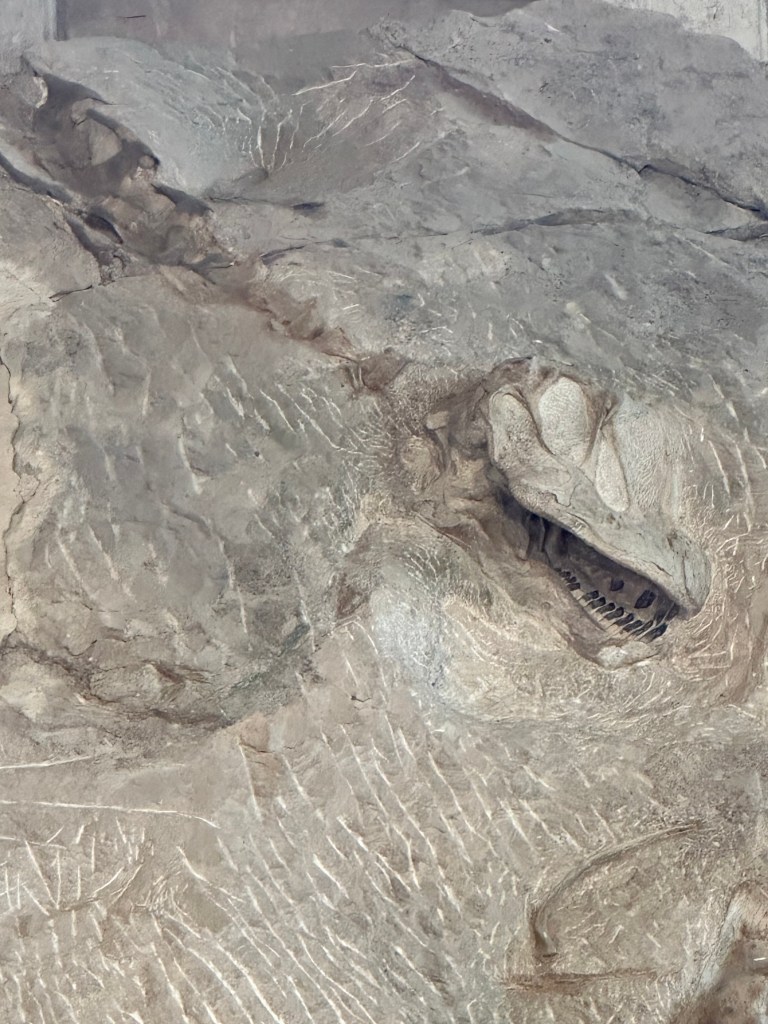
The skull and vertebrae demonstrate potential of a past life. The various ligaments, muscles, nerves, and skin are now missing. The colors of this sauropod are long extinguised. All of these aspects were once there in a living organism. The presence of these various tissues provided potential for movement, eating, breathing, and reproduction. You can imagine skin and muscles around the bones, but the effect seems blurry around the edges. It is hard to see the dinosaur as it actually looked while alive.
As another example, consider this mollusc shell that I found at 7000 feet elevation.

The shell was about the size of my hand. It is hard to imagine its potential when it actually was alive within a well-formed shell, potentially filter feeding, and potentially performing external fertilization in the Jurassic waters.
Although the mollusc is now a fossil, it once was alive, could produce more life, and could influence other life and the environment around it. In fact, since its remnants are contained in the continuing elevation of the land occuring through millions of years. the mollusc has continuing potential to be part of geological activity over immense time periods.
It is hard (at least for me) to visualize such potential when looking at a cracked fossil. That potential of past life reminds of art.
I do not think life is a Heironymus Bosch painting.
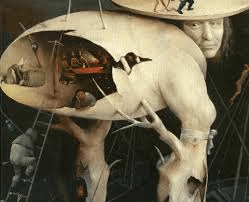
The Garden of Earthly Delights by Bosch (made between 1490 and 1510)
I don’t envision life as hell. Death is a natural part of life’s processes. Bosch’s painting is exact, well made, and clear. The anatomy and the behavior of past life on our planet is not always clearly defined. Fossils, trace fossils, and ancient animal tracts are blurred at the edges metaphorically as they obscure what was actually happening both 1) at the moment in time when the organism lived as well as 2) in the future potential that the organism contained before the fossil was made.
I think life can be visualized more like a Claude Monet painting.

Water Lilies by Monet (1919)
The lilies are indistinct…are dim…yet are full of potential. The more you stare at the painting, the more you see what could be. The lillies have the capacity to change in the light of artistic impressionism. Our impression of the lilies changes through time.
So, that is how I consider God in nature. I am someone who leans into theological naturalism. I think God exists, but God is in nature itself. God is in / through / around nature at all locations and in real time. This naturalist interpretation of God limits the possibility of the supernatural although I cannot rule out the supernatural if the universe is potentially infinite in size.
I take it as a theological a priori reality that God is love. In this love, God wants creativity moving forever onward, if possible. God wants creativity, and nature just has to somehow freely “choose” to align with the Divine for the potential of further novelty, life, and beauty. God wants this creativity in real time while moving eternally onward.
Just like Monet’s lilies, the fossils at Dinosaur National Monument point to the potential for change over time as well as to the potential of yet unknown future beauty extending from remnants of animal life in the past.
Nature has the capacity to be a divine and infinite art gallery.
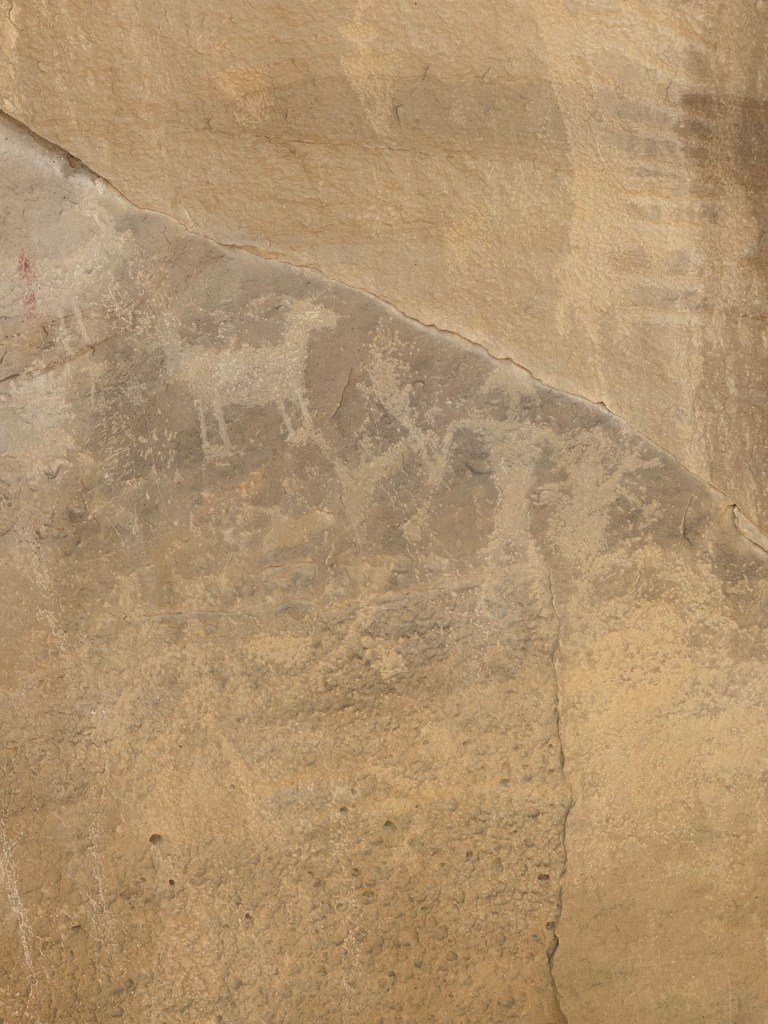
By the way, I would like to end this post with a picture of a petroglyph made by someone from the Fremont peoples (300-1300 BCE). I found this petroglyph at Dinosaur National Monument. Similar to my description above, the petroglyph is vague in figure formation, yet beautiful and full of potential.
 Phi-The-Sci: Equilateral Musings