I thought I would send out a quick post before I head out to Canada midweek to go salmon fishing in Canada. I will be fishing around Blackfish Sound which is seriously away from most of civilization.

I did this same trip with friends 2 years ago. Blackfish Sound is an incredibly beautiful place to fish. There are mountains, forests, and tons of wildlife. The animals there include grizzly bears, bald eagles, sea lions, orcas, porpoises, humpback whales, and of course tons of fish.

A picture of some of the wildlife from my last trip
The weather around Blackfish Sound this time of year is cool during the day and cold at night. The weather, geography, water, and biological diversity is, in many ways, the definition of beauty.
However, there is death here too. Animals must eat. Grizzly bears eat the salmon and other mammals. Eagles eat the fish and rodents. Humpback whales eat the herring and the krill. Orcas, porpoises, and sea lions eat the fish. The orcas eat the sea lions as well as young porpoises.
I kill and eat there too. The late summer is the time of the salmon runs in which the salmon migrate from the Pacific Ocean and into the rivers of Canada from which they originally hatched. After they spawn in those same rivers from which they came forth, they die. This biological process is called “semelparity.” I am clueless as to how they know where they should return to die.
When we catch the salmon, we hit them on the head with a bat to kill them instantly. I’ll be honest. I know they are fish, but I can feel a bit cruel about hitting them. In Utah, I do “catch and release” when I do fly fishing. However, the Pacific salmon are gong to die anyway. The guides tell me that when the salmon all reach the end of their journey, they die and rot in mass quantities. Perhaps I am saving my personal catches a quick end as opposed to ending up as part of a mass death.

Large number of dead Sockeye Salmon after spawning
It is hard to create a synthesis from the thesis of beauty of nature associated with the antithesis of death of organisms.
I also see this dichotomy of beauty and death at my workplace in the hospital. As a physician, and in particular as a physician for children, I see beauty in the potential of young people as they grow up while also seeing the disaster that occurs following the death of a child.
On a personal note, I have seen death in action — whether with patients or with family members. Death is an odd event. I feel immense sadness when a relative of mine dies or when I have a pet die. Why do I not feel this same sadness for the millions of creatures who die in Blackfish Sound as part of natural biological cycles? Why do I not feel it for the individual krill eaten by the whales? I don’t think it is possible for the human brain to capture the emotion of constant mass biological death. Our brain seems to block such emotions out so that we can move on in life.
I have no answer to why beauty and suffering co-exist. Perhaps beauty in nature is subjective quality while death is an objective fact. I believe that subjectivity and objectivity co-existing at all times and at all places is a metaphysical possibility. Perhaps the concepts of beauty and death can be switched to allow beauty in nature to be an objective fact while death is a subjective quality for which we don’t understand it underlying meaning.
I am a theist, so I think God exists in the setting of such disparate ideas. Readers of my posts know that I believe God is participatory but not forceful. God desires novelty and creativity, but God does not force us to co-participate in novelty / creativity.

Photo from my last fishing trip
As I stated in my last post, the death of an organism leads to available energy resources for other creatures to use in order to grow. The various fats, protein, and carbohydrates of the dead creature are instantly available to the spectrum of creatures ranging from simple bacteria to large carnivores.
I have two thoughts here.
First theological consideration: Perhaps God lures for creativity in such as way that nature uses the mechanism of death to bring forth new life. Animals, plants, fungi, bacteria, etc. use the various elements of a dead creature for growing and building their own lives — for being creative. In such a setting, God would lure for creativity, yet God would freely allow nature to choose any possible way to be creative. Nature could “choose” to use death (encompassed in greater process of entropy) as a way to be more creative over time. God lures for the creative; nature makes its own rules as to how to be creative.
I have come up with a theological term here which I call “lim Δ” which is a limit “lim” to change “Δ“. I use this term in my book, “A Theology of the Microbiome.”
Second theological consideration: Perhaps God lured nature early on in Earth’s history of life just enough to increase subjective beauty while decreasing the objective reality of death. Consider the Ediacaran Period (600 – 538 million years ago) in which the first animals (perhaps proto-animals?) appeared. There is evidence of the Ediacaran Period in the fossil record. These animals were softbodied and mainly sessile. These animals were likely filter feeders. Only a few of these creatures were able to move. Although they may have consumed bacteria as filter feeders or as bacterial mat feeders, obvious carnivorous activity is not found. Good references are here and here.

Illustration of the Ediacaran Period (from Earth Archives)
This system irreversibly changed in the setting of the Cambrian Period (541 – 485 million years ago) which followed. As animals evolved and were able to move, predation became much more possible.
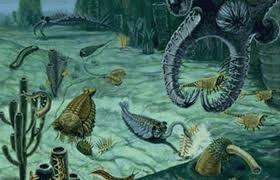
Illustration of the Cambrian Period (from Understanding Evolution)
Thus, nature could have had a greater alignment with God’s lure of more beauty and perhaps less death early on in our planet’s biological history such as during the Ediacaran Period. God lured for creativity in the Cambrian Period and still lures today, but perhaps nature has freely put more limits on what creativity entails so that death is the driving force of creativity.
The Ediacaran Period could metaphorically be considered a type of Garden of Eden with no predation although death still occurred. After all, entropy eventually consumes all life. Nature on our planet freely took on creativity in a different direction than God’s lure for novelty. As a result creativity persists, beauty is present, but mass death is a type of process or answer to create new life.
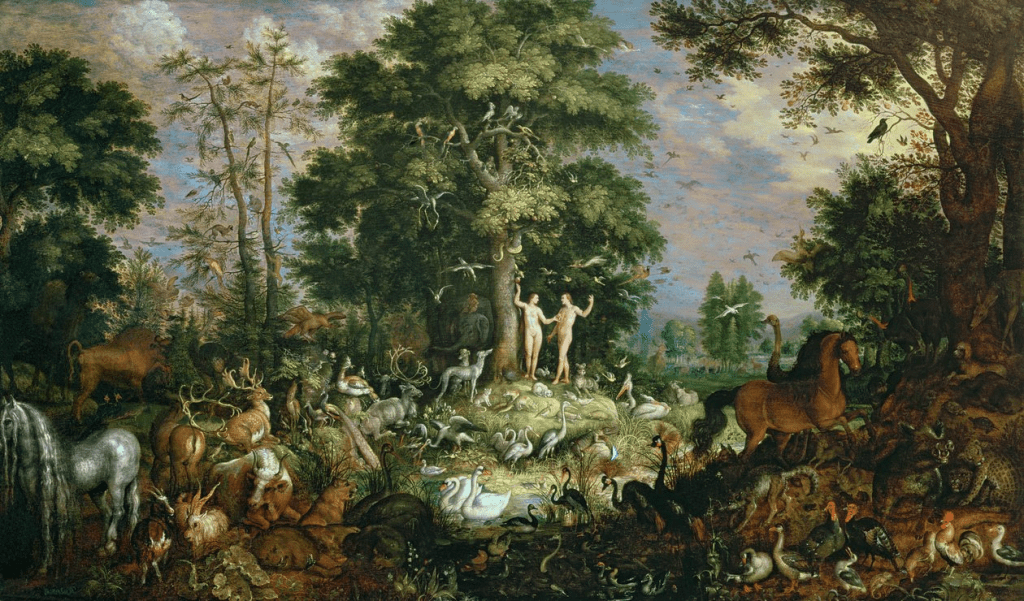
“Garden of Eden” by Roelandt Jacobsz
My ideas obviously are embryonic in thought. I should try to flesh them out more. I probably will be thinking about such ideas while sitting on a boat in Blackfish Sound and looking at the beauty of the natural world.

image created by Gemini Advanced
 Phi-The-Sci: Equilateral Musings