Human brain structure formed in complexity over time, and I have wondered when the first of our genus (Homo) began to think about God(s) and potentially the afterlife.
There are some early potential intentional burial sites noted at Qafzeh Cave (Israel), Tabun Cave (Israel), and Tinshemet Cave (Israel) that were made by Homo neanderthalensis, Homo sapiens, or perhaps both interacting together or in close proximity between 100,000 – 115,000 years ago. By intentional burial sites, I mean ochre use or leaving tools in such graves could suggest that the dead individuals were interred by the community who perhaps had a hope for life after death.
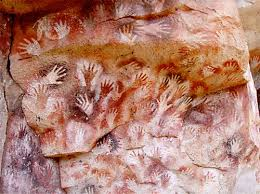
prehistoric red ochre handprints
The correlation of these ancient Homo locations in the Levant which were in the general vicinity of where the Abrahamic religions mostly began is not lost on me. However, I do realize that correlation is not causation.
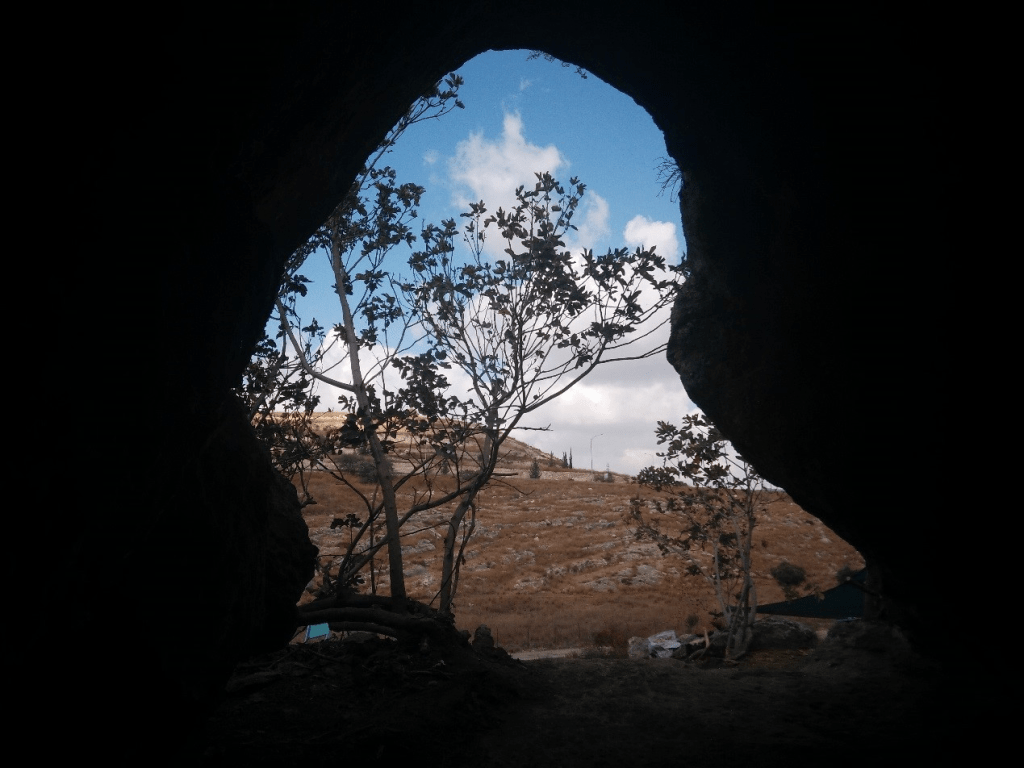
Tinshemet Cave
I have written in the past about evidence that there may be proto-religious structure in some monkey societies as described here and here. I have no clue what these monkeys are doing as I am not a chimpanzee just as I am not a bat. I don’t think it is possible for humans to understand even primitive spirituality (if it exists) in other species.
Then why did humans become religious? Why and when did we first start to consider the presence of God(s)? Banerjee and Bloom argue that theistic beliefs are strictly cultural which could certainly be true. A “blank slate” of the brain in regards to the metaphysics of God(s) would certainly argue that culture would be the sole influence in a belief of God. If we were born with no real subjective thoughts and without real world objective experience (hunger, pain) from our limited experience in the uterus, then any idea of God would be subjective and culturally based.
However, there has been pushback to this idea as the brain may have basic templates in place for which to add on objective and subjective experience. Could a template exist in an advanced brain structure that allows for metaphysical thought?

Blank slate / tabla rasa
When it comes to the brain, I often wonder if I am follower of mysterianism. That is, I wonder if the brain is too complicated for us to ever figure out. I do believe we should try to figure out how the brain works in relation to consciousness, but the process seems extremely complicated (especially since it is difficult to define consciousness and subjectivity).
So…I am going to look at the genus, Homo, and the development of a belief in God(s) from a natural theology perspective. I have written about this idea before based on the writing of David Ray Griffin. Griffin succinctly defined God in the world without the need for supernaturalism as NATURALISMppp. The three “p”s consist of prehension (the importance of time in creativity / novelty), panentheism (ALL are in God), and panexperientialism (all have experience).
How did Homo start to consider God(s) through Naturalismppp? Was there an increase in a certain number of neurons that caused Homo to start considering Divinity in the world around them? Did axons or dendrites in nerve cells reach a communicative ability in the brain milieau around them to allow subjective ideas about God(s)? Did voltage-gated sodium, potassium, or calcium channels in neurons become efficient enough to allow Homo to consider ideas well past basic human needs?

image from the Queensland Bain Institute
I do not know. I do have a strictly metaphysical, theological hypothesis. It is not scientific in any way, but it could be considered an extension of Naturalismppp.
What if we propose that God yearns or lures for increased creativity in real time eternally? What if at every level of reality, God lures for the good (i.e., creativity) while every level of reality can freely consent to or ignore the lure? What if one of God’s lures is for a species (or genus) to come about which can commune with Deity naturally though senses, through the environment, through the central nervous system, through brain function? What if all species have some type of understanding here that humans will never understand? I don’t know, but the proposal should be expanded theologically.
This proposal would encompass the elements of Naturalismppp in the setting of both process theology and open & relational theology. Evolution (and not necessarily guided evolution) would require prehension or the effects of time and resultant change. It would require the universe to be in God so that God is in, around, and through every entity in the setting of panentheism. It would require that all entities experience, a la panexperientialism.
The term “emergence” is used as a term in science when describing phase transitions, molecular properties separate from a molecule’s constituency of atoms, or development of neural networks.
I wonder if there was an ancient “spiritual emergence” that evolved as the various Homo species evolved and brain structure grew.

human evolution from Britannica
Perhaps there was that final neuron which grew in place or a calcium channel that became more efficient that caused one of us or a group of us to look at the stars and wonder if there was THAT which created the world around them. The group of these individuals who buried their dead with bright colors as well as with items to use in the afterlife suggests both a neurologic change from an evolutionary perspective in addition to cultural pressure.
Thus, belief in God(s) could simply be part of the human experience. This belief in God(s) may wax and wane, but I propose that it will never completely go away — similar to our long-standing ability to covet, to commit warfare, to care for the unrelated person or other species, and to love.

Lascaux cave art
 Phi-The-Sci: Equilateral Musings