Short post today.
I am heading out to the Grand Targhee Resort in Alta, Wyoming tomorrow for a several-day conference on open & relational theology (ORTCON25). This is an annual event for those people interested in open & relational theology as well as process theology. This resort lies within the Grand Tetons.

This year, I will be speaking about my book, A Theology of the Microbiome, has been published for a while now. I have been asked to give a talk about the main points of this book. By the way, if you purchase the book, all proceeds go to the Center for Open and Relational Theology (a worthy cause). Hint, hint.
Obviously, I can’t put the whole talk into my post today, but my concluding slide from the talk is below. From a metaphysical perspective, I am finding the concept of lim Δ more and more interesting. If we accept a God who desires but does not force change / novelty in all levels of reality, then nature can freely put limits on change. It is easy to see lim Δ everywhere — evolution, cosmology, human behavior, and on and on.
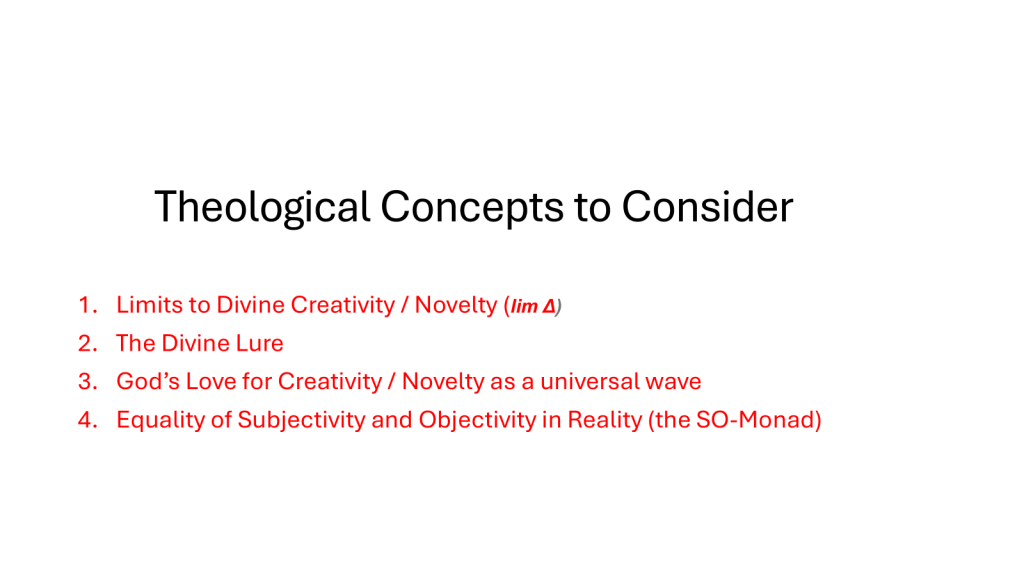
My final slide (above)
Otherwise, I think for this week’s post, I will put in a link for a fascinating article titled, “Personality changes following heart transplantation: The role of cellular memory” published in the journal, Medical Hypotheses. Unfortunately, this article is mostly behind a paywall. The basic point of this read is that some patients who undergo successful heart transplantation can begin to have small personality changes over time. The question (okay, this is difficult to believe) is that the transplant recipient might be getting some of the behavior from the donor through the heart transplant. Just so you know, the evidence here is pretty weak.
The authors of this study provide some ideas about why this effect is occurring. There could be some genetic issues occurring from the donor affecting the recipient’s neurological system. We already know that donor cells cause problems with the body of the recipient in certain cases, such as graft-versus-host disease.

Illustration of graft-versus-host disease, from Nature
I provide medical care for patients for liver transplantation. I have never seen such an effect. If I am honest, I think such personality changes described in the article are likely due to improved cardiac circulation, medication side effects (lots of drugs are involved), and prolonged hospitalizations.
However, from a process philosophy / process theology perspective, could this potentially be an example of panexperientialism? By “panexperientialism”, I mean that ALL entities have experience. Some people will extend this idea to “panpsychism” in which all entities have consciousness. I am not in the panpsychism camp, but I think panexperientialism has potential.
So…Is this heart transplant story an example of panexperientialism? It has metaphysical implications, but I am not sure it has biological implications.
More to come…
By the way, I recently finished a book chapter for an upcoming book titled, “Renewing Faith.” I was asked to be a contributing author. The book won’t be out for a while, but I tried to use my chapter to emphasize the importance of science when considering theology. In my chapter, I stress, as I always do, the importance of vaccination to prevent horrible diseases. Vaccination to prevent disease spread is a real-world, concrete example of Mark 12: 30-31.

An artist’s perspective of panexperientialism (based on a blog post that I wrote).
 Phi-The-Sci: Equilateral Musings