Currently, I have been reading through Bartley’s book, The Retreat to Commitment. Although it is a book concerning the philosophy of science, it does go into considerable detail about theology, specifically Protestant thinking. This book’s first publication was in 1962, and science has certainly changed since then. Perhaps 21st century theologians, philosophers, and scientists would find the book dated. I am not sure. If you ever buy this book (which I highly recommend), get a version with the appendices. The appendices have great stuff in them. In particular, Appendix 1 (“A Metacontext for Rationality”) goes into great detail comparing Western and Eastern metaphysics.

Chapter 2 (“The Search for Identity in Protestantism”) has some interesting statements. Per Bartley, “Although the basic defense of contemporary Protestant thought does ultimately rest on an appeal to irrationalism, many of the most significant features of its historical development are fairly logical products of certain long-standing theological assumptions…” He continues, “…throughout most of its history Protestantism had been closely allied with the rationalist tradition.”
Does contemporary Protestant thought “appeal to irrationalism”? I am not sure how to respond here. First, in the setting of influential movements such as Christian fundamentalism (a late 19th / early 20th century phenomenon) and Young Earth Creationism, the appeal seems to be to literalism. It is weird to consider, but the Enlightenment did have an odd side effect of bringing back some types of Biblical literalism. For example, as some theologians from that time would learn more about the history of the Bible, they often would align what they learned with a apologetic, wooden interpretation. Examples are here and here.
In other words, although early Protestant thought may have been rational to some degree, they appear to often have been held back in approaching a pure rationality to reality. For example, many early Protestant theologians accepted that the Earth was not the center of the universe, yet there may have been pushback by others, such as Luther. It should be kept in mind that further research suggests Luther was not as anti-science here as originally thought.
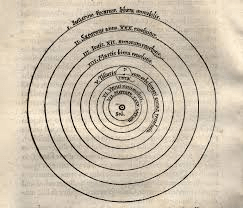
Copernican heliocentrism
Large swaths of Protestant thought, especially in the current United States, do seem to be rationalist in an unusual sort of way. One can be irrationally rational if one has an quick, uneducated, easy answer for a difficult problem. The extinction of species? Answer: Noah’s ark and the worldwide flood happened no matter what the science otherwise says. The old appearance of the Earth and the much older appearance of the cosmos? Answer: No worries. It is a 6-day creation no matter what the science says. Did the sun stop for Joshua (Joshua 10)? Answer: No worries because although modern physics states that such a occurrence is impossible and would destroy the planet, the Bible says it happened, so it happened. These examples are irrationally rational. They are quick, thought-stopping answers to complex aspects of the natural world.
Thus, when topics become complex, this immediacy of rationality without education becomes toxic. Ideas that are extremely complex (evolution, Big Bang cosmology, pandemics, etc.) becomes immediately simple. Evolution? Didn’t happen. The age of the cosmic microwave background? Still a 6-day creation. Vaccines? Satanic. Global warming? Doesn’t matter because Jesus is coming back. Existence of God? “Yes, of course” or “No, of course.” Renormalization (i.e., getting rid of infinities in theoretical physics to get potential results) works great in science but never in theology. It is okay to accept the potential infinity of God and our limited understanding of deity.
Modern theology, when done well, grasps at both the rational as well as the irrational in the setting of the human experience. We are limited species in scope and time. Grasping at both the rational and irrational should occur throughout the human religious experience. If there is a multiverse, then perhaps God has always been co-existent nature, even before our own universe was created. Evolution does occur, so perhaps God is aware of change. Perhaps God is aware of death and evil (natural and moral), but perhaps God cannot immediately (or perhaps can never) fix this aspect of our existence and in nature. In my religious tradition, I subjectively may believe Jesus was resurrected, but I can’t explain it (irrational). Future scientific research may prove some aspect of physical reality that would align with resurrection potentially happening (unlikely), but it could happen if one believes that science explains the objective (rational).
Perhaps this explanation of good, modern theology runs into strains of mysticism. I don’t know.
Rational and the irrational. Theology and science. Theism and atheism. The objective and the subjective. Potentially disparate ideas such as these seem to be far apart but may touch in certain areas and in certain times of human thought.
Bartley talks “continually refurbished Christianity” in the setting of science. I think this idea is helpful. It is never wrong to throw out the old furniture if the house is still in good shape.

Image generated by Gemini Advanced
 Phi-The-Sci: Equilateral Musings