Carlo Rovelli, the well-known theoretical physicist, just posted this article in Nature titled “Why Bad Philosophy is Stopping Progress in Physics.” Rovelli is known for many things, but his big interest is in the theory of loop quantum gravity. Loop quantum gravity is a theory (currently unproven but potentially testable) that space and time come in discrete, interlocking, tiny loops that exist throughout the universe. It is an attempt to quantize gravity to some degree.

A simple way to visualize loop quantum gravity (see this link).
Rovelli states the following:
“My hunch is that it is at least partly because physicists are bad philosophers. Scientists’ opinions, whether they realize it or not (and whether they like it or not), are imbued with philosophy. And many of my colleagues — especially those who argue that philosophy is irrelevant — have an idea of what science should do that originates in badly digested versions of the work of two twentieth-century philosophers: Karl Popper and Thomas Kuhn.”
My post would go on forever if I talked about the ideas of Popper and Kuhn, but we should appreciate the priority of Popper’s theory of falsification (very important in medicine) and Kuhn’s theory of paradigm shifts. You can review the links that I have provided regarding their philosophical ideas.
Rovelli points out that many physicists do not understand the ever-present vitality of these two ideas in the philosophy of science. If physicists (and, of course, scientists) do not understand these ideas, then they are stuck making theories that do not work and are not testable. I will be honest here as academic medicine is very stuck when it comes to a bad philosophy of science. We do so many things that we think work but are not testable. In the science of medicine, we are often combining the objectivity of medical science with the subjectivity of the patient’s experience. We see these issues when medical providers promote anti-vaccine conspiracy theories, do surgeries that are unnecessary but generate revenue, and prescribe inappropriate antibiotics. Also, we often miss paradigm shifts. Physicians ignoring the importance of hand washing as discovered by the great Ignaz Semmelweis is a profound example.
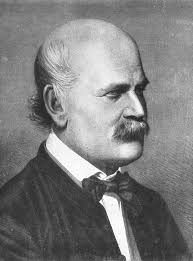
Ignaz Semmelweis
Sabine Hossenfelder had made an interesting observation when it comes to the human perception of reality. In her YouTube talk, she makes it clear that humans use science, philosophy, and theology as a triad for which to see the world. I think she is quite correct. One may look at all aspects of this triad as being equal in importance. One may emphasize 1 or 2 of the triad aspects at the expense of the 3rd aspect. All such emphases or observations affect our view of reality individually and as a species.
Religion: Rovelli’s objective description of the issues pertaining to the advancement of science certainly can parallel the subjective issues with religion, especially in regards to Christianity (for which I profess to).
Let’s change his quote as follows: My hunch is that it is at least partly because religious people are bad philosophers. Religious peoples’ opinions, whether they realize it or not (and whether they like it or not), are imbued with philosophy. And many of my fellow Christians — especially those who argue that philosophy is irrelevant — have an idea of what religion should do that originates in badly digested versions of the work of…
Religious people of every type (not just Christians) have a view of the world that is their reality. This view will have some type of philosophy defined as a way to visualize the world around them. As we are a quarter of the way through the 21st century, we see “badly digested” religion every day and especially in the United States. Ideas surrounding scripture inerrancy is an example. Young Earth Creationism is an example. Being religious and also anti-science is an example. Being religious and also anti-education is an example. Promoting quack science in the name of religion is an example. Not understanding the importance of science as both an objective reality and as a helpful subjective partner in religion is an example. These ideas are nothing more than bad religion based on bad philosophy.
We can do better.
I will end this post with my change in Rovelli’s quote: “have an idea of what religion should do that originates in badly digested versions of the work of…”
What is this great “OF“? I would argue that the “of” is good education. Bad religion is a badly digested version of the potential for a good education — science, theology, and other important subjects.
This “of” is considering the ideas of science when considering God. This “of” is considering new theological ideas that offer a loving version of God but not a demanding, difficult, punitive version of God.
I have spent much time in my prior posts describing this latter version of God that continually loves in real time and throughout eternity. My dissertation advisor and mentor, Dr. Thomas J. Oord, has written much in this area in his essays and books.
Good theology in the setting of understanding good philosophy and good science has the potential to make our world better. Perhaps our species will understand this important triad in the future. I pray that it will become so.

image generated by Gemini Advanced
 Phi-The-Sci: Equilateral Musings