Our seminary book club met last week to review an article titled “The Bible as a Two-Testament Collection of Writings in Science-Faith Dialogue.” Here is the link, but unfortunately, it is behind a paywall. Perhaps you can access it through a university or public library.
The article was written by William Horst at Fuller Theological Seminary, and I really think his work here is quite good.
The basic premise of the article is that early “science” changed significantly between the New Testament and Old Testament time periods. Ancient science was somewhat similar to today in that it included observation (induction) and some engineering / hypothesis testing (deduction). However, inductive / deductive capacity likely continued to improve throughout the time of the Bible being written. This improvement makes sense when one considers how science had changed and advanced over time — with an emphasis on the importance of the need for time. One can think about ancient astronomers following the constellations and planets over time (induction) or the Roman empire building their aqueducts (deduction) as examples.

Roman aqueduct
I would like to highlight some aspects of this article as follows:
Christians, like me, tend to forget that Judaism looks at the Adam and Eve story very differently. I think this contrast is a good thing since Christian fundamentalism’s interpretation of the early chapters of Genesis has led to problematic motifs that bleed into my country’s politics and educational system. In a similar manner, Second Temple Judaism (when Jesus was walking the Earth) also had different interpretations regarding Adam and Eve. In other words, strict, literalist readings of the creation story in Genesis are filled with problematic issues.
Second Peter’s flood description (in Chapter 2) may not be accurate scientifically, but it is an example of everyday educational training of early Christians during the time period of its writing (see below).
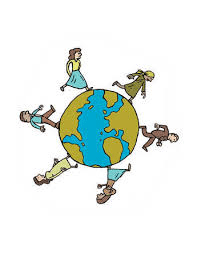
Horst states “…the state of human knowledge in the Mediterranean world was quite different in the first century CE, in comparison to a handful of centuries earlier.” This statement is very true and very important. For example, the educated elite of the Roman world considered the Earth a globe. Prior earlier Middle East societies considered the Earth flat with a dome above and a separate underworld below.

image from BioLogos
Although early Christians lived under the rule of the Roman empire, they were not exposed to the latest knowledge of the empire due to the immense poverty and poor information exchange in the ancient world. For example, Erastosthenes (276 – 194 BCE) had already performed an early calculation of the Earth’s circumference with surprising accuracy. It is unknown how much of his discovery reached the Roman population as a whole, but I would hypothesize that only the elite would have known of this scientific work.
Knowledge about world geography was significantly greater during the time of the New Testament compared to the time of the Old Testament. Roman knowledge of the world’s continents included much of Asia and Africa, and there were writers who hypothesized that continents existed on other parts of Earth’s globe.
Education was very different between the time periods containing the Old Testament and New Testament writers. Compared to today, science education during the writing of the Bible was pre-modern and was typically available only to the rich populace. Information about education in ancient Israel is limited, but likely higher learning included reading / writing, scripture reading, and wisdom teaching. Even a primitive level of science was not present. On the other hand, New Testament (i.e., Roman) education was significantly more advanced in the sciences in a manner similar to a liberal arts education today. Such education was available only for the wealthy although Roman cities often provided free, public lectures for the general audience.
Here is where we get into the Second Peter problem. Per Horst, “The
first-century CE Roman author Pliny the Elder draws a distinction between learned
people, who acknowledge the spherical nature of the earth, and the ‘common herd’ who scoff that any humans standing on the bottom half of the globe would surely fall off.”
The writer of Second Peter was not part of some common herd. He or she was likely not as educated as the Roman elite. Only 5-10% of Romans could read, and very few received a good, formal education. Thus, this epistle writer more than likely was not informed about the world being a globe. This lack of information certainly complicated the global flood story in Second Peter. The writer of Second Peter may have been limited in their understanding by using Old Testament world geography, or the writer was simply describing a myth. By the way, there are many good things about myths.
How does this relate to today? Well, the Earth is indeed a sphere (actually it is an oblate ellipsoid due to centrifugal forces). The known world (the known universe) is about 93 billion light years across and is 13.8 billion years old. We know about evolutionary biology. We know about genetics. We have the Standard Model describing subatomic physics.

The Standard Model from the U.S. Department of Energy
One has to concede that disruptions caused by the Roman Empire had to influence New Testament writers. Roman government rules, the international roads, the intermixing of cultures, etc. all had an influence on these writers. The Hellenistic influence on the Gospel of John is just one example.
Today, scientific and cultural disruptions are much, much greater. I would argue that these modern disruptions should be considered opportunities. They are opportunities for taking into account what God means in an ancient and incredibly expansive known universe (we don’t know what exists beyond the known universe). There are opportunities for taking into account the Christ story in the setting of Big Bang cosmology or in the setting of genetic causes of behavior that might at one time have been considered “sin” or “possession.” In fact, sin’s definition as well as the importance of terms like “grace” and “faith” need to be re-considered or re-imagined in the setting of the second law of thermodynamics and the immensity of time.
Our current view of science does not solely impact Christianity. All of the world’s major religions fall into similar needs for change.
Science changes. Sciences advances. Religion will change. It already has. Perhaps religion and its effect on humanity will advance as well.

image created by Gemini Advanced
 Phi-The-Sci: Equilateral Musings