I consider myself Christian, but in light of my country (USA) currently having its politics eroding into religion, I think a better term for me might be “Jesus follower.” I am not sure here. I am a member of the Presbyterian-USA demonimation. I joined this specific denomination because I support their policy of LGBTQ+ inclusion, and I want all minorities (racial, ethnic, cultural, gender, and religious) to be welcomed into greater society. PC-USA currently seems to align with this position. I also joined this denomination so that I would be eligible to sit on local church committees. I want to make sure that we keep Jesus as the focus while being kind to others in our community.
But let me be clear, I consider myself a Jesus follower well before considering myself a member of PC-USA.
Why am I bringing this aspect up? Well, I believe in God. There is tragedy, chaos, and the unstoppable trajectory of entropy throughout nature. I am aware that many people look at the world and do not believe in God when they see evil, sadness, and entropy. That is an extremely valid belief system that I often can agree with.
I will be honest. For some reason, I see a beautiful world. Personally, I think it is due to my exposure and work in the field of science. I work in medicine which is kind of science / science adjacent. I get frustrated with humans, but I am a lover of nature. I was the little kid that used a cheap microscope to look at bacteria in dirty water. I am a huge fan of mountains and love their geology created by tectonics and glacier formation. I find pictures of galaxies amazing.
When I look at nature, I feel I am in the presence of God perhaps expressed so well by Paul or by Augustine. Although I feel God is in the world, I have no proof and never will have proof. My atheist friends (who I love dearly) believe that there is no God. Again, there is no proof to their belief system. Both of our sides hit a roadblock.
Atheists are helpful here and often are not listened to by religious audiences. God is not provable. Sorry. That is just how it will be. Conversely, a lack of God is not provable.

“Doubting Thomas” by He Qi
The unknowing. It can be a dark night of the soul. This unknowing should, in my opinion, lead to all of us not really caring about proving God’s existence or non-existence. It should make us think about why we still care for each other, for other species, and for our planet. When contended with over time, this unknowing can lead to a deeper understanding of oneself and one’s relationship with other humans and the world at large. A believer in God often believes that caring for the “other” is a prime responsiblity of humans reacting to the divine. A non-believer in God also expects that caring for the “other” is of utmost importance as we all have a limited period of time on the planet. Both ideas of caring for the poor, the sick, the very young, and the very old are beautiful. They seem to be related.

For example, you see a car wreck occur and pull over to see if anyone needs assistance. Our state liquor stores in Utahwill round up to the nearest dollar to help the homeless if you ask them to make this donation. The rounding up process seems (from what I have observed) to occur with all types people — religious and non-religion alike. Humans from all religious, societal, or cultural backgrounds do charity work. Many humans volunteer at homeless shelters, animal shelters, food banks, and at schools with high-risk children.
Why is this?
I think there is something else going on here. When a human does something that is worthwhile to the greater community but not to themselves / their family directly, why is such an act performed? Is this altruism controlled human evolutionary pressure? Is this a byproduct of group selection? Is this a culturally learned trait? Does being kind or altruistic make one more likely to reproduce?
However, could kindness to the “other” be a direct consequence or a by-product of something much bigger than our species? At least on our singular planet, other animals are altruistic. Evolution, gene selection, epigenetic factors of the environment or culture… Could all of these factors point to the fact that the world is yearning to be beautiful. The second law of thermodynamics never stops advancing. We all die, and all potential energy will be used up in the far distant future. However, is goodness or kindness or whatever metaphysical concept that one can come up with trying to break into creation? Is this a “still small voice” that is tragically but beautifully present in every drop of time?
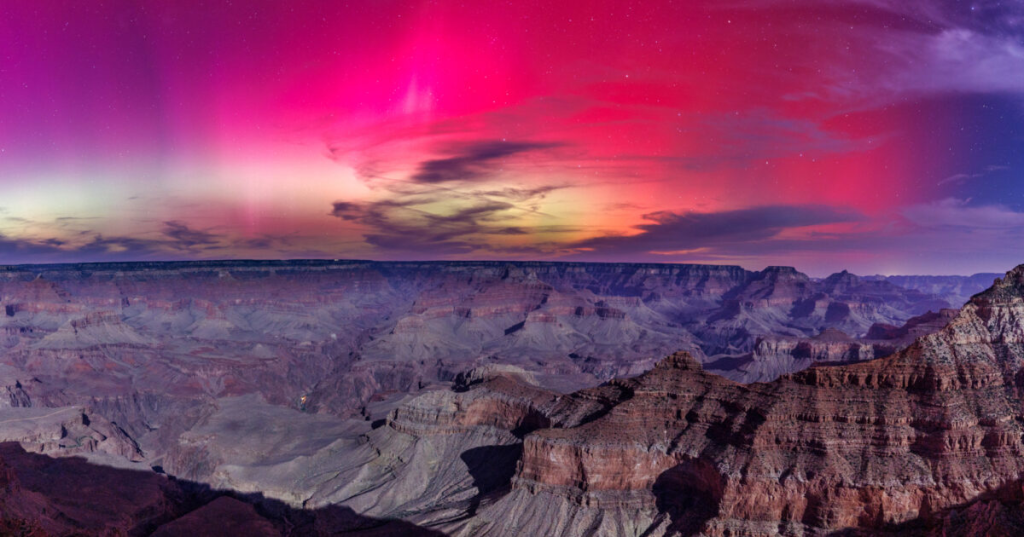
The Grand Canyon, Arizona
This goodness or kindness doesn’t necessarily require a God. Thus, are such behaviors part of the universe, perhaps related to panexperientialism? Is this potential for goodness seen on Earth also potentially present throughout the universe as some type of subjective field?
Is this goodness a byproduct of quintessence (a cosmology idea) with its associated potential energy? Is this goodness a result of the universe (with our without God) learning and providing opportunities for creation or novelty? Is this God providing love at all levels of reality / at all moments of time?
Thomas J. Oord states this well in his book, Defining Love : A Philosophical, Scientific, and Theological Engagement (Brazos Press). He describes God’s love as “full-orbed.” Agape, eros, philia and all of the other ways that love has been describe throughout human history also is in God. God is completely relational to the world — from quarks to quasars and with humans in between.

The Andromeda galaxy and our Moon in the night sky (EarthSky)
So, regardless of our metaphysical beliefs, we seem to be obligated to care. We are not forced to care for others, but I think that God / the universe / combination / who knows (?) wants caring to be one of the points of the universe — divinely inspired or not.
When we don’t know about the cause of reality, we should begin to think that this unknowing should lead to our care for the other.

Image produced by Gemini Advanced
 Phi-The-Sci: Equilateral Musings