I recently read the article, “On Questioning the Design of Evolution” by E. V. R. Kojonen in the latest issue of Theology and Science. Unfortunately, it is not an open access article, but perhaps you can find it somewhere for your reading. In many ways, the article is excellent.
The article discusses the weaknesses of the arguments promoting “Intelligent Design” (ID) which claims to be science but which is just theology. In my opinion, ID consists in a space where creationists can say “and God is here” when looking at biological structures, especially in the setting of evolution. ID points to such issues as “irreducible complexity”, possible evolutionary directionality, and direct design by God which they state proves God is present in nature. This idea of “prove” is fraught with so many issues. First of all, ID is not provable. From a Popperian perspective, it also is not disprovable. One cannot come up with a scientific, objective model to prove or to disprove ID. If a hypothesis isn’t provable or disprovable, it falls into the realm of subjective thought which includes the fine arts, some liberal arts, and theology.
Theology can be an objective study. How many people believe in a religious system, the growth or decline of a religious group, the amount of property owned by a religious group — these are objective areas of study. However, the majority of theology is subjective. Being subjective is certainly fine as long as the subjectivity is not harmful. Having theology convince others to harm minority groups is bad theology. Having subjective theology be anti-science is bad theology.
Here is where ID is problematic. I actually think it is harmful simply for the reasons that many of its proponents believe it should be 1) considered to be a part of science or 2) considered it to BE a scientific field. Just dreadful.
ID IS NOT SCIENCE. IT IS THEOLOGY.
Let’s take the evolution of the eye. ID proponents in general would state that the evolution of the eye directly has required God. They would especially state this idea in the setting of organisms with no eyes changing over time to organisms with eyes. The ID argument typically has been that the eye is too complex (irreducibly complex) for an eye to evolve over millions or years. The presence of an eye would be an example of “and God is here.”

Trilobite
It is as if they believe that no genetic or paleontology evidence exists for primitive eye development. This idea is patently false as seen here, here, here, and many other scientific sources. I also don’t know how ID propents describe “and God is here” in the setting of species losing eye structure over time.
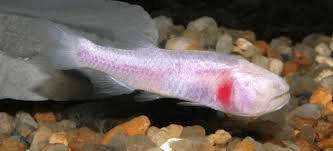
Blind cave fish
Here is what ID would propose:

A biological structure exists at Time 0. It is complex. The only other way to get to a changed structure at Time 1 is through the direct interaction of God.
Fine. However, this idea is strictly theological and not scientific. I would argue that this idea is bad theology. If God interferes here, then why does God not interfere to help good things and to prevent bad things in nature?
In the setting of process theology, this idea is improved.

In ideas surrounding process theology, God is in the change of the REAL world in REAL time. Some process theologians state that God desires novelty and is in the flow of change. Some process theologians state that God lures for the best outcome although nature can ignore any divine lure. In many ways, this latter idea is modeled by Open and Relational Theology.
Nature can be studied scientifically, and theology should not insert itself saying “and God is here.” Here is a helpful reference. Unlike ID, process theology and open & relational theology do not insert God’s self directly affecting nature. Instead, God is in, around, and through nature and in time itself to observe change (including evolutionary change) while desiring and celebrating change. Of course, evolutionary change in the setting of process theology still could be directional which may have some scientific basis when one considers the ideas of Simon Conway Morris.
Good theology incorporates science. It should not attempt to BE science.
Our world is not static. Our theology should not be static either.
Image generated by Gemini
 Phi-The-Sci: Equilateral Musings