I gave an overview of my recent book, A Theology of the Microbiome during ORTLine this weekend. ORTLine in an on-line session theology meeting consisting of many authors who discuss their books followed by reviews of their works by experts in the field of Open & Relational Theology (ORT) or in related fields.
My book was chosen, and I was happy to discuss my book. By the way, the conference is a wonderful way to learn about theology with an emphasis on science, technology, psychology, education, and many other fields. This conference is free from any fundamentalist or nationalist components. Theology, when done well (as in ORTLine), is exploratory, interpretive, and thought provoking.
One reviewer asked me a very good question about capitalism. If process theology suggests that God desires novelty and creativity, then isn’t capitalism a metaphor for process theology? After all capitalism strives for the “new” to keep the marketplace happy.
Here is an expansion of my answer:
Keep in mind that process theology is a cousin of ORT. Process theology is derived from process philosophy with these essential components: 1) change is the basis of reality, 2) time seems to be fundamental, 3) God desires novelty. ORT goes on to suggest that the future is open. God does not exactly know the future although perhaps God may know statistically (read my book here). God also loves every entity in nature since God is “relational.” Such “love” is a desire for “creativity.”
So, what does this mean in the setting of capitalism? I would say no relation exists between process theology / ORT and pure capitalism.
First, Alfred North Whitehead (the modern proponent of process philosophy — not theology) stated in his book, Process and Reality:
“God and the World stand over against each other, expressing the
final metaphysical truth that appetitive vision and physical enjoyment have
equal claim to priority in creation. But no two actualities can be tom
apart: each is all in all. Thus each temporal occasion embodies God, and
is embodied in God. In God’s nature, permanence is primordial and flux
is derivative from the World : in the World’s nature, flux is primordial and
permanence is derivative from God. Also the World’s nature is a primordial datum for God; and God’s nature is a primordial datum for the
World. Creation achieves the reconciliation of permanence and flux when
it has reached its final term which is everlastingness-the Apotheosis of
the World.”

Alfred North Whitehead
One way to read this part of the book is to consider that 1) change is essential in reality and 2) God’s memory of all events is eternal. Eternal — nothing is forgotten in God. Keep in mind that this is God as described by philosophy, so novelty taking place in time while not being forgotten through time makes sense philosophically.
However, in process theology, one could exchange “novelty” for “creativity”. Creativity is the new, ever-better, ever-more striving, ever-more reaching to goals of ultimate creation or love. This creativity has no limit.
Capitalism crushes the old novelty. Capitalism strives for the new, perhaps as a form of economic evolution, but the ultimate form will never be reached. Capitalism is simply a human endeavor, and all humans have a limit. Our species has a limit. We will go extinct some day.

ORT seems to make sense when we consider humans and economic activity. If God is love, and God desires creativity in time, then perhaps Scandinavian countries are a limited metaphor for this divine desire. There is a strong social safety net in such countries. These countries have excellent healthcare systems. Yes, the tax burden is higher, but people in these countries seem to live longer and perhaps are happier.

image from the World Economic Forum
We can expand this metaphor to all of reality. Creativity is a divine desire freely given to all of nature. Every entity in nature can proceed with, ignore, or go against God’s creative desire in real time. We see this example in humans every day from how we treat the “other” to our wars and to human-caused environmental disasters.
But perhaps, just perhaps, God wants there to be some kind of “safety net” for creativity to abound not just on Earth but also throughout the cosmos. One can think about gravity, electromagnetism, the strong nuclear force, the weak nuclear force, the speed of light, and biological evolution as examples.
Creativity throughout nature may be a combination of accepting God’s desire of creativity “for the good” in the setting of a background of some natural security through physical laws. Scandinavian countries have chosen to secure the health and wellness of their people (and not always well). Nature has chosen to secure the health and wellness of the entirety of its entities for the potential of infinite creativity.
I think more theological work is needed here.
Odds and Ends:
Of note, my book (A Theology of the Microbiome) is now available as an audiobook.
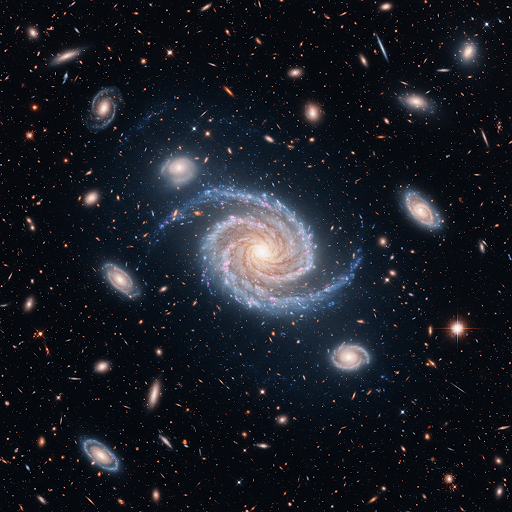
image created by Gemini Advanced
 Phi-The-Sci: Equilateral Musings