In my prior post, I provided a discussion as to why I think we should consider that evil explored in theodicy likely should only be explained as “natural evil”. I provided some research / references suggesting that organic brain disease seems to describe why people often cause moral evil. Thus, moral evil is physically just natural evil. This is a theology statement. It cannot be proven, but it can be considered.
What does such a statement mean in terms of how we look at the world and how we consider theodicy?
First, I think that if we say that evil is natural, then the supernatural goes away and causes of evil are easier to study and to prevent. This idea an be uncomfortable for many people, including me. However, in my theological training, process theology and open & relational theology have taught me that one can be quite religious and look at the world through the lens of natural theology.
There will be no solutions to the problem of theoci y, but perhaps we can “cut around the edges” in order to take comfort when we see horrific problems in the world or are affected by personal tragedy.
I will provide some potential ideas below that should warrant theological research.
This argument is weak but here goes… Perhaps we will learn more about entropy as we learn more science. The connection between evil / theodicy and entropy could become more clear with time and research. As an example, the “heat death ” of the universe is expected to occur in about 10<sup>100</sup> years from what I have read. Our view of the universe has changed drastically from Ptolemy to Galileo to Einstein in less than 2000 years. Perhaps we will learn more about the universe and entropy that change our ideas about disorder, theodicy, and death. I have no clue.
The universe could be cyclical in nature. Thus, the potential for creativity, novelty, or rebirth of life could be eternal in nature. This idea is extremely controversial.
Even in a more entropic universe, creativity could continue. I heard a physicist or cosmologist (I am not sure) on a podcast or Youtube videal (I am not sure) state that a life form living trillions of years from now would see the universe as it is at that moment in time. The life form would still see creativity in the world around them but not in a manner that we see it.
If there is a multiverse (or if there is no entropy outside of our observed universe), then entropy could be somewhat of a pointless concern as new bubble universes continue ad infinitum.
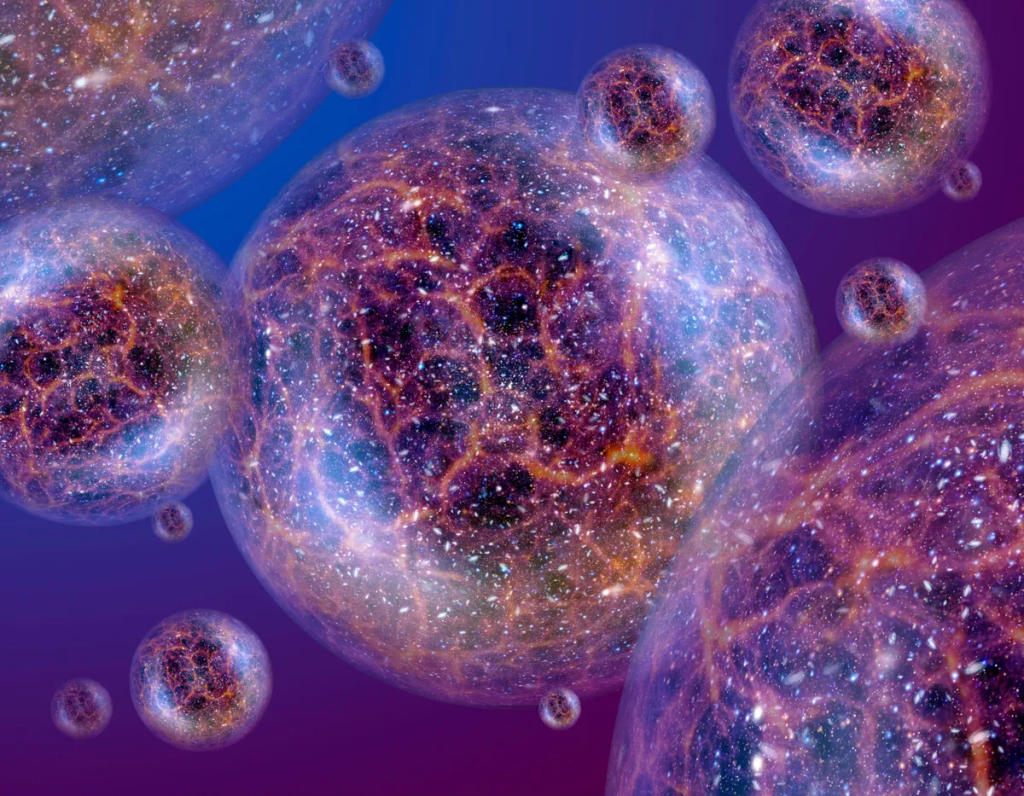
image from Smithsonian
I am not sure that entropy would increase in an infinitely large system with no boundaries. Entropy might increase or decrease, but it is not clear if it would move in one direction or another.
In a space containing complete entropy, there is always a chance, no matter how remotely small, that particles would get together and form structures. This structure formation would be certain if time is infinte. This is the Boltzman brain idea. Perhaps a completely entropic universe could, over infinite time, form even larger structures…new galaxies? A new universe? Granted, this idea has many problems to consider.
The Many Worlds Interpretation can, theorectically, suggest a person lives forever on some branch. This has theological implications but it also has pretty significant entropic the theodicy implications.

Image from Britannica
Finally, theology… If one accepts a God of love in the setting of process theology or open & relational theology, there is always a lure for creativity or novelty in all of nature, including our universe. There is always the eternal lure for “the good” which I would define as continued creativity through time...no matter what happens. Creativity wins every time.
I explain the possible theology aspects of this idea in my recent book, A Theology of the Microbiome. In the book, I state, “God is not a deistic God or a philosophy of materialistic naturalism. God desires creativity, and God’s divine lure at every second in time exists for all entities. God loves all of reality, as expressed by the inherent drive of the divine lure for creativity throughout the universe.”
Theologians should consider some of the ideas that I have expressed above. Their consideration is especially important as our colleagues in the sciences are exploring and testing these theories already.

image from Meta AI
Odds and Ends:
- Dinofest is coming to the University of Utah! It is amazing. You should come if you are close by. Link is here.
- Speaking of entropy, this New England Journal of Medicine has a review on an intractable problem in U.S. medicine. No real solutions were given in this article.
 Phi-The-Sci: Equilateral Musings