Bad things are just going to happen. We can go round and round about the awfulness of natural evil and moral evil, but there appears to be no way to get around the fact that the presence of evil persists in a world that many people believe God is present in it. This is the issue of theodicy.
From my prior posts, you probably have ascertained that I assume God’s presence in the world is more naturalist in perspective — a natural theology. Much has been written about how Christianity and Judaism have the potential for naturalist tendencies. Other strains of the world’s religions also have this potential. I don’t need to expand on this issue as others have written much more here. How does theodicy as a theological concept in the scientific concept of entropy?
Entropy is described by the Second Law of Thermodynamics. Simply put, energy available to organize systems will change from useful to non-useful energy over time even as the total energy of the system remains the same. Thus, matter (for example, particles) will move to their most probable state over time. Consider several particles in a box separated by a tunnel or hole. If you put the particles just in one side of the box, they will spread out evenly over time to both sides of the box. The chance of them all moving randomly back to that same, one side is incredibly small. It is not impossible for such an action to occur, but it is a really, really, really, really, really, really, really, really, really, really, really small chance in time.
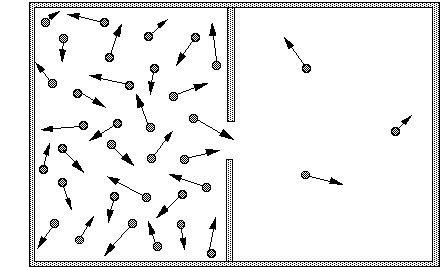
The image above comes from a great link that describes entropy.
In other words, matter spreads out over our observable universe over time. The energy needed to put matter elements back into an ordered state is essentially wasted and not usable. This fact explains why we see entropy throughout the universe. As our universe continues to expand (apparently faster and faster), the volume of the universe grows which gives particles more and more areas to move into. This is entropy…a complete flattening of the position spaces of particles with no useful energy to make particles form usable structure.
Thus, in the setting of natural evil, theodicy makes sense. A planet’s energy is used up, and life on that planet ends. An animal eats another animal in order to get energy with an overall reduction in usable energy. A star expands and explodes making the star and its associated planets useless. From a human perspective, illness occurs as more random mutations occur in an individual’s DNA or as immune systems break down. Death occurs. Death is universal.
In the setting of moral evil, theodicy and entropy may not appear to naturally match. For example, is murder due to entropy? Here is where I wonder the following:
Is moral evil still simply natural evil?
Possible evidence:
- Psychopaths may have abnormal gyrification in the brain.
- Abnormal white tract density may be abnormal in psychopaths.
- Psychopaths may be cortical thinning of the brain.
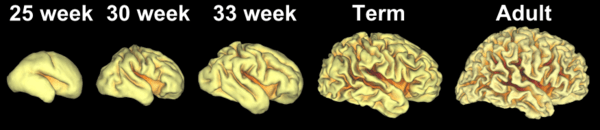
Brain gyration (from Wikipedia)

Images of cortical thinning (from PNAS)
It should be kept in mind that relating brain structural anomalies to human behavior are filled with issues. Often such studies are poorly performed. It is very well known that two independent readers of a radiographic image (or MRI) can have some human interpretation issues when describing a finding (Cohen kappa testing). It can be hard to diagnose psychopathy in some patients. A great review article about the limitations of this research is here. I highly recommend this open access article.
Finally, if one thinks about moral evil in the setting of society or culture, can one argue that moral evil in such arenas are not natural? I think this is yet again natural evil. A drought from weather patterns causes people to fight for resources. Wars are often simply fights over limited resources found in and on the planet (for example, the Pacific Theater in World War 2). In the end, is the inital cause of the suffering / evil simply natural and not moral? If one considers the ideas contained in panexperientialism, would all theodicy have a natural cause?
I want to bring up two potential ideas that need work:
- Perhaps all theodicy is natural and should not be divided into natural and moral theodicy.
- God fits into this idea…somehow.
In my next post, I will post some potential ways forward although the issue of theodicy never provides clear answers.
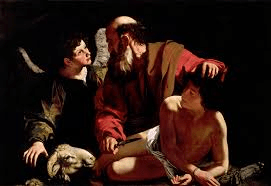
Painting by Caravaggio
Odds and ends:
- Interesting review in Nature has come out about a new book that emphasizes organism development as a driver for evolution. Link is here.
- God and Nature Magazine has a good open access, on-line article titled “The Questions We Ask AI.” I personally think that current AI projections are greatly overhyped.

Image created by Meta AI
 Phi-The-Sci: Equilateral Musings