I am a huge fan of the American Scientific Affiliation (ASA), and in fact, I have been a member of the ASA for over 20 years. The ASA is a collection of scientists (broadly defined) who are also Christian. Although I am speaking from a Christian perspective, the work of the ASA is parallel to science education being done in other religions.

Specifically, the ASA reaches out to Christian groups to help them understand that science is extremely important in our society, including in religious societies. If one wants to love one’s neighbor, then appreciating and understanding simple scientific principles are completely congruent with the Christian faith. Such examples include understanding the importance of evolutionary science, genetics, Big Bang cosmology, prevention of global warming, and the importance of vaccines.
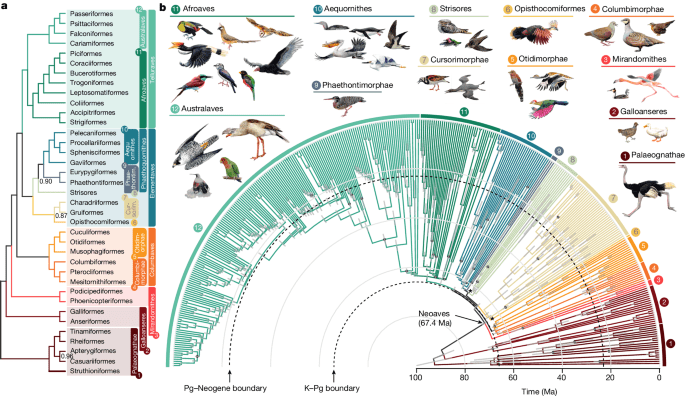
Evolutionary tree of birds from Nature
When one thinks about “Christian fundamentalism”, one may suppose that fundamentalism is an ancient concept. Not so. It is really more of a religious movement that started up in the early 20th century. It is a new movement Good references are here and here. Christian fundamentalism is decidely anti-science, which in my opinion, makes it potentially anti-Christian especially when it is involved in the anti-vaccination movement.
The ASA has a wonderful peer-reviewed journal called Perspectives on Science and the Christian Faith (PSCF) that is helpful in 1) understanding this fallability of fundamentalism and 2) providing helpful resources for those in science who try to teach and promote science in educational settings, churches, and communities.
The September issue PCSF had a great artile titled “Contemporary Challenges to the Pursuit of Truth” by Keith Miller. Typically, PCSF embargoes articles for one year before making them open to the public, but I did find a link that works.
Miller defines the overall issues that we run into when dealing with fundamentalists and their understanding of science. Specifically:
- Absence of shared presuppositions and methodologies (you can be religious and still can see an objective reality as described by science)
- Loss of trust in expert consensus communities
- Lack of historical knowledge (big one — hey, even scientists and physicians don’t always realize the history of our fields)
- Isolation from diverse perspectives
- The inability to set personal egos when searching for truth.
Miller defines each of these issues and provides potential ways to interact with other individuals, especially when dealing with those who appear hostile to modern science. Honestly, we who understand science fairly well need to set aside our presumptions about the intelligence of those in fundamental communities. My interactions with such communities is that their pastors and laity are quite intelligent, but they simply do not understand how science works. In many ways, I blame the lack of funding of public education in the United States for this issue.
I would recommend this article highly if you want to understand how the Christian fundamentalist mind works. The author provides solutions for dealing with the issues brought up by people who live in a fundamentalist environment. Perhaps you can share it with someone who is in such a community. I am sure there are wonderful resources for other faith streams as well.
Odds and ends:
- Interesting “Theories of Everything” podcast with David Bentley Hart. I enjoyed it.
- The same September PCSF journal has a wonderful article titled, “Flood Geology and Conventional Geology Face Off Over the Coconino Sandstone.” It is a wonderful article refuting the so-called “science” (really it is pseudo-science) attempting to prove the global flood described in the Old Testament. It is okay that the story of Noah and the diluvial flood are a myth. Myths are very important for teaching and for understanding the human psyche. The article should be free to the public in a year.
- The ASA has another journal that is open access and free to the public called God and Nature Magazine. I recommend it as well for more reading resources.

Image created by Meta AI
 Phi-The-Sci: Equilateral Musings