I had a great time doing a talk for the Institute on Religion in an Age of Science (IRAS) last week. I was expected to put together an accurate and comprehensive lecture, and I appreciate the audience attending the lecture who asked me hard questions. Hard questions are always good in science, philosophy, theology, and many other subjects.
One comment that I received was the following: “What we are working with here is physical. Makes sense because that is our neighborhood. We understand things based on what we experience. Love / God is incorporeal and and yet blends somehow with the corporeal. How do they integrate?“
This is a deep comment and question that reflects centuries of philosophical inquiry.
First of all, I am not a substance dualist. Mind and body, mind and God, and human body and God are difficult to separate for many reasons. I would need a good reasoned theological argument that the two dualism realms 1) are demonstrably separate and 2) have some way for communication to occur between realms.
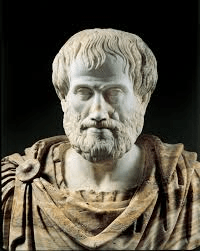
Aristotle
Aristotle states in his Metaphysics: “For the science which it would be most meet for God to have is a divine science, and so is any science that deals with divine objects; and this science alone has both thesequalities; for (1) God is thought to be among the causes of all things and to be a first principle, and (2) such a science either God alone can have, or God above all others. All the sciences, indeed, are more necessary than this, but none is better.”

Rene Descartes
Descartes stated later: “It is not [the figures] imprinted on the external sense organs, or on the internal surface of the brain, which should be taken to
be ideas—but only those which are traced in the spirits on the surface of
the gland H (where the seat of the imagination and the ‘common’ sense is
located). That is to say, it is only the latter figures which should be taken
to be the forms or images which the rational soul united to this machine
will consider directly when it imagines some object or perceives it by the
senses.” What is machine? Well, per Descartes, “I suppose the body to be nothing but a statue or machine made of earth, which God forms with the explicit intention of making it as much as possible like us.”
This “gland H” was the pineal gland. Lots of issues here.
If God is the “first principle”, then how does nature communicate or follow? Is there some substance undefined that connects the nature and divine?
Is God truly “alone” is the richness of experience? Does God not experience what nature’s entities, including Homo sapiens, experience?
Is “gland H” / the pineal gland the seat of consciousness of humans? No. Scientific discovery shows that the pineal gland controls melatonin production which subsequently controls our sleep – wake cycle. There is no large anatomic or small cellular structure in the pineal gland that could be described as some type of antenna for the soul or for communication with God. Trust me. Lots of people have examined this area. I have also examined the pineal gland during my gross anatomy class in medical school.
By the way, when I consider the Penrose–Hamerof ideal of brain microtubules involved in quantum mechanics processes, I sometimes wonder if this is a recapituliation, of sorts, of Cartesian dualism. I’m not sure and am no expert.
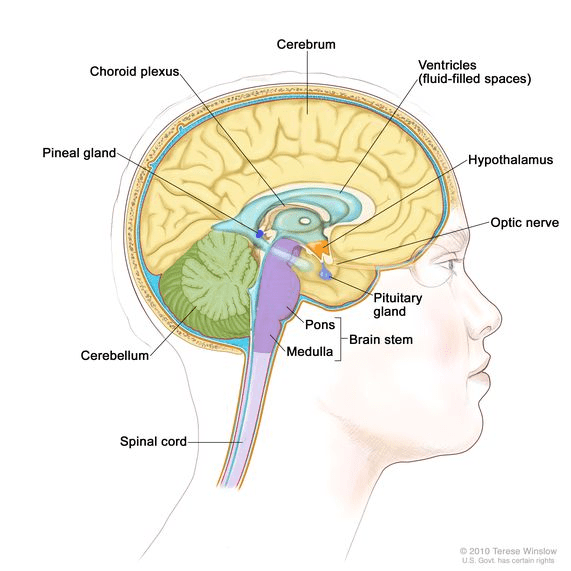
location of pineal gland (from cancer.gov)
So, dualism doesn’t seem to work.
What to do, what to do….
If God and nature (including our species) are not separate, then they are, to some degree, one. Here is where panentheism exists. All of nature, including humans, are in God. “I know the Lord is always with me” (Psalm 16:8). “I have been crucified with Christ and I no longer live, but Christ lives in me” (Galations 2:20). Many other such verses are present if there is a need for Biblical justification.
May I perhaps provide another justification?
As we learn more about our world, our species’ concept of deity must necessarily change. Ideas surrounding “religious fundametalism” may crop up in all of the world’s religions occasionally. However, as we learn more about nature objectively, we always change our philosophy, sociology, and theology subjectively. Always.
The so-called “Venus of Willendorf” may have had religious meaning in the Paleolithic in the hope of divine intervention for a good food supply and a delivery of a healthy infant. In modern times, we have the capacity to feed the world as well as the ability to mostly have successful deliveries. Of course, due to racism, facism, and war, such possibilites are limited.

Praying to saints or carrying holy verses, pilgrim badges, or icons on the body were used to protect against disease and other types of suffering in the Middle Ages. There was no ability to accurately diagnose and to treat diseases that today are often incredibly easy to cure. We still pray and carry religious momentos in the so-called modern world. We could rid the world of diseases worldwide, if we wanted to. The science is there; the human will is not.

What has happened in objective ideas of science in the past 200 years? It is amazing to consider. Let’s list some discoveries: 1) evolution, 2) modern medicine, 3) modern chemistry, 4) discovery of other galaxies, 5) finding black holes, 6) quantum mechanics, 7) finding gravitational waves, 8) discovering DNA, 9) understanding both special and relative relativity, 9) the computer revolution with the resultant smart phone and artificial intelligence, 10) germ theory, 11) antibiotics, 12) vaccines, 13) satellites and on and on.
Our theology must advance as the science advances. There is no other way to reconcille how humanity thinks about God. In fact, I believe strongly that the objective (science) affects the subjective (art, theology) and the subjective reflects back onto the objective to help science consider ever more far reach and important potential discoveries. Philosophy helps science. Understanding history helps the understanding of science. Theology with its elements of philosophy and history can be essential as humans always will be religious to some degree.
Back to panentheism… Science has shown that our observable universe has up to 2 trillion galaxies. Experiments surrounding wave-particle duality so far have found no hidden variables to cause a deterministic outcome (so far, of course, and more discoveries might be made to change this proposal).

image from NASA
So, an immense universe in the setting of some randomness at the microscopic level could theologically point to God who encompasses all (panentheism) and experiences all (panexperientialism).
The ideas of objectivity and subjectivity surrounding the human condition will continue to influence each other in a circular sense through real time as long as our species exists.
The science will change. The theology will change. Perhaps we will understand God a bit more.

Image created by Meta AI
 Phi-The-Sci: Equilateral Musings