I recently gave a talk to the IRAS (Institute on Religion in an Age of Science) as part of their monthly lecture series. I spoke to this organization because 1) it was free (so no stress about being paid for content), 2) it is important to utilize the liberal arts part of one’s brain, and 3) the IRAS asked tough but fair questions. Theology is similar to philosophy in that propositional statements are often questioned deeply which is certainly appropriate as it leads to further statement refinement.
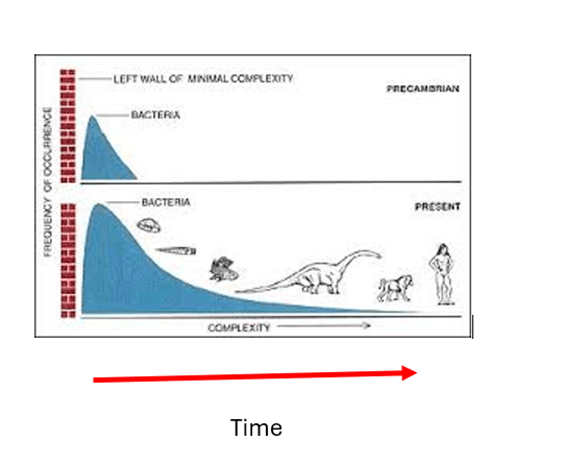
During my talk I talked about Stephen J. Gould’s “wall of minimal complexity” as seen in biological evolution. As an aside, Gould is one of my favorite writers. The illustration that he developed is below:

Basically, this diagram shows that the entirety of Earth’s biomass is mainly unicellular in origin. Thus, organisms with complexity are very, very rare. Keep in mind that this diagram doesn’t include plant-life which has the most biomass.
Now, if one adds a ray at the bottom of Gould’s diagram described as time, then one sees that increased complexity matches increases in time. I’m willing to admit that very complex organisms have ocurred in Earth’s history (such as during the Cambrian explosion). However, it does seem that increased biological complexity involves a time function.
In the theological ideas of process theology (derived from process philosophy) as well as in Open & Relational Theology (ORT), time is pretty much a priority function. Extremely long time periods are even more essential (for example, billions of years; trillions of years; time running eternally). Time allows for the occurrence of novelty or creativity. God desires novelty / creativity in process theology; God desires loves novelty / creativity in ORT. God loves all of levels of the natural world in ORT.
Another way of thinking about this issue is to consider God wanting novelty / creativity through time at all levels of nature. There is some type of divine lure desiring the “good” or the best for creativity. This lure affects all levels of nature in which nature can be neutral, negative, or positive in response. I like the idea of the divine lure.
God is not actively involved in novelty / change. God does not force. In process theology, both God and nature are in the flux of change, and change is primordial to God and nature. In a sense, God learns. From a Christian perspective, God as Christ can be seen to learn (for example, Christ is described as being “amazed” as in Luke 7:9). In ORT, God and nature indeed may be in the flux of change, but God has the divine lure in place eternally at every time moment and at every location to plead for or desire for novelty / creativity. This divine lure is prioritized as divine love with God loving every entity throughout time and place. Creativity can be seen as love.
Process theology and ORT have components of 1) time, 2) prehension (experience over time in which the past affects the present which affects the future), 3) panentheism (all of nature is in God), and 4) panexperientialism (all entities experience — even God). I have discussed time, the divine lure, prehension, panentheism, and panexperientialism in my prior blog posts.
Back to the Gould’s wall of minimal complexity…
I would like to first suggest that the huge amount of biomass that is “basic” in complexity such as bacteria are the potential for the continuing divine lure in creation. In such a setting, biological evolution leads to continuing creation in time. Keep in mind that unicellular organisms are still pretty complex.
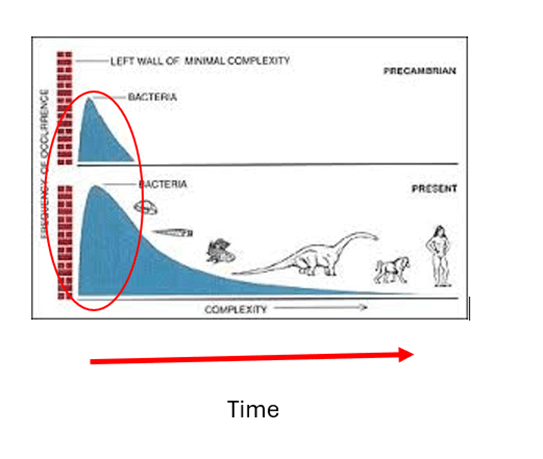
The red oval (above) surrounds the bacterial or unicellular biomass. It is loaded with evolutionary potential to proceed from unicellular organisms to multicellular organisms, including sauropods and humans. As an example, think about Lynn Margulis’ endosymbiont theory in which mitochondria were previously bacteria (the prokaryote) absorbed into other cell types in the distant past leading to a new type of cell (the eukaryote). It is a beautiful theory and quite true as mitochondria have their own separate DNA different from the cell nucleus. The beauty here has subjective elegance perhaps, theologically, due to the presence of a divine lure. This potential requires 1) time (immense), 2) potential (similar to potential energy with potential creativity changing to actual creativity in time), and 3) a divine lure.

However, what happens before and after the complexity limitations set forth in Gould’s wall of complexity? Consider the figure above. Again, if we include an element of time, this idea means that time keeps occuring (makes sense), potential continued / continues (before life on Earth; beyond humans currently) eternally, and the divine lure is ever present throughout the universe eternally but in real time.
Before life on Earth, there was complexity. Planetary formation arising from a disc of gas and dust around our sun was complex. Planetary bombardements from meteors hitting our planet prior to life on Earth was complex.
As time extends forward from the present, God will lure for novelty / creativity eternally. This lure will continue even if our species goes extinct. The lure for novelty / creativity will continue on our planet or somewhere else in time and in space in our unbelievably massive universe.
This lure for creativity (which I really think is a lure for the “good”) suggests a God that wants all entities to have some degree of freedom and suggests a God who loves…even if we don’t understand this degree of love associated with the divine lure.
Odds and Ends:
- Here is the link to my talk to the IRAS. It is on YouTube and free to the public. https://www.youtube.com/watch?v=B8Id8-zQCVA
- Here is a great link on Arxiv about writing letters of recommendations in academic astronomy. I do such letter writing frequently. It is interesting how the fields of academic astronomy and academic medicine relate when it comes to writing letters of recommendations.
- Here is a link to BioLogos. I support this organization financially. It is a great resource to help introduce Christians to scientific ideas, especially evolution. Their resources are free to the public. Consider supporting them financially. I am pretty sure there are such resources for other religious groups which are just as equally important.

image created by meta AI
 Phi-The-Sci: Equilateral Musings
