In my recent blog posts, I talked about my awesome trip to the Galapagos Islands with my spouse. Beautiful place. Beautiful pictures. I read On the Origin of Species by Charles Darwin during my trip which is a beautiful read. Thus, beautiful place, beautiful pictures, and beautiful read can cause one to think.

picture of a giant Galapagos tortoise that I took during the trip
In the book, Darwin talks quite a bit about progress in the setting of evlution. If you look at his book (here is an open access link), he has these statements.
And as natural selection works solely by and for the good of each being, all corporeal and mental endowments will tend to progress towards perfection.
The inhabitants of each successive period in the world’s history have beaten their predecessors in the race for life, and are, in so far, higher in the scale of nature; and this may account for that vague yet ill-defined sentiment, felt by many palaeontologists, that organisation on the whole has progressed.
I do not doubt that this process of improvement has affected in a marked and sensible manner the organisation of the more recent and victorious forms of life, in comparison with the ancient and beaten forms; but I can see no way of testing this sort of progress.
Progress: I am keeping in mind that Darwin is a 19th century writer, and his wording can be interpreted in different ways. Also, Darwin didn’t know about genetics involving DNA, and he didn’t have experimental tools to most accurately determine the ancient aspects of our planet.
I am thinking that when he says “progress”, he means “change” or “superior change” or perhaps “novelty.” Keep in mind that Darwin was in the milieu of speculative ideas of the 19th century which proposed that humans were experiencing overall progress as a species.
When we look at his writing, we are considering it through our own 21st century lens of a postmodern (perhaps with some remaining modernism) / neoliberal / and recently post-truth (unfortunately) society.
In other words, perhaps Darwin is really meaning novelty when he describes evolution. Simply put, novelty can be unique, but in over time and in other spacial locations, it can be repetitive. Convergent evolution might be such an example. Novelty is contained in creativity, and creativity is thought to contain purpose. In the setting of a divine lure (see my prior posts), a gentle reassurance to all levels of nature by God with no associated direct divine intervention could lead to creativity which, of course, would contain novelty. A helpful reference is here.
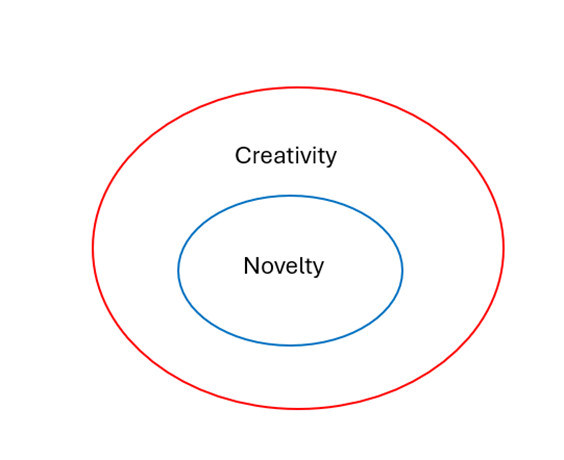
Pierre Teilhard de Chardin would suggest that evolution, and thus creativity, has a purpose that is both cosmic and divine. Simon Conway Morris would suggest that evolution has a directional signal, not necessarily theistic.
What about me? I don’t know. As a physician, I see a large amount of suffering. This observation would go against creativity by God in an active sense. On the other hand, I have seen amazing advances in diagnostics and therapeutics in modern medicine. This observation suggests our species is doing some things right regarding creativity although we still need to do so much work involving basic needs worldwide — clean water, clear air, ease of access to vaccinations, etc.
As a baby theologian (I’ve had my DThM degree for less than one year), I am inclined to think there is creativity in reality which would contain novelty (see graph above).
My idea is contained in my new book (A Theology of the Microbiome) which I have included below:
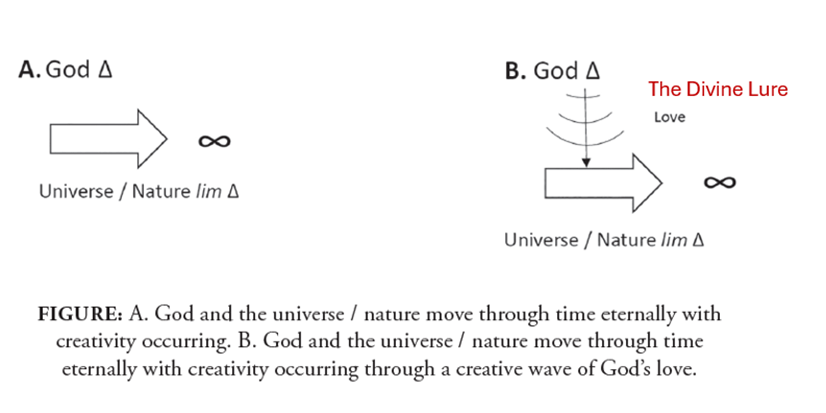
This figure is from the book. In Figure A, I propose that God and nature (which contains the universe) progress forward in time. Time moves forward eternally. Both God and nature react to change as time is fundamental to all reality. Time also allows entities to potentially experience creativity. Such an idea is fundamental in ideas which surround process theology. There are limits to creativity put in place by nature which I define as lim Δ or a “limit to change.” I discuss lim Δ more in the book if you want to buy it (hint, hint).
In Figure B, I propose a different model that is somewhat similar to Figure A. God and nature do progress forward in time. However, God lures for the “good” which I define as creativity. Love in all of its forms is inherently creative. This lure by God at all levels of nature is never directly acting in terms of making nature change. God is love, and love does not force. This divine love is a simple pleading for creativity, for novelty, for a continuation of love that is eternally present in all places, in all moments of time, and progressing forward in time eternally. Every entity in nature can respond positively, negatively, or neutrally do this eternal call.
One last thought….I have read Steven Pinker’s Enlightenment Now. I think it is a very good book. Many people don’t like it because I think they just don’t like Pinker. Regardless, he demonstrates throughout the book that humanity seems to be improving over time when one evaluates human life span, disease prevention, education, food safety, and other factors. However, he is quite clear that 3 things will stop this progression in our species: 1) uncontrolled global warming, 2) nuclear war, and 3) the rise of facism.
I think Pinker is correct. Our species has the ability to listen to the divine lure. We can ignore it and put our species, other species, and our planet in a multitude of dangerous scenarios. We can listen to it and move forward with wonderful potential.
Odds and Ends (I just started this new section for extra stuff that I have thought about or am doing. I won’t always include this section):
- I am sorry that my writing is infrequent. I have a full-time job as a physician which keeps me quite busy. I try to write once per week at a minimum.
- My talk for the Institute on Religion in an Age of Science (IRAS) seemed to go well. I spoke on Wednesday this week. Supposedly, IRAS will have the talk (video and audio) up next week. I will provide a link later.
- I do some occassional clinical research, writing, and speaking about medicine, mainly in the field of pediatric gastroenterology. A co-worker and I just had this review of cystic fibrosis published in Practical Gastroenterology which is a free, open access journal. The link is here.
- An interesting article in Nature about Artificial Intelligende, industry, and academia has come out. Honestly, ALL of academia — science, liberal arts, and the fine arts (and you too, theology!) should be at the table during this discussion.
image generated by Meta AI
 Phi-The-Sci: Equilateral Musings