*Death by a Thousand Cuts
First, I want to be positive, and I want to talk a bit about my current work in theology. If you have been reading my blog, you know that I am very much into stimulating the artistic / subjective part of the brain since much of my life is centered in the medical science / objective part of my brain.

image from Springer Healthcare
First, theology… A good thing about academic medicine is that many universities utilize “community engagement” as part of academic advancement in non-tenure positions. Although I am a full professor, I am non-tenured. This position may sound strange to people who are in academics but who do not work in medicine. Typically, physicians who work at an academic medical centers / universities are salaried simply because they provide and generate revenue for patient care just like any private medical office you might drive by. I see patients — I bill for my care — I keep my job. It is actually quite hard to lose a physician job in such a setting since I generate money for the academic medical center / university, and I should be a positive revenue stream. I could get tenure, but I’ve seen friends in medicine who work for the tenure track. It involves extra paperwork, and I honestly have not seen any difference in their day-to-day work.
Thus, my community engagment for many years has been trying to reach out to religious groups in order to talk about the importance of science in the setting of religion. The “war” between science and religion makes absolutely no sense theologically, philsophically, and metaphysically. The worst of the worst among religious people as well as non-religious people have made up a fight that doesn’t need to exist.
My engagement work in this area includes on-line religious journals, Youtube videos, and my recent book. I have never been punished by my university for this outreach (and I work at a publically-funded university).
Although I do this work outside of my job, this part of academic medicine is very good.
Now the sad part.
Academic medicine has changed vastly since I entered medical school in 1991. There are many good things — better drugs, better openness about mental health, better surgical outcomes.
The bad thing is that academic medicine and private practive are becoming the same thing. Research and medical education are dissolving as medical schools and their respective universities chase after dollars from clinical care.

Clinical care in academic medicine pretty much trumps everything these days. Funded research is hard to do if not impossible to do with a busy clinical practice. More and more journals are charging extraordinary amounts to publish articles often at the expense of the journal author(s). Finally, much has been written about the demise of medical education.
So…The December issue of the Journal of Pediatrics has an #openaccess article about pediatric endocrinology fellows transitioning from training to the full-time faculty work force. A “fellow” in medicine is someone who is training for subspecialization. For example, I am a pediatric gastroenterologist. My residency was in “pediatrics.” My fellowship afterwards was in “pediatric gastroenterology.”
The article is titled “Measuring Up: Do Pediatric Endocrinology Fellows’ Career Expectations Align with Workforce Reality?” It is worth the read. Here is a summary:
- Article data came from a survey of pediatric endocrinology fellows in the U.S. and Canada using a 15 part questionairre in 2024.
- Most of those fellows surveyed wanted to go into academic medicine. This makes sense. Most pediatric subspecialists go into academic medicine in the U.S. and Canada (unlike adult subspecialists).
- Fellows wanted 61% of their time to be spent on patient care. The other 39% would be available for teaching and research. Their actual time in patient care for their new faculty jobs was 75%. That 75% does not allow for much time in the areas of teaching and research. In my experience such a “free” 25% involves taking care of patients through the 24-hour ubiquitous electronic medical record demands. That 25% involves contacting patients, contacting other specialists, dealing with insurance companies, and dealing with often absurd departmental and overall university mandatory forms. It is of utmost importance to be in contact with patients and specialists when needed, but it eats up that 25% quite a bit.
- Ideal free time to pursue non-clinical activities (education, research) was 39%. The actual free time for their new faculty jobs was 18%.
- It should be noted that 9% of fellows were being offered jobs with less than 50% clinical care time. These would be considered research jobs. However, let me tell you have this career works. When one takes a job like this, the young faculty has a very short time period to get an NIH K award for initial funding. Sometimes a university provides seed grant money to aim for a K award, but this is not a universal benefit. The K award then needs to be transitioned to a R01 award in order to be an indepedent principle investigator. If you don’t get on this track quickly or if the grant opportunities disappear, then you are moved over to the busy clinical patient care track. I have worked at a few academic medical centers during my training and in my career, and in my experience, most of the physicians on the research track just end up just seeing patients as their career evolves over time.
- A total of 87% of fellows thought they would have a long-term research career. Let’s be honest. If you have 18% free time and can do medical education with the addition of good, funded research, then you are a genius. My friends with MDs who have gone into full-time research typically work longer hours and make less salary than those who are mainly seeing patients. Full-time research for an MD is very, very hard. Some of the best junior MD researchers that I have known have ended up switching to clinical medicine in 5 to 10 years. It is all very tragic as they often have ideas that could change the priorities of their fields.
- The Discussion section of the article is quite good. You can read it yourself. I did see the following statement in it: “As some authors have envisioned, finding financially sustainable ways for physicians to participate in research beyond the ‘traditional’ physician-scientist model may be a meaningful way forward.” My friends, I can tell you that some variant of this statement has been put in articles about the loss of physician researchers over the past 20 years.

graph from the NIH
Someone once said “What is the use of dreaming of a better world when we can’t even fix our own?”
If the problem is not fixable, then we just need honesty in our medical training at the medical student, resident, and faculty level. We all see the academic medicine job ads in medical journals with the following statement: “Clinical and basic science research opportunities available.” This wording should be translated as “Clinical and basic science research opportunities available on your own time, outside of work, with little help of getting funding by the institution, at the risk of alienating your friends and family while getting burned out.”
An oldie but goodie book on this topic is here:
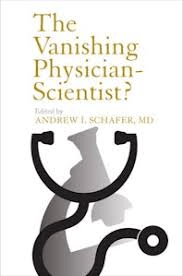
I’m not exactly sure what end-stage capitalism consists of, and I know there is a variety of soft definitions. However, in the setting of academic medicine, 1) the push for more and more clinical revenue with 2) less emphasis and funding for medical education and 3) less opportunity for good research leads to 4) all of us being replaceable cogs in the healthcare economic machine. Clinician with hopes and dreams comes in; clinician gets burned out; clinician drops out; new, young clinician with hopes and dreams comes in; ad infinitum & ad nauseam.

image made from Meta AI
 Phi-The-Sci: Equilateral Musings