This is my second post about my recent trip to the Galapagos Islands. I have been wanting to write more on this blog, but my schedule is very busy at work. I am working on an upcoming lecture (which appears to be a big deal — more later), and I am in the starting stages of putting together Christmas cards for the year.
As I stated in my last post, the Galapagos Islands were amazing. Simply amazing. The ecology and geology of each island was so vastly different. Different islands experienced different weather conditions based on different island currents. There was minimal human activity present.
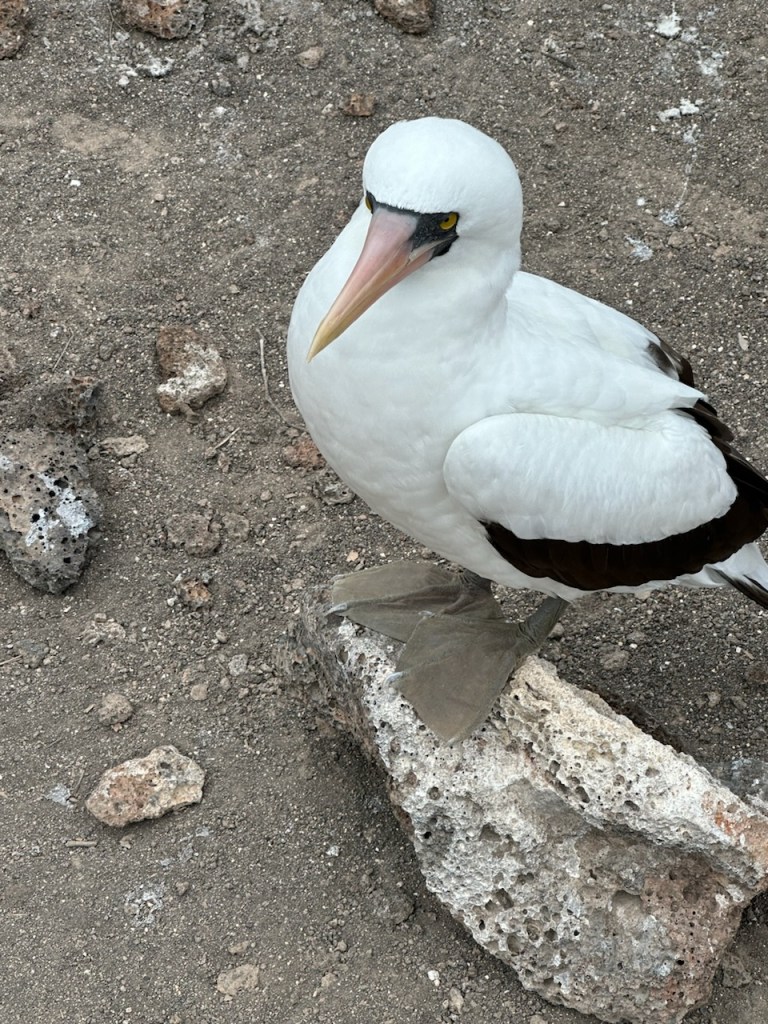
A Boobie who thought I was a very curious creature.
The Galapagos Islands are a UNESCO World Heritage Site. As such, Ecuador enforces strict laws regarding how humans interact with nature on these islands. On the vast majority of the islands, NO human interference is allowed. Some of the islands have had no human presence for decades. There are walkable trails that can be accessed, but one has to go with a guide. Absolutely no touching of the wildlife is allowed. Significant interaction with the wildlife leads to loss of access to the islands and even potentail arrest. I was fine with this legal requirement.
For example, at Parque National Galapagos, we saw many birds. Since human interference has been extremely limited, birds such as Boobies did not fly away if we approached them (6 foot limit!!!). They were not scared of us, and some would approach us with curiosity. We were not predators to them but were simply another animal. The passive interaction between these birds and myself seemed to be a metaphor for the Garden of Eden which, of course, is a beautiful metaphor itself.
Another rule on the Galapagos Islands is that humans do not remove dead animals. Absolutely control by nature is a requirement. A dead body stays where it stays. Crabs, insects, bacteria, the tide, etc. deal with the body as it remains. The dead body changes in time.

Remains of a sea lion on Santa Fe Island
This continual presence of death around the islands seemed somewhat Edenic to me as well. The corpses and skeletons were rare but present. Birds, sea lions, iguanas, and tortoises walked through and around the dead without concern or stress. Their lack of fear of the dead made me feel comforted. I thought about Genesis: “God saw everything that he had made, and indeed, it was very good.” It was not perfect. It was good. Very good.
In process theology (and in its cousin, open and relational theology), change is the ultimate reality. Thus, time and change are first principles. God is in the flux of change, and God recognized change and perhaps is influenced by change. Birth occurs. Life occurs. Death occurs. All is change, and “…it was very good.”
Theodicy always will be a tough issue for religion, and there are no easy answers. However, I believe that reality 1) is not black and white and 2) is suffused with change. God may, in fact, lure for the good. This is the “divine lure” written about by many philosophers and theologians. This divine lure is the lure for creative change, and if creativity is good (which I think is true), then overall change (not specifically change at one particular instance at one moment in time) is good. God does not directly interfere but lures for the good. God lures creation. God loves creation.
Gary Dorrien has been explicit here: “Religion is pointless without God, but modern science negated traditional ways of conceiving God’s existence. Wieman argued that whatever else the word ‘God’ may mean, at bottom it designates the
‘Something’ upon which human life and the flourishing of the good are
dependent. It cannot be doubted that such a Something exists. If there is
a human good, it must have a source. The fact that human life happens
proves the reality of the Something of supreme value on which life depends.”
Theologically speaking, I would argue that God is always there luring for the good. All levels of nature can accept or deny the lure and move forward in time, but the still small voice of God is continuously present.
We all die — bacterium to human. However, there are ideas to consider. I would recommend Mirjam Schilling’s fine work in this area. Pain is a type of warning signal that can be heeded. Death prevents overpopulation, and overpopulation is associated with even worse pain and more death. Perhaps there is a positive aspect for suffering in that it is preventative against even worse outcomes to occur. Humans currently have the ability to reduce suffering worldwide — in our species as well as others. The divine lure is present eternally and in real time. The divine lure is asking us to consider the other with the other consisting of all aspect of our world.
We should always consider the lure.
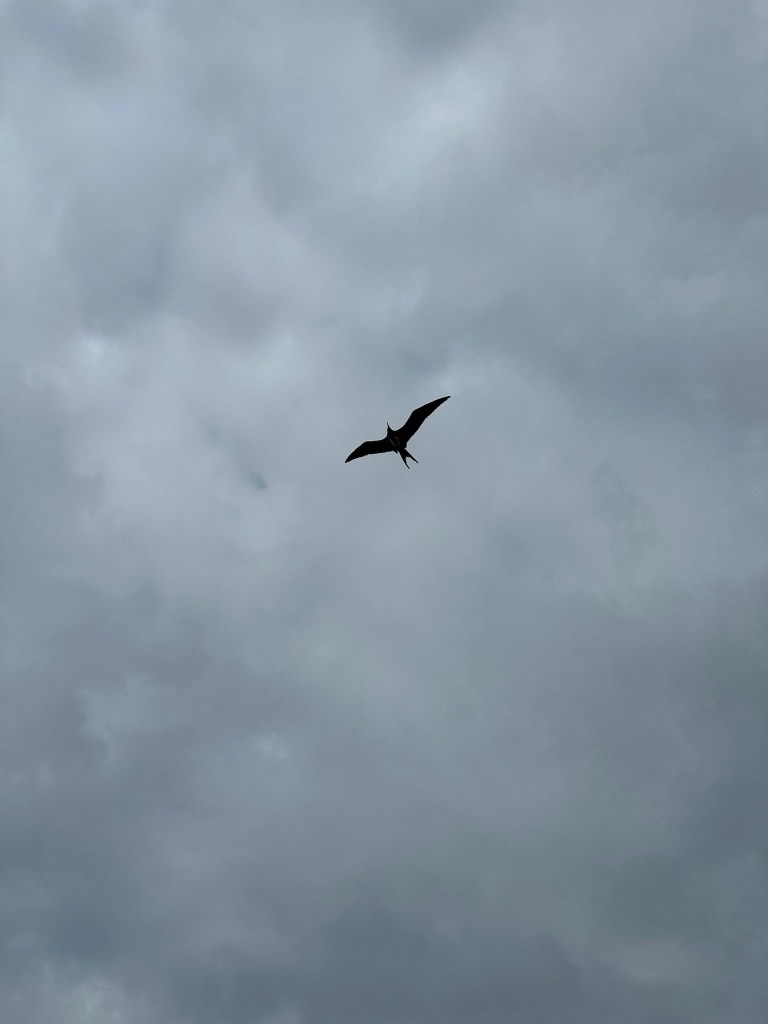
I took this picture one day in the Galapagos Islands. It seemed ethereal to me.
 Phi-The-Sci: Equilateral Musings