Well, it has taken me some time to get back to the blog. I recently have spent 9 days out in the Galapagos Islands (Ecuador). If one is able to go visit this wonderful place, please do it. There are so many things that I could write about regarding ecology, biology, and geology of this region. The panoply of island geology, fauna, and flora; the dedication of the people of Ecuador who care for these islands, different constellations seen in the southern sky from this region of Earth… Simply amazing.
During my trip to the islands, I brought along Charles Darwin’s On the Origin of Species (Penguin, 2009). The book was initially published in 1859. I read the book while in the Galapagos to get an idea about what Darwin was thinking when he visited these islands and was mentally fermenting the idea of biological evolution.
Darwinian evolution typically involves the priority of traits that can persist based on survival through the generations of a species over time. The Darwinian synthesis included genetic change (typically mutation) leading to phenotypic (molecular or structural) change.

image from Cambridge University Press
I think that many people do not realize that there is an important influence here oft forgotten — epigenetics. Simply put, epigenetics are the outside influences that change gene expression. Methylation of DNA (adding a methyl group to DNA) leads to clinical changes associated with brain function and the development of colon cancer. A great review is here.
Back to to the On the Origin of Species… Darwin uses the term “use and disuse” frequently. In other words, the use of a biological function or the disuse of a biological function leads to survival based on the particular situation of that species. Such examples include “…use and disuse seem to have produced some effects…” (p. 412). “Effects of external conditions – use and disuse, combined with natural selection…” (p. 125). I did a quick “find and edit” function on a PDF of this book and found 13 instances of Darwin writing “use and disuse”.

a picture that I took of a Galapagos hawk (Buteo galapagoensis)
Why is this idea important? Well, I think many people hear about Darwin and assume his theory of evolution containing “survival of the fittest” was an early explanation of genetic variation since genes were not discovered as of yet. Gregor Mendel was to clarify all such concepts, of course.
However, Darwin is very clear that “use and disuse” has to do with the environment, and, indeed, many things can be epigenetic in cause, including the altitude, diet, humidity, toxin exposure, and on and on and on. In other words, evolution has a genetic component and an equally important epigenetic component.
Theology: Where does this lead us? In the theological and philosophical concept of prehension, many such outcomes are available before an event occurs in real time. If God desires free will at all levels of reality (i.e., no determinism), then change can occur at ANY level — genetic or epigenetic. The important wording here is “can occur”. Nature obviously put limits of creativity. Turtles do not fly. Further, if God desires free will at all levels in nature, then nature can freely (remember — God desires free will in such a theological model) put limits on creativity. In my recently published book, I have come up with a theological term here — lim Δ — a limit [lim] to change [Δ].
So, evolution is indeed a true and validated scientific fact. The idea of a “war” between religion and science is absurd in so many ways. Theologians and laity can use modern science, including evolutionary science, to consider God and creation in new ways since change over time is a very basic part of our existence.
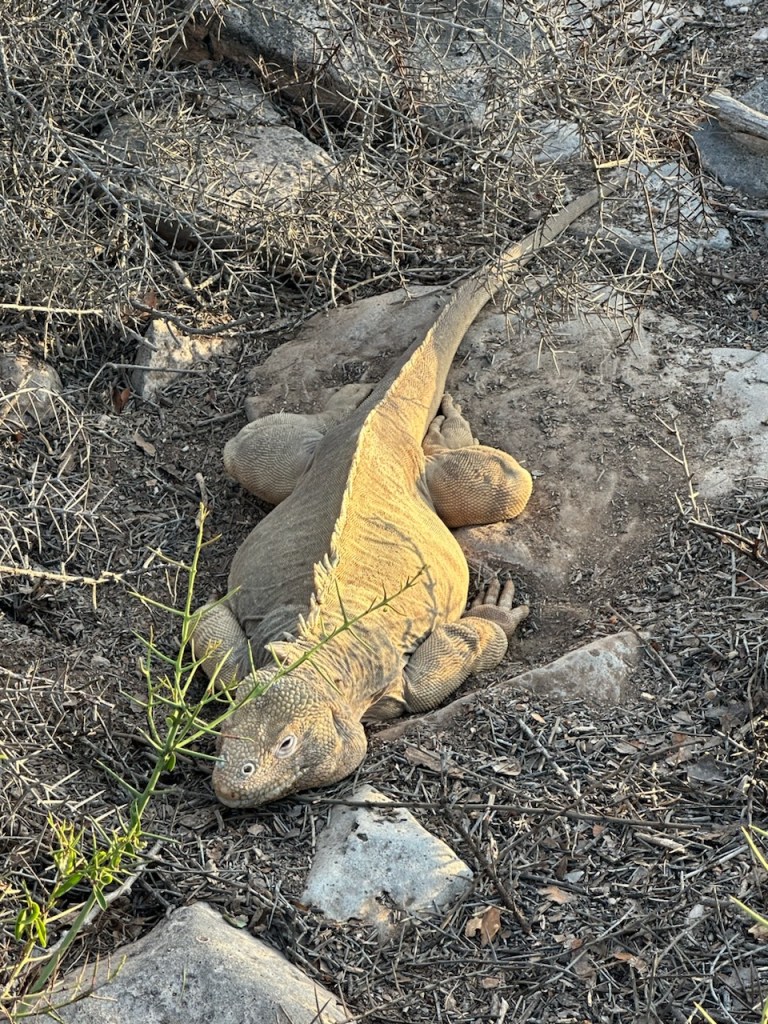
picture that I took of the Galapagos land iguana (Conolophus subcristatus)
 Phi-The-Sci: Equilateral Musings