It’s been a busy and emotional week, so I am going to write a short post. I had to fly across the country for a relative’s funeral. I then have had an old friend of mine visit from Texas, and I have wanted to entertain him WHILE I have worked this week.
Anyway… I wanted to expand on the ideas from my last post.
Where does our idea of God come from? No one knows. It could be the ultimate human meme. It could be epigenetics influencing the genetics of some human neurotransmitter. It could be just a consequence of all human cultures over time throughout the planet. However and from a theological perspective, the human idea and perhaps perception of God may be due to panentheism. Panentheism is the concept that ALL is in God — every atom, every human, every galaxy, our universe. Thus, it is the nature of reality to have God present everywhere and in every moment in time. As I have stated in previous posts, this consideration of God is not defined as a deterministic, omniscient God but rather a God of creativity and luring. God would lure for creativity or novelty over time, and creativity over time would be an expression of God’s love.
Now, when I say that theology matches the science, then I mean that theology matches knowledge acquisition. Science in Latin is “scientia” which simply means “knowledge.” My proposal is that every time that our species has discovered new knowledge (objective) or made a modifying statement about knowledge (subjective), this process can reflect God’s immanence in our world.
For example, early Homo species would appreciate new life every spring. The acquired knowledge of time, regeneration, and life would then be reflected onto ideas about God’s reality. From a panentheism standpoint, these ideas would template onto some concept about God.
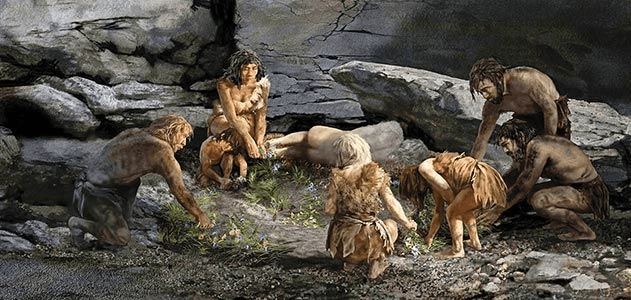
image from Smithsonian
Isaac Newton described gravity. Ideas surrounding nature as potentially mathematical was investigated by others, but Newton was a giant here. From a panentheism standpoint, mathematics and nature would describe something about God. Mathematics and its reflection on nature become even more metaphysically beckoning when the science of physics is advanced to consider quantum mechanics or general relativity.

image from Live Science
Consider the Surrealism Art Movement. Surrealism, in many ways, was a consequence of the tragedy of World War I. War is brutal and typically pointless. Surrealism can emphasize meaningless but also can emphasize beauty emerging out of chaos. If God lures for the good or for love, then beauty can arise out of human foolishness.

image from Abrakadoodle
Thus, any objective or subjective fact or event learned can give us an idea about God. This is a theological statement and not a scientific statement, and better theology in the setting of a world that seems to want scientific progress makes for improved interactions between humans. Objective truth influences subjectivity interpretation. Subjective interpretation influences. God can be understood by the unveiling of new facts and their interpretations.
Our species has the ability to understand more and more of eternal divinity throughout nature and through time. It is beautiful to consider.
As a final example, consider the ideas surrounding the Forman Thesis (how Weimar culture and society influenced early interpretations of quantum mechanics). An on-line PDF of this important paper is here.

image created by Meta AI
 Phi-The-Sci: Equilateral Musings