Stephen Jay Gould is one of my heroes for many reasons. I love thinking about evolution (I’ve done some prior work looking at founder effects in humans), and Gould has some many interesting ideas in the field of evolutionary science. More importantly, I love his writing style. If I could emulate him in terms of clarity and his almost a poetic type style of story telling, I would be quite happy.
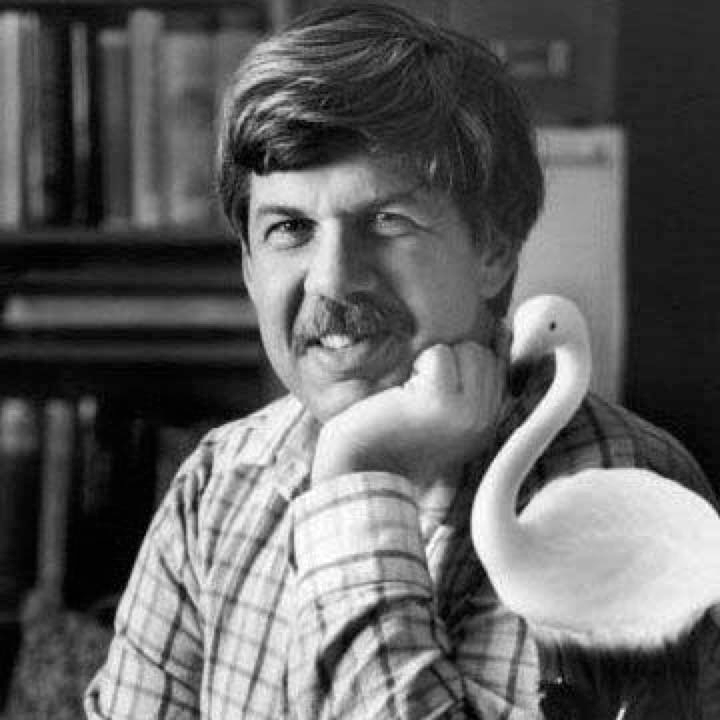
image from Clark University
I’ve read many of his books and tons of his essays through the years. Recently, I was thinking about his famous essay (co-written with Richard Lewontin) titled, “The Spandrels of San Marco and the Panglossian Paradigm: A Critique of the Adaptationist Programme.” I read it again this weekend. There are many, many things to say about this piece. Let’s limit our discussion to this essay section:
We wish to question a deeply engrained habit of thinking among students of evolution. We call it the adaptationist programme, or the Panglossian paradigm. It is rooted in a notion popularized by A.R. Wallace and A. Weismann, (but not, as we shall see, by Darwin) toward the end of the nineteenth century: the near omnipotence of natural selection in forging organic design and fashioning the best among possible worlds. This programme regards natural selection as so powerful and the constraints upon it so few that direct production of adaptation through its operation becomes the primary cause of nearly all organic form, function, and behavior.
As a metaphorical example, they discuss the spandrels of the San Marco (Venice, Italy). The dome of the cathedral needs spandrels in order to not collapse. The spandrels have painted designs on them. Here is their point: The spandrels do not exist to have beautiful art on them. They exist to support the dome. The art is a secondary product only — not initially appeciated and perhaps a random byproduct. No art needs to exist on the spandrels. The art is simply a byproduct not related to original form.
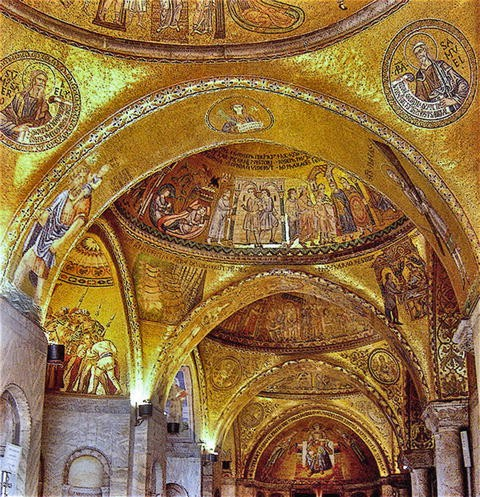
image from Springer
This issue of phenotypic variability in large structures also may extend to the microscopic level of epigenetics. Although chemical changes to DNA, such as methylation, may be adaptive, I think non-adaptive / randomness change in-and-of-itself may be occurring.
Where am I taking this post? The scientific debates of adaptionism and non-adaptionism in evolution are extremely fascinating. Can we take this discussion outside of science and apply to how we live subjectively?
As an example, one could consider the Gould / Lewontin essay and its non-adaptive evolution emphasis as a master example of randomness associated with bleakness in nature (subjectively, of course). If all or much is random, then what is the point of anything? Camus would agree here as all would be absurd.
However, I think the regular person walking around and doing what they do as part of their daily life would not think life is constantly absurd. It there an overall purpose to all of THIS — life, relationships, culture, society, our planet, our universe? Such questions are philosophical and theological but no less important than the scientific discussions that appear here.
As Marjorie Suchocki has expressed in her books (God Christ Church: A Practical Guide to Process Theology), we humans are always experiencing “perpetually perishing.” This idea is quite right. We are perdurants. We are indeed clumps of matter, but the most important aspect is the change in the matter. This change involves time which is a force in itself but which is still underneath the ultimate priority which is CHANGE. This change in-and-of-itself takes in consideration all of matter, space, and time.
In Process and Reality, Alfred North Whitehead has stated:
Every actual entity is what it is, and is with its definite status in the universe, determined by its internal relations to other actual entities. ‘Change’ is the description of the adventures of eternal objects in the evolving universe of actual things.
I love Whitehead so much, but it is important to consider his emphasis on Platonic objects (the ‘eternal objects’). One can consider changing (see what I did there) the idea of eternal objects to change itself as the ultimate eternal object / Platonic form. Thus, everything changes. There may be prehensive / panentheistic / panexperiential aspects to this change (Naturalismppp — see prior posts), but change is the base structure of nature.
From a religious perspective, God is in this change. God changes as God learns with us, experiences us, loses with us, loves with us, loves us. God’s love extends to all entities in nature. Change occurs, but God being an eternal entity experiencing all change also remembers us eternally as we change.
Finally, I have talked about the “divine lure” in prior posts. God wants change. God desires change. This change is voluntary at all levels of nature. God desires change so much that God is change from a metaphysical sense. This change allows one to consider all sorts of adaptive or non-adaptive evolutionary arguments. However, if God calls all of nature in that “still, small voice”, then nature can proceed unfettered in all sorts of directions with some type of voluntary goal of God that nature (including every human) has every right to be neutral upon, to go against, or to go alongside such a call. God loves everyone of us. God loves every entity in nature. God perhaps has a goal here (I think God has a goal — I may be wrong), but God will never force that goal.
Evolutionary science is wonderful. A religious person should not ignore this field of science, but to appreciate it, perhaps interpret it from a theological perspective, and to look for God’s quiet call for change.

image created by Meta AI
 Phi-The-Sci: Equilateral Musings